‘Living with two life-threatening diseases’: Five children at the centre of MP district’s lapses
A state-level inquiry team constituted by the state government to probe how the five children with thalassemia contracted HIV during blood transfusions has found major lapses — from not maintaining records of donors to failure in conducting HIV tests properly.
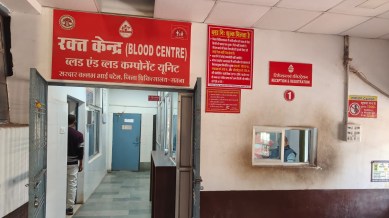
The blood bank at the district hospital in Satna. Its in-charge and two laboratory technicians have been suspended. (Photo: Anand Mohan J)
Advertisement
The nine-year-old wants to become a CID officer. He loves cricket, especially batting, and says mathematics is his favourite subject. “I like numbers,” he tells The Indian Express. “I go to school. Many people don’t know what I am going through.”
The child is one of five children with thalassemia in Madhya Pradesh’s Satna district who tested HIV positive between March and early April this year after receiving blood transfusions at government and private hospitals.
You’ve Read Your Free Stories For Now
Sign up and keep reading more stories that matter to you.
A state-level inquiry team constituted by the state government to probe how the five children with thalassemia contracted HIV during blood transfusions has found major lapses — from not maintaining records of donors to failure in conducting HIV tests properly. On Friday, the state government suspended three health officials.
For the affected children and their families, the situation presents an unimaginable nightmare — endless hospital visits, shattered dreams and, above all, the fear of living with not one but two life-threatening diseases, one of which the patients are still unaware of.
The nine-year-old’s father said his son was just two years old when he was diagnosed with thalassemia, a genetic blood disorder that requires multiple blood transfusions to make up for less haemoglobin in the bloodstream.
For years, school remained possible with regular treatment.
That changed in March, when the family learned he was HIV positive.
“He has struggled so much at such a young age; now he has an additional burden. All I can do is smile at my son when he dreams of becoming a CID officer and give him hope,” the father said.
Story continues below this ad
Elsewhere, the father of a three-year-old girl, who tested HIV positive, said the family learned about the infection only five months ago — after more than two years of regular blood transfusions for the child. However, while the authorities are treating this as one of the five cases, here the girl’s parents are HIV positive too.
Since the diagnosis, the family has sequestered itself, fearful of how the news will be taken by others.
“We cannot tell our relatives about this disease. We don’t know how to explain it. Even the hospital told us to remain quiet,” he claimed. “We don’t know who to ask for help anymore.”
The father of another 15-year-old spoke of his daughter’s unrealised dreams. “She studied till Class 6 but had to stop going to school about two years ago because her health kept deteriorating,” he said. “I wanted her to become a big officer one day.”
Story continues below this ad
The families accused the district hospital of negligence. “They have done this to my family,” said the first father. “Everything changed because of them.”
So far, those suspended include the district hospital blood bank in-charge, Dr Devendra Patel, and laboratory technicians Ram Bhai Tripathi and Nandlal Pandey. In addition, a show-cause notice has been issued to Manoj Shukla, the former civil surgeon of the Satna district hospital, seeking an explanation for alleged administrative and supervisory failures.
Shukla told The Indian Express that “there was a breakdown in communication from the nodal officers who first got to know about the infection” and that “the civil surgeon’s office at the time was not informed”.
Story continues below this ad
At the counselling centre for HIV-positive patients at the Satna district hospital, a counsellor, exhausted after a gruelling shift of tracking over 198 donors, struggled to relay instructions to her team.
“First, we had to break the news to the five families that their children were HIV positive. We also had to question parents about their sexual history to trace the source of transmission. These are very hard conversations when they don’t see a bright future for their child anymore,” the counsellor said.
Counselling teams were deployed for donor follow-up, but the response was limited. “About 125 people were contacted. Only two to four agreed to come forward. The rest denied donating blood or refused testing,” an official said.
A senior health official said the first donor-tracing exercise was halted in April due to safety concerns. “We stopped the operation in April because donors became abusive, and we did not have adequate manpower to handle the situation. Now we are tracing them again,” the official said.
Story continues below this ad
Some donors allegedly issued threats. “We were told, ‘If you call again, we will shoot you. Do not come to our homes’,” a counsellor said.
It was Dr Sadhna, who heads the Integrated Hemoglobinopathy and Haemophilia Centre, who first raised an alarm after noticing unusual symptoms in one child. “An eight-year-old child with thalassemia developed a severe cough and cold. He was referred to Rewa Medical College, where an HIV test was conducted. The test came back positive,” she said.
Following this diagnosis, a broader screening exercise was undertaken. “After that, we tested all thalassemia patients under our care and found that five children were HIV positive,” she said.
On the scale of testing, Dr Sadhna said some patients could not be immediately traced.
Story continues below this ad
“We have not been able to track down 10 patients. They are from other districts and have not been returning to us. Some are from Panna district. We have their details and will test them when they report back,” she said.
When contacted, Dr Devender Singh, the blood bank in-charge suspended on Friday, said that all blood units transfused to the children had undergone multiple layers of screening and tested negative at every stage.
“Blood samples are first tested at our blood bank and then sent to a private agency for triple testing. In all cases, the samples were found to be negative,” he said.
But he also admits that donor tracing has been a major challenge. “Nearly 50 per cent of donor data is either incorrect or outdated. Many addresses are outside Madhya Pradesh or are wrong,” he said.
Anand Mohan J is an award-winning Senior Correspondent for The Indian Express, currently leading the bureau’s coverage of Madhya Pradesh. With a career spanning over eight years, he has established himself as a trusted voice at the intersection of law, internal security, and public policy.
Based in Bhopal, Anand is widely recognized for his authoritative reporting on Maoist insurgency in Central India. In late 2025, he provided exclusive, ground-level coverage of the historic surrender of the final Maoist cadres in Madhya Pradesh, detailing the backchannel negotiations and the "vacuum of command" that led to the state being declared Maoist-free.
Expertise and Reporting Beats
Anand’s investigative work is characterized by a "Journalism of Courage" approach, holding institutions accountable through deep-dive analysis of several key sectors:
National Security & Counter-Insurgency: He is a primary chronicler of the decline of Naxalism in the Central Indian corridor, documenting the tactical shifts of security forces and the rehabilitation of surrendered cadres.
Judiciary & Legal Accountability: Drawing on over four years of experience covering Delhi’s trial courts and the Madhya Pradesh High Court, Anand deconstructs complex legal rulings. He has exposed critical institutional lapses, including custodial safety violations and the misuse of the National Security Act (NSA).
Wildlife Conservation (Project Cheetah): Anand is a leading reporter on Project Cheetah at Kuno National Park. He has provided extensive coverage of the biological and administrative hurdles of rewilding Namibian and South African cheetahs, as well as high-profile cases of wildlife trafficking.
Public Health & Social Safety: His recent investigative work has uncovered systemic negligence in public services, such as contaminated blood transfusions causing HIV infections in thalassemia patients and the human cost of the fertilizer crisis affecting rural farmers.
Professional Background
Tenure: Joined The Indian Express in 2017.
Locations: Transitioned from the high-pressure Delhi City beat (covering courts, police, and labor issues) to his current role as a regional lead in Madhya Pradesh.
Notable Investigations: * Exposed the "digital arrest" scams targeting entrepreneurs.
Investigated the Bandhavgarh elephant deaths and the impact of kodo millet fungus on local wildlife.
Documented the transition of power and welfare schemes (like Ladli Behna) in Madhya Pradesh governance.
Digital & Professional Presence
Author Profile: Anand Mohan J at Indian Express
Twitter handle: @mohanreports ... Read More