Journalism of Courage



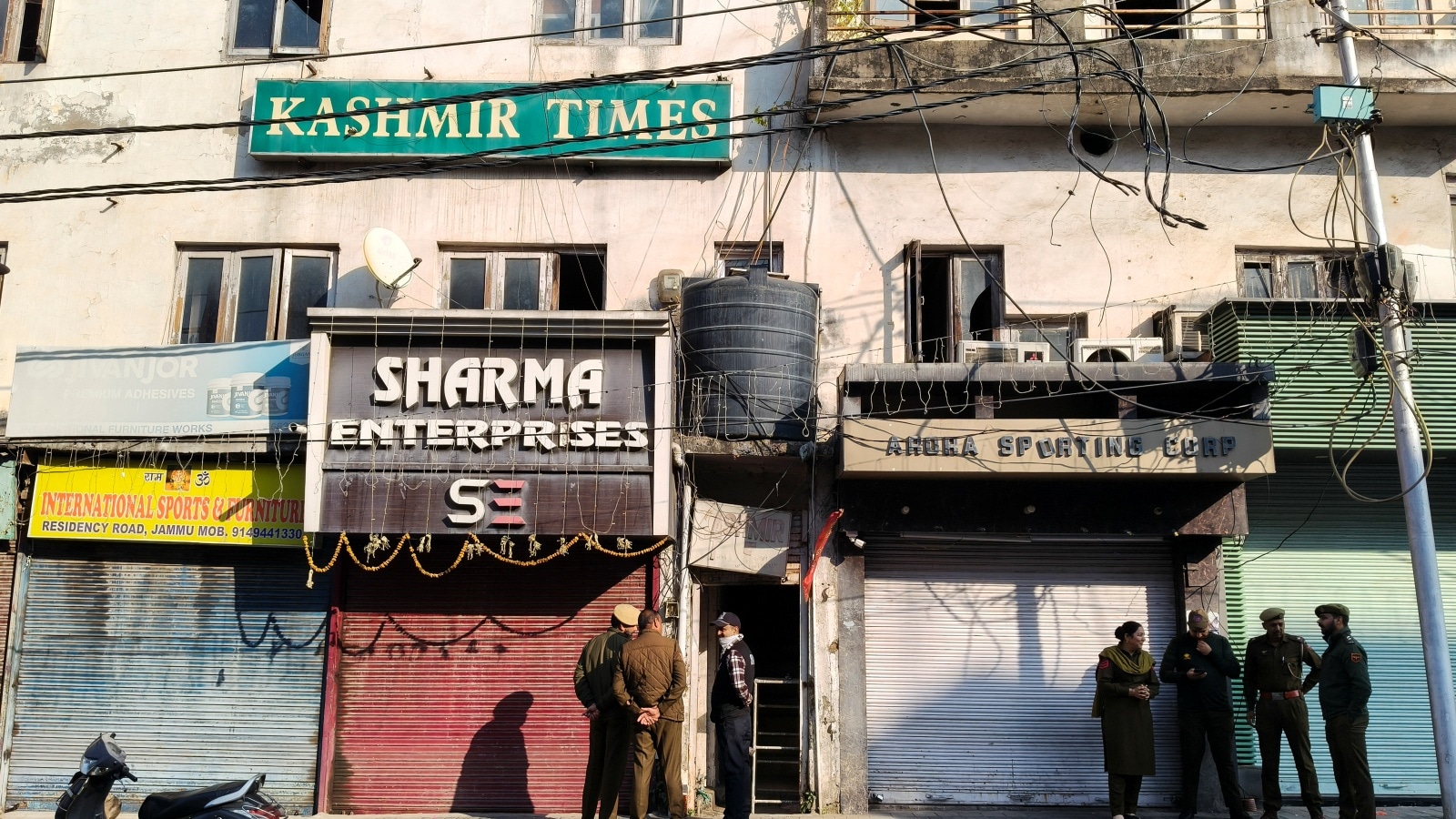 Security officials outside The Kashmir Times, Jammu, Thursday. (PTI)
In November 2024, The Kashmir Times published an old article by its founder-editor Ved Bhasin, describing how he set up the newspaper 70 years ago.
“I started The Kashmir Times in 1954 as a weekly after my Urdu weekly Naya Samaj, started by me in 1951 and which had emerged as the powerful voice of dissent against the authoritarian regime and entrenched establishment, was banned by the Government in 1954 under the infamous Defence of India Rules.”
On Thursday, The Kashmir Times, one of Jammu and Kashmir’s oldest newspapers, seen in the recent past as a strong voice against the Centre’s measures in the Union Territory, found itself at the receiving end. In the first such action against the daily, the Special Investigation Agency (SIA) of J&K Police raided its offices in Jammu and claimed to have recovered arms and ammunition.
The SIA’s list of charges against The Kashmir Times include “disseminating terrorist and secessionist ideology”; “spreading inflammatory, fabricated and false narratives”; “attempting to radicalise the youth” of J&K; “inciting disaffection and separatist sentiments”; “disturbing peace and public order”; and, “challenging the sovereignty and territorial integrity of India through print and digital content”.
On Friday, the SIA put out a statement saying the recoveries from The Kashmir Times indicated “suspected linkages with extremist or anti-national elements, warranting further detailed investigation”. It added that the residence of owner Prabodh Jamwal in Jammu had also been searched as part of the investigation.
In the past few days, the newspaper, now only digital, had carried opinion pieces questioning measures such as the demolition of the house in Kashmir of an accused in the Delhi Red Fort blast, and the “targeting” of Kashmiris. One of the pieces was by Anuradha Bhasin, Ved Bhasin’s daughter and the Executive Editor of the paper. Jamwal is her husband.
In a statement following the SIA raids, Anuradha Bhasin and Jamwal described the accusations as “unfounded” and an “attempt to silence” them.
Hurriyat Conference chairperson Mirwaiz Umar Farooq criticised the action against The Kashmir Times Friday, saying press freedom had become “a target of authorities”, and that every dissenting voice was seen as “anti-national” and “a threat”. “The Kashmir Times has a great legacy of Ved Bhasin ji, which the current management is carrying forward,” Mirwaiz said.
Leaders of the ruling National Conference and Peoples Democratic Party have also criticised the action as an attempt to exert pressure on the media.
Having begun as a weekly English language newspaper published from Jammu, The Kashmir Times had within a decade started printing daily. As its subscribers grew, the newspaper also began circulation in Kashmir. The Kashmir Times Group of Publications came to include, over the years, a Hindi daily, a Dogri daily and a children’s magazine.
Bhasin passed away in November 2015 at the age of 86, with Anuradha taking over and operating as Executive Editor since.
In 2019, after the abrogation of Article 370 in Parliament, followed by sweeping detentions and a security clampdown in J&K, Anuradha moved the Supreme Court against the prolonged Internet shutdowns. She contended that the cumulative effect of the restrictions, such as imposition of Section 144 and restrictions on Internet and communication, had had a chilling effect on free speech and the freedom of press in the Valley.
In October 2020, the Estates Department of J&K sealed the Srinagar office of the newspaper, located in Press Enclave, which had been allotted to them in the early 1990s.
In 2020, in the case Anuradha Bhasin vs Union of India, the apex court ruled that “responsible governments are required to respect the freedom of the press at all times”. “Journalists are to be accommodated in reporting and there is no justification for allowing a sword of Damocles to hang over the press indefinitely,” it said.
Later, Bhasin came out with a book on the months following the abrogation of Article 370 and the lockdown in J&K, titled ‘A Dismantled State: The Untold Story of Kashmir’. In June, this was one of the books banned by the Lieutenant Governor’s administration in J&K.
Following Covid and other setbacks, as well as the shrinking of print readership, in November 2023, The Kashmir Times turned fully digital.
Anuradha Bhasin and Prabodh Jamwal now live outside the country.
In the past, other newspapers in Kashmir have faced action. In October 16, Kashmir Reader was banned for being “a threat to public tranquillity”. Later, offices of the English daily Greater Kashmir were searched in connection with a case of funds being raised from “India and abroad in the name of charitable activities” and being used “for carrying out secessionist and separatist activities in J&K”.

 5 min read