Journalism of Courage



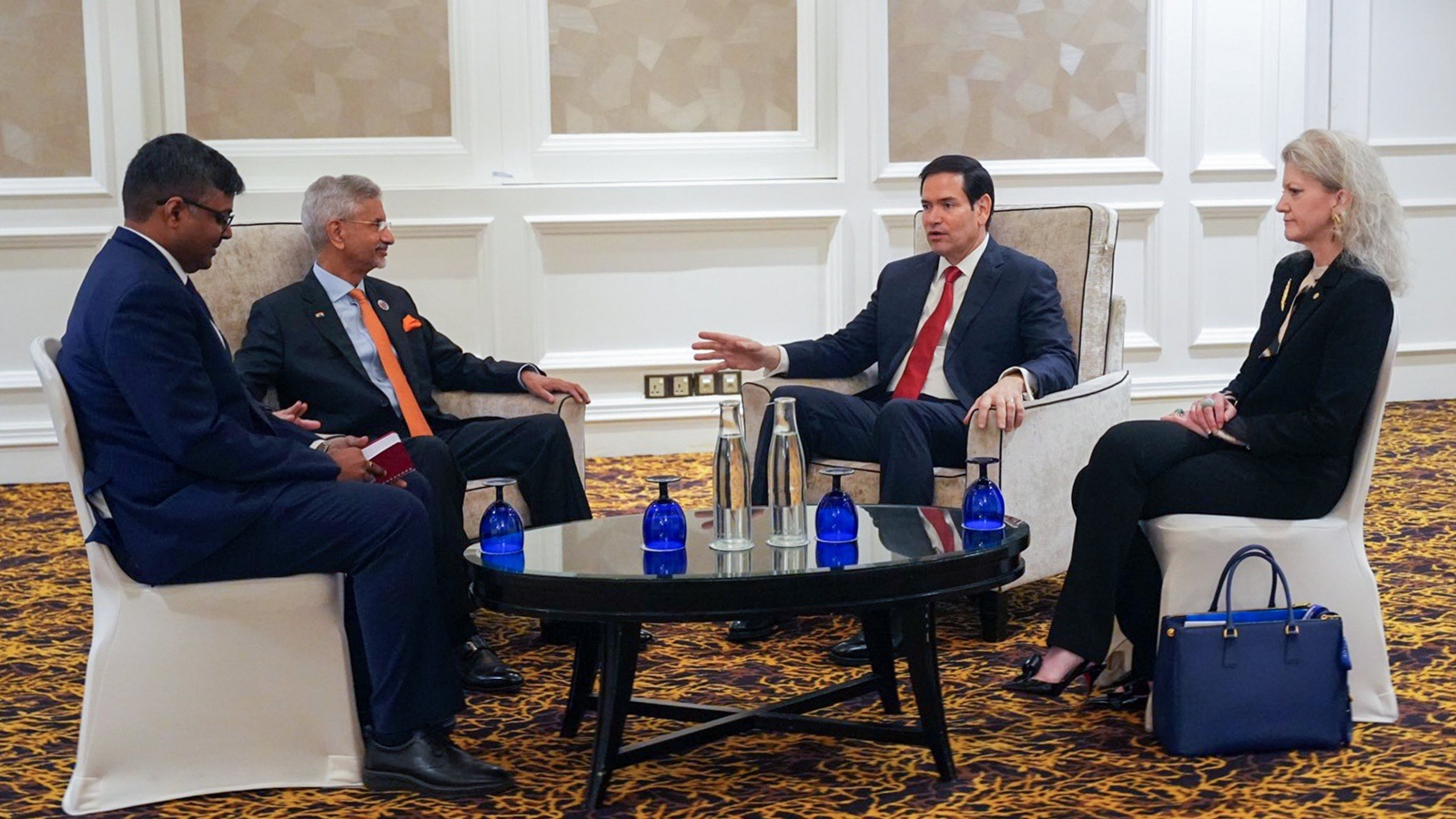 External Affairs Minister S Jaishankar in a meeting with US Secretary of State Marco Rubio, in Kuala Lumpur on Monday. (Source: @DrSJaishankar X/ANI Photo)
Hours after he met US Secretary of State Marco Rubio in Kuala Lumpur Monday, External Affairs Minister S Jaishankar took a swipe at the Trump administration, saying energy trade is becoming “increasingly constricted”, “principles are applied selectively and what is preached is not necessarily practised”.
His remarks at the East Asia Summit stem from the US imposition of a 25 per cent tariff penalty on India over its purchase of Russian oil in addition to the 25 per cent tariff on goods. The US has not imposed penalty tariffs on Europe and China which have also been buying energy from Russia.
“Energy trade is increasingly constricted, with resulting market distortions. Principles are applied selectively and what is preached is not necessarily practiced,” Jaishankar said.
And referring to Beijing’s actions, he said, “We meet in complicated times. There are growing concerns about the reliability of supply chains and access to markets. Technology advancement has become very competitive, the quest for natural resources even more so.”
“But change has a life of its own. And the world will inevitably respond to new circumstances. Adjustments will be made, calculations will come into play, fresh understandings will be forged, new opportunities will emerge and resilient solutions will be devised. At the end of the day, the realities of technology, of competitiveness, of market size, digitisation, connectivity, of talent and of mobility cannot be ignored. Multipolarity is not just here to stay but to grow. All these warrant serious global conversations,” he said.
On the conflicts in Europe and the Middle East, he said, “We are also witnessing conflicts that have significant repercussions, near and far. Deep human suffering apart, they undermine food security, they threaten energy flows and they disrupt trade. India, therefore, welcomes the Gaza peace plan. We also seek an early end to the conflict in Ukraine.”
India has already supported the Gaza peace plan, and Prime Minister Narendra Modi spoke to President Donald Trump on October 9, lending his support to the peace plan.
Without naming Pakistan, Jaishankar referred to the Pahalgam terror attack and India’s Operation Sindoor: “Meanwhile, terrorism poses a continuous and corrosive threat. The world must display zero tolerance; there is no room for ambivalence. Our right of defence against terrorism can never be compromised.” he said.
Representing India on behalf of Prime Minister Modi at the East Asia Summit, he said, “India fully supports the activities of the EAS and its future directions. We recently hosted the EAS knowledge exchange workshop on energy efficiency policies and a conclave of higher educational institutions.”
He also flagged maritime cooperation in the wake of Chinese assertion in the South China Sea and the Indo-Pacific: “Our commitment to furthering maritime cooperation remains strong, in line with the ASEAN Outlook on the Indo-Pacific and our shared commitment to the 1982 UNCLOS. 2026 will be observed as the ASEAN-India year of maritime cooperation. Notably, more nations have joined the Indo-Pacific Oceans Initiative.”
He said India has proposed an EAS Maritime Heritage Festival in the ancient port of Lothal in Gujarat. “We also intend to host the 7th EAS Conference on Maritime Security Cooperation,” he said.
On Myanmar, he said India was a ‘First Responder’ during the earthquake in March, and the “project on the India-Myanmar-Thailand Trilateral Highway, in which all of us have stakes, continues to progress”.
“We share the concern about cyber scam centres in the region which have also entrapped our nationals,” he said. “India values EAS’ contribution to peace, progress and prosperity”.
Earlier in the day, Jaishankar held talks with Rubio on the sidelines of the ASEAN and East Asia summits. “Appreciated the discussion on our bilateral ties as well as regional and global issues,” he said in a post on X.
On Sunday, Jaishankar held separate talks with Malaysian Prime Minister Anwar Ibrahim, Singapore’s Foreign Minister Vivian Balakrishnan and his Thai counterpart Sihasak Phuangketkeow.

 4 min read