New Delhi/srinagar | Updated: May 14, 2017 04:49 AM IST
4 min read
Whatsapp
twitter
Facebook
Reddit
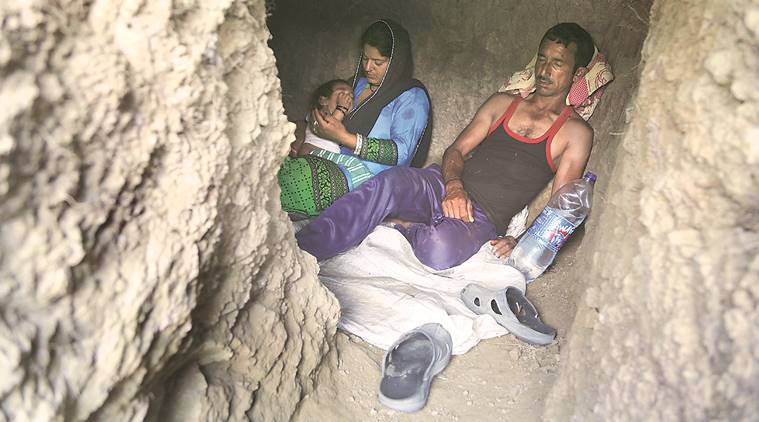
At a bunker near Bhawani village in Nowshera sector along the Line of Control on Saturday. (Source: AP)
With infiltration from across the border and Line of Control likely to spike with the onset of summer, the security establishment is learnt to have conveyed to the Centre that imposition of Governor’s Rule could make it easier to contain extremist elements in Jammu and Kashmir, and help improve the overall security situation in the Valley.
The security establishment in the state has been worried about the homegrown militancy in South Kashmir, which has traditionally been a stronghold of the ruling PDP. Several instances of the snatching of weapons have been reported in this area, and videos and pictures have surfaced showing militants in groups of 30 or more.
Senior PDP leader, Public Works Minister and official spokesman of the J&K government, Nayeem Akhtar, told The Sunday Express that the government “has not been informed” about any move to impose Governor’s Rule on the state. “But whenever they (New Delhi) want to impose central rule, they can do that,” Akhtar said.
He said that “if it (Governor’s Rule) happens, it will not be the first time that Governor’s Rule is imposed in J&K”.
The security establishment would want some of the leaders of stone-pelting groups of protesters to be sent to prisons outside the Kashmir Valley, if not outside the state, official sources said.
The security establishment also believes the alliance between the PDP and BJP is one of the causes of Kashmiri anger. “If there is Governor’s Rule, it will at least take this one factor out of the equation. Other factors will remain, though,” a top security official told The Sunday Express.
Akhtar, however, said “such a measure” (imposing Governor’s Rule) hasn’t worked earlier”. An “exclusively military approach cannot provide any solution because we are dealing with people here”, he said. “It (the situation) can be only resolved with a sympathetic outreach which is the core theme of the agenda of (PDP-BJP) alliance.”
He said “nothing could be expected in the absence of an inclusive approach laced with humanitarian feelings and political outreach”.
Story continues below this ad
“Of course, those who swear by the gun alone can be neutralised only through strong measures,” Akhtar said. “The real challenge is to seek the involvement of people in doing so, and to make militancy irrelevant and democracy the preferred option,” he said.
J&K has its own Constitution, and Governor’s Rule is imposed on the state for a period of six months in case of failure of the constitutional machinery, under Section 92 of the state Constitution. The proclamation is issued by the Governor after receiving the consent of the President of India. The state Assembly can be either dissolved or kept in suspended animation. If it is not possible to restore the constitutional machinery within six months, the provisions of Article 356 of the Constitution of India are extended to J&K, and President’s Rule is imposed.
J&K Governor N N Vohra met Prime Minister Narendra Modi in New Delhi on May 5. Vohra has been governor of the state since 2008, and the state has seen three spells of Governor’s Rule in his tenure.
There has been a sharp increase in the number of attacks on security forces in the Valley in recent months. The abduction and killing of 22-year-old Lt Ummer Fayyaz in Shopian on Tuesday had been described as a “watershed moment” by the Army.
Muzamil Jaleel is a Deputy Editor at The Indian Express and is widely recognized as one of India’s most authoritative voices on Jammu & Kashmir, national security, and internal affairs. With a career spanning over 30 years, he has provided definitive on-the-ground reportage from the heart of the Kashmir conflict, bearing witness to historic political transitions and constitutional shifts.
Expertise and Investigative Depth
Muzamil’s work is characterized by a rare combination of ground-level immersion and high-level constitutional analysis. His expertise includes:
Conflict & Geopolitics: Decades of reporting on the evolution of the Kashmir conflict, the Indo-Pak peace process, and the socio-political dynamics of the Himalayan region.
Constitutional Law: Deep-dive analysis of Article 370 and Article 35A, providing clarity on the legal and demographic implications of their abrogation in 2019.
Human Rights & Accountability: A relentless investigator of state and non-state actors, uncovering systemic abuses including fake encounters and the custodial death of political workers.
International War Reporting: Beyond South Asia, he provided on-the-spot coverage of the final, decisive phase of the Sri Lankan Civil War in 2009.
Landmark Exposés & Impact
Muzamil’s reporting has repeatedly forced institutional accountability and shaped national discourse:
The Kashmir Sex Scandal (2006): His investigative series exposed a high-profile exploitation nexus involving top politicians, bureaucrats, and police officers, leading to the sacking and arrest of several senior officials.
Fake Encounters: His reports blew the lid off cases where innocent civilians were passed off as "foreign terrorists" by security forces for gallantry awards.
SIMI Investigations: He conducted a massive deep-dive into the arrests of SIMI members, using public records to show how innocuous religious gatherings were often labeled as incriminating activities by investigative agencies.
The Amarnath Land Row: Provided critical context to the 2008 agitation that polarized the region and altered its political trajectory.
Over the years, Muzamil has also covered 2002 Gujarat riots, Bhuj earthquake, assembly elections in Bihar for Indian Express. He has also reported the peace process in Northern Ireland, war in Sri Lanka and national elections in Pakistan for the paper.
Awards and Fellowships
His "Journalism of Courage" has been honored with the industry's most prestigious accolades:
Four Ramnath Goenka Awards: Recognized for J&K Reportage (2007), On-the-Spot Reporting (2009), and Reporting on Politics and Government (2012, 2017).
Kurt Schork Award: From Columbia University for international journalism.
Sanskriti Award: For excellence in Indian journalism and literature.
IFJ Tolerance Prize: For his empathetic and nuanced reporting in South Asia.
International Fellowships: Served as a visiting scholar at UC Berkeley and worked with The Guardian, The Observer, and The Times in London. He has also received Chevening fellowship and a fellowship at the Institute of Social Studies, Hague, Netherlands.
Professional Presence
Current Location: New Delhi (formerly Bureau Chief, Srinagar).
Education: Master’s in Journalism from Kashmir University.
Social Media: Follow him for field insights and rigorous analysis on X (Twitter) @MuzamilJALEEL. ... Read More


 4 min read


 At a bunker near Bhawani village in Nowshera sector along the Line of Control on Saturday. (Source: AP)