Journalism of Courage



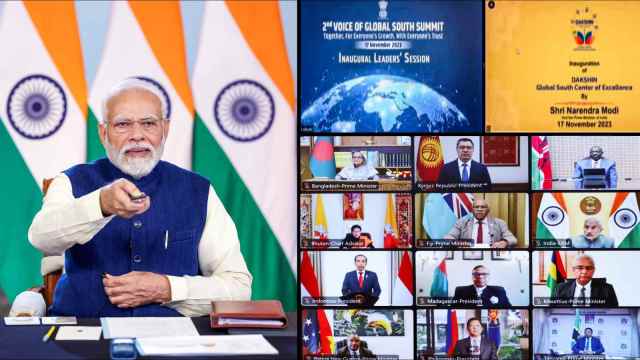 **EDS: IMAGE VIA PMO** New Delhi: Prime Minister Narendra Modi attends the inaugural session of the 2nd Voice of Global South Summit via a video conference, on Friday, Nov. 17, 2023. (PTI Photo)(PTI11_17_2023_000066A)
 In his first public remarks on the Gaza war, Prime Minister Narendra Modi on Friday sought to frame the Israel-Hamas conflict as a “new challenge” to the Global South’s prosperity.
Speaking at the India-hosted virtual Voice of Global South Summit where he apprised leaders about the achievements of India’s G20 presidency that largely focused on addressing challenges facing the Global South, Modi said, “For global prosperity, Sabka Saath, Sabka Vikas (together with all, development for all) is needed. But we all are seeing that new challenges are emerging from the incidents in West Asia.”
“India has condemned the horrific terrorist attacks in Israel on October 7. Along with restraint, we have also emphasised on dialogue and diplomacy. We strongly condemn the deaths of civilians in the conflict between Israel and Hamas,” he said.
He also referred to his phone conversation with Mahmoud Abbas, President of the Palestinian Authority, last month.
“After speaking to President Mahmoud Abbas, we have sent humanitarian assistance for the people of Palestine. This is the time when the countries of the Global South need to speak in one voice for the greater global good,” he said.
His statement, inclined a bit more towards the Palestinian side after condemnation of the “horrific terrorist attacks” on Israel, advocated “restraint” while emphasising “dialogue and diplomacy”.
While he highlighted his conversation with Abbas, he did not mention the phone call last month with Israel’s Prime Minister Benjamin Netanyahu.
Modi had tweeted on the Hamas attacks on Israeli civilians and military personnel on October 7 itself, calling them “terror attacks” and condemning them – this was seen as a pro-Israel statement. He condemned terrorism after he spoke to Netanyahu, but the Ministry of External Affairs sought to nuance its position and tried to walk the diplomatic tightrope by committing to the Palestinian cause and advocating direct talks between Israel and Palestine.
The Global South, representing developing and under-developed countries, has been watching India’s position on the Israel-Hamas conflict very closely. Many have been vocal in their support for the people of Gaza and, in this context, the Prime Minister’s remarks are significant.
Modi’s call for diplomacy and dialogue, while similar to the formulation from the Russia-Ukraine war, talks about respecting international humanitarian law – a message to Israel which has been conducting air strikes on Gaza, with the stated objective of destroying Hamas. Palestinian authorities have said that the air strikes have killed more than 11,000 people including civilians and babies.
He has also spoken to leaders of Iran, Jordan, Egypt, UAE as part of New Delhi’s diplomatic engagement.
India’s position has been closely watched by the leaders of the Global South — a group of developing and under-developed countries.
At the summit, Modi called for cooperation under the framework of ‘five Cs’ which he explained as consultation, cooperation, communication, creativity and capacity building.
“For ‘One Earth, One Family, One Future’, let us all move forward together with five Cs,” he said.
‘One Earth, One Family, One Future’ has been India’s theme for its G20 presidency.
Modi also mentioned forward movement at the G20 on several initiatives which would benefit the Global South. The next G20 leaders’ virtual summit is scheduled to take place on November 22.
He described the Voice of Global South as the most unique platform for the changing world of the 21st century.
“Our priority was to make the G20 inclusive and human-centric on a global scale. Our effort was that the focus of G20 should be development of the people, by the people and for the people,” he said.
“It is with this objective that we organised the Voice of Global South Summit for the first time in January this year. In more than 200 G20-related meetings held in different states of India, we gave prominence to the priorities of the Global South,” he said.
“The result was that we were successful in getting everyone’s consent on the issues of the Global South in the G20 New Delhi Leaders’ Declaration,” he said.
Modi inaugurated the first Voice of Global South’s Centre of Excellence — called DAKSHIN (Development And Knowledge Sharing Initiative) — which was announced during the first Voice of Global South summit in January this year.
This initiative, developed in collaboration with over 400 think tanks worldwide, sets the foundation for a dynamic and constructive discourse, an official said.
“As partners in progress, these think tanks are poised to make substantial contributions towards formulating innovative development solutions. Together, they aim to shape a shared vision for a vibrant future within the Global South,” the official said.
Modi also talked about the African Union’s entry into the G20 as a permanent member at the New Delhi summit of the grouping.
“I cannot forget that historic moment, when the African Union was inducted into G20 as a permanent member with India’s efforts,” he said.
External Affairs Minister S Jaishankar, who also addressed the Foreign Ministers’ session, called on the countries of the Global South to work towards self-reliance to mitigate vulnerabilities vis-a-vis economic concentrations, noting that the Covid-19 era was a stark reminder of the perils of dependence for basic necessities on far-away geographies.
“The New Delhi Leaders’ Declaration will be remembered for bringing back the G20 focus on the real and serious concerns of the Global South,” Jaishankar said, adding that the document is a “comprehensive message” on promoting strong, sustainable, balanced and inclusive growth.
Without making any specific references, he said there continues to be “resistance” for a greater role for the Global South in shaping solutions for the key issues of present times.
“As we look ahead, our vision of everyone’s growth, with everyone’s trust is far from accomplished. While change is the natural order, there continues to be a resistance for a greater role for the Global South in shaping solutions for the key issues of our times,” he said.
“But together, we need to continue putting greater emphasis on the need to take everyone along and everyone’s views along while we deliberate at multilateral and plurilateral forums,” he said.

 6 min read