Journalism of Courage



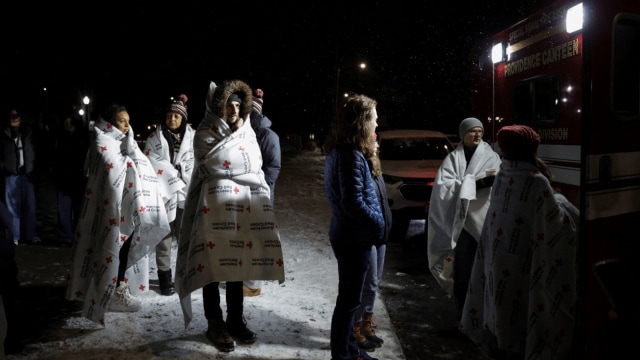 Indian students and researchers at Brown University described panic, prolonged lockdowns and narrow escapes after a mass shooting during exams. (Reuters)
 It was 4.20 pm on Saturday, December 13. An Indian postdoctoral researcher was working in a laboratory at Brown University in Providence, Rhode Island, a few blocks away from the building where he usually spent his days. His phone beeped with an emergency alert.
“Urgent: There’s an active shooter near Barus & Holley Engineering. Lock doors, silence phones and stay hidden until further notice. Remember: RUN… HIDE… FIGHT, as a last resort,” it said.
The second-year postdoc researcher at Brown’s School of Engineering froze. Barus & Holley Engineering Building, a seven-storey complex housing the university’s engineering school, was where his office was. He had worked there the day before. On Saturday, he had gone to a different lab, purely by chance.
“I was very lucky,” the 32-year-old researcher who declined to give his name, told The Indian Express by phone on Sunday. “I usually work in that (Barus & Holley) office. Yesterday, I wasn’t there. That probably saved me.”
The researcher said that upon reading the message, he locked himself inside the lab, switched off the lights, silenced his phone except to answer repeated calls from Brown’s Department of Public Safety, and waited.
He would remain there until 10.30 pm, following protocol as police searched the campus.
When the shelter-in-place order was eventually lifted, he did not walk the five minutes to his home. Instead, he took an Uber through streets filled with police and public safety vehicles.
The shooting at the Barus & Holley Building had taken place in a classroom where year-end final exams were underway. Two students were dead, and eight others had suffered gunshot wounds, most of whom were described as critical but stable.
A ninth person was injured by bullet fragments, officials have said. It is not clear if this person is a student. University president Christina H Paxson later said she had been told that nearly all the victims were students.
Thirty hours after the shooting, late on Sunday night – at noon on Monday in India – the shooter remained at large. Authorities in Rhode Island said they had released a person of interest who had been detained earlier, American media reported.
“We continue to make every effort to ensure the safety and security of the campus,” the university said. “Every member of the Brown community” was advised to be “vigilant in their own activities on campus”.
For international students on campus, the hours after the shooting were full of fear and anxiety.
A 25-year-old Indian researcher from West Bengal, who is a second year PhD student of engineering, with lab and office in the Barus & Holley Building, told The Indian Express that the first alert arrived at 4.22 pm.
“It was too cold on Saturday morning. I had planned to go to the lab in the Barus & Holley Engineering Building, where I usually work, but was feeling lazy. That is what may have saved me,” he said.
The researcher said he “could not imagine what may have happened” had he been in the building during the shooting.
“At one point, we got another message saying a suspect was in custody,” the researcher, who said he preferred to remain anonymous, said. “Then another email came saying there was no suspect in custody and that we should continue sheltering.”
The researcher said he had friends on the seventh floor of the building. The shooting, as far as the students were able to understand at the time, had taken place on the first floor. Unsure of the number of shooters, police had evacuated students late into the night.
“They were frisked,” the researcher said. “They were given food and water. Some were taken home by city buses or by Brown’s shuttle services.”
The 25-year-old himself lives a few blocks away from the site of the shooting. He said that the realisation – which came only later – that he may have actually come face-to-face with the shooter, was frightening.
“What I am presuming is that the path the shooter took to escape is the same path that I use every day to enter and exit the building,” he said. “When I realised that, it really scared me.”
A 25-year-old Master’s student of data science from Gujarat was alone in her apartment two streets from the campus. She had a final project due the next day, and her two roommates were away for the weekend.
She said she did not panic when the first alerts arrived. “Initially, the first two alerts felt okay,” she said. “I did not know that anyone was hurt.”
But the alerts kept coming, every 20 to 25 minutes. “That was when I realised this was serious,” she said.
The student locked the windows of her room and drew the curtains. Through messages, she learned that former co-workers at the campus fitness centre were locked inside locker rooms. A friend who had barricaded themselves inside an office did not reach home until 3 am, escorted by police.
When news came that two students had been killed, she could no longer work. “I couldn’t sleep until 6 am,” she said. “I kept thinking… What if I had been there?”
She said she had written an exam in the same building just two days previously, and had walked along the same route that the shooter had likely taken.
She said she did not immediately call her parents in India. “I did not want them to worry,” she said. They ultimately saw news reports and called her on Sunday morning.
Brown had always felt safe, this student said, with buildings that cannot be entered without access cards, night shuttles, and walking escorts.
She has spent about seven years in the United States, having completed her Bachelor’s from California State University, Sacramento. “Even during my Bachelor’s, campuses always felt secure,” she said. “I don’t know how this person (the shooter) entered.”
The postdoc researcher at the top of this report also articulated that sense of disbelief. He too has spent more than seven years in the US, having obtained a PhD from the University of California, Irvine.
He said he had known, in the abstract, that mass shootings were part of life in the US. But universities had felt different, he said.
“You think of campuses as protected spaces. This incident has revived questions that many researchers carry about gun access and how easily ordinary academic spaces can become sites of violence. It’s one thing to read about it happening somewhere else and quite another when it’s in the building where your office is,” he said.
The PhD student concurred. “We always felt Rhode Island was safe,” he said. “It’s a blue state. It’s not a high-profile area. I used to walk around campus at 10 pm, sometimes return from the lab at 1 am. It always felt safe.”
‘Blue’ states in the US are those in which voters predominantly support the Democratic party. The most vocal supporters of gun rights have traditionally been the Republicans, and the Republican party, which has deep links with the gun lobby, has repeatedly opposed efforts at gun control.
By Sunday morning, the shelter-in-place order had been lifted, but the campus was far from normal. Police barricades remained in place. Media reports said authorities had released just eight seconds of CCTV footage, and asked residents on nearby Waterman Street to share their security camera recordings.
In an email sent to the entire Brown community on Sunday, President Paxson said law enforcement agencies had been working to identify and capture the suspect, and that thousands of students had been transported out of sealed-off areas.
In a follow-up email, Provost Francis J. Doyle III said that given the impact of the tragedy and the likelihood that many students might wish to leave the campus and go back home, the remaining undergraduate, graduate, and medical classes, exams, papers, and projects for the Fall 2025 semester would not take place as scheduled.
The PhD student said he had not returned to the engineering building, and did not plan to do so any time soon. The postdoc researcher said he would stay away from campus possibly until the end of the holidays in January.
The MA student said she did not want to step out right now. “You hear about these things happening elsewhere. You never imagine it’s going to be where you study or on the same route that you walk everyday,” she said.
But her work would have to continue, she said. “As a Master’s student, I still have to take everything for a grade.”

Reserve Bank of India Governor Sanjay Malhotra has said interest rates are likely to remain low for a “long period” as India continues to post strong economic growth, which could receive an additional lift from trade agreements currently being negotiated with the US and Europe.
 9 min read