Journalism of Courage



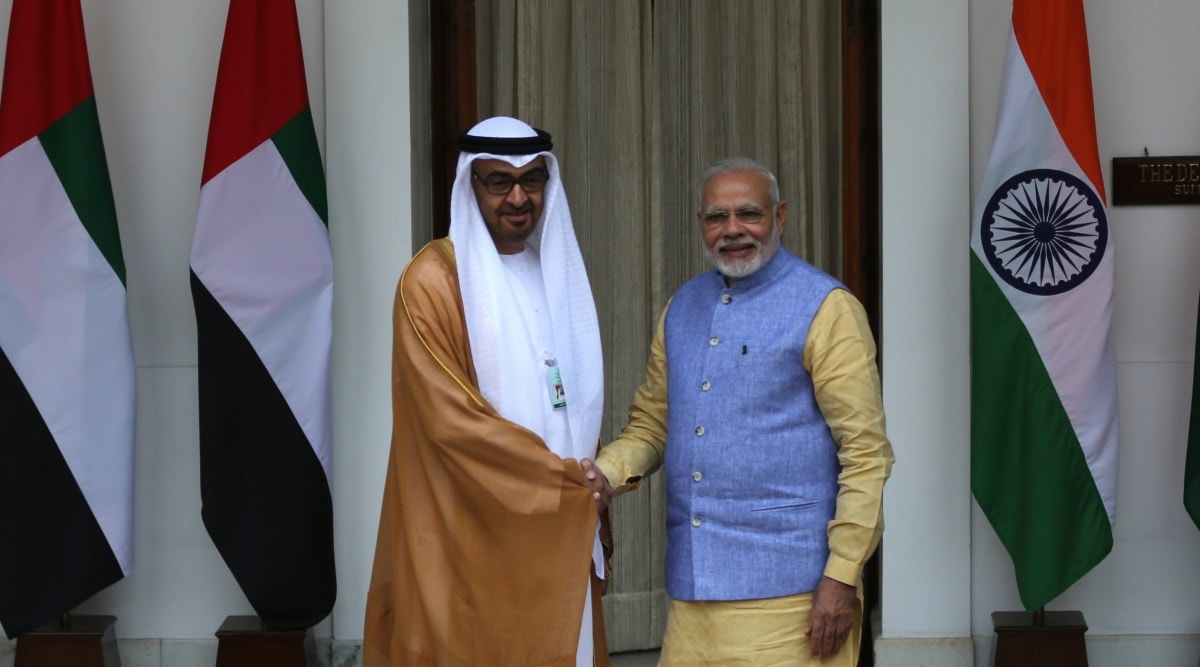 PM Narendra Modi shakes hands with Sheikh Mohamed bin Zayed al Nahyan in New Delhi in 2017. (Express Photo: Tashi Tobgyal, File)
THE COMPREHENSIVE Economic Partnership Agreement (CEPA) with the United Arab Emirates (UAE), likely to be signed on Friday at a virtual ceremony in the presence of Prime Minister Narendra Modi and UAE Crown Prince Sheikh Mohamed bin Zayed bin Sultan Al Nahyan, is being viewed both as consolidation of the strategic partnership with the Gulf country, as well as a template for reviving the long-elusive free-trade agreement (FTA) with the Gulf Cooperation Council (GCC) at a crucial time in world politics.
The CEPA, scheduled to be signed on Friday evening, will include a digital trade element, which officials are describing as a first of its kind for both countries.
The United Arab Emirates is India’s third largest trading partner, and second largest export destination. Bilateral trade between India and the UAE stood at $43.3 billion in 2020-21. Exports were $16.7 billion, and imports, driven by oil, pushed the balance in favour of the UAE at $26.7 billion in 2020-21.
The India-UAE CEPA aspires to take bilateral trade to over $115 billion within five years, Commerce Minister Piyush Goyal had said last September when the two sides formally launched negotiations toward the agreement. Of this, trade in goods is expected to increase to $100 billion, and in services by $15 billion.
Sources at the Commerce Ministry said that the early harvest agreement would likely include a chapter on digital trade which would be aimed at enhancing cooperation between the two countries on digital trade in the future.
The chapter on digital trade is likely to include frameworks on paperless trading, digital payments and online consumer protection, as well as address issues such as intellectual property rights in digital trade, and challenges to small and medium enterprises.
The agreement is also expected to give Indian industry access to the entire West-Asian region in sectors such as gems and jewellery, textiles, and leather goods. The UAE hopes to get enhanced market access in India for its petrochemicals, metals and dates. “The finalisation of the agreement in record time — we have negotiated this in four months — shows that where there is a will, there is a way. India can negotiate FTAs. With this, we can even relaunch the GCC free-trade agreement (FTA) negotiations. This FTA with the UAE becomes a template for the GCC,” said an official, speaking on the condition of anonymity.
Speaking in Dubai in December last year, Goyal said that India’s “goal is to become number one trading partner of the UAE”, adding that the UAE was “a gateway to GCC and all of Africa”.
A free trade agreement with the GCC comprising Saudi Arabia, Kuwait, UAE, Oman, Qatar and Bahrain as its members was first envisaged in 2007, but got stuck after a couple of rounds of negotiations.
“The CEPA makes the UAE the preferred partner in the GCC. If a commodity is acceptable to the UAE, then objections to it by other GCC members become less defensible, because with the India-UAE agreement, Indian goods will flow to the other GCC countries as the UAE has no customs barriers,” said the official.
The GCC has FTAs with the European Free Trade Association (EFTA) comprising Iceland, Norway, Lichtenstein, Switzerland, and Singapore.
The agreement with the UAE is gong to be the second FTA signed by the Modi government after a similar pact was signed with Mauritius last April. India is negotiating a raft of other FTAs with the UK, the EU, Australia, Israel and Canada.
After walking out of the Regional Comprehensive Partnership Agreement, the Modi government signalled that it considered a shift to bilateral free-trade agreements with individual nations or a bloc more beneficial for India. (With inputs from ENS, Delhi)

 4 min read