6 min read
Stay updated with the latest - Click here to follow us on Instagram

Journalism of Courage



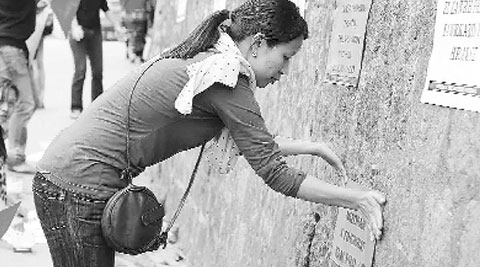 Youths from the Chaltlang South Presbyterian Church putting up posters denouncing alcohol as the “killer of body and soul” and citing quotes from the Bible. (Source: Express photo by Lalremruata Khiangte)
The Sunday before the Congress government was to table a much-debated Bill to allow the sale and consumption of alcohol in Mizoram and end an 18-year-old liquor ban, Excise Minister R Lalzirliana attended an evening Church service in his neighbourhood of Armed Veng.
Towards the end of mass prayers for the continuation of total prohibition in the state, Lalzirliana stepped up to pray, and in his booming voice that could be clearly heard by the congregation, said: “Lord, I am the one who is to table this new Bill this week. If it is against your will, then make it impossible for me to do so by sending a calamity on me or my family.”
Lalzirliana, the second-in-command in the state Congress government, was speaking in all seriousness. As Kerala heads towards prohibition, distant Mizoram these days is hiccuping its way out of it — shaking and stirring the same mix of the Congress party and Church. Unlike in Kerala though, here the Congress and Church find themselves on opposite ends of the battle bottle.
On July 10, when Lalzirliana rose from his seat next to Chief Minister Lal Thanhawla and introduced the Mizoram Liquor (Prohibition and Control) Bill at the state Assembly, people were glued to their television sets across the state to watch on. It was the longest debate in the 40-seat Assembly in recent memory — with 19 Congress MLAs pointing out that prohibition-induced spurious alcohol had caused the deaths of countless youths, and the six opposition legislators warning that the move would lead to “mass drunkenness and social discord”.
At one point, Revenue Minister R Romawia wept, saying, “Our sons and our daughters are dying because of spurious alcohol.”
Cabinet Minister Zodintluanga, whose prosperous family business was once dominated by liquor trade, recalled a speech by Laldenga, the founder of the main opposition party, the Mizo National Front (MNF), which is opposing the new law. Laldenga had said, he pointed out, that “Alcohol is neither wrong nor right. It is just a thing. We will not consult any religion because that is not what a secular government does.”
Finance Minister Lalsawta went further: “In the early 1990s, I was against condoms, but I was wrong. Abstinence does not always work. And I also believe that we as a party should be ready to lose an election if we are to do something we feel is correct. I strongly disapprove of those who hide behind the Church.”
A month and a half on, the debate hasn’t died. Christian youth groups put up thousands of anti-alcohol posters across the state before the Bill was tabled and Church groups continue to organise mass prayers in the state for continued prohibition.
Local Councils of more than a dozen Aizawl neighbourhoods have announced that they won’t allow the sale of alcohol in their areas, or let it be warehoused, consumed or transported from there. Phullen, a self-declared “dry village”, also issued a public statement to that effect.
At least half-a-dozen local units of the Young Mizo Association, the state’s most powerful and largest voluntary organisation that has spearheaded a campaign against drugs and alcohol, have asked residents not to sell alcohol. Some local YMA units are on patrol every night to make sure there are no “liquor dens” or youths drinking in dark roadside corners.
During the prohibition years, the YMA had come to be known for its strong-arm tactics against such “liquor dens”. Some people even died at the hands of zealous mobs that often associated themselves with the organisation’s now-defunct ‘Supply Reduction Service’.
The Congress believes the Local Councils which have prohibited alcohol are doing it at the behest of the MNF. The day after the new law was passed, its president and former CM Zoramthanga had warned: “This law will be the toughest law to implement.”
Incidentally, towards the end of its rule in 2007, the MNF government had tweaked the prohibition law — with the Church looking the other way — to allow farmers in the colder eastern regions of the state to build wineries and use locally grown grapes to make wine. That industry is now worth more than Rs 4 crore annually and supports hundreds of families through sale of Zawlaidi (Love Potion) and Zowine brands.
The Excise Department is currently working on rules to accompany the new law and liquor shops and bars are expected to open in Mizoram before Christmas. While allowing the consumption, sale, retail, manufacture, storage and transport of various kinds of alcohol, including country-made ones, the new Bill emphasises on permits, including for buying alcohol, and also provides for fines and jail terms —ranging from five days to five years — for a plethora of offences. The new law also empowers citizens to arrest offenders, provided they hand them over to police or excise.
There is another Kerala parallel incidentally in the Mizoram story. The current momentum to lift prohibition saw the first push by then governor Vakkom Purushothaman in July 2013. At a press meet, Purushothaman called Mizoram “the wettest dry state”, telling its government that it was missing out on alcohol as a major source of revenue.
The state he cited as an example was home state Kerala.
Stay updated with the latest - Click here to follow us on Instagram