This is an archive article published on November 10, 2014
Ex-Kashmiri separatist leader Sajjad Lone praises PM Modi: ‘He talked as if I was PM, not him’
Lone said he had apprised PM as a Kashmiri about difficulties being faced by people of Valley due to September floods.
Written by Muzamil Jaleel
New Delhi | Updated: November 10, 2017 06:03 PM IST
4 min read
Whatsapp
twitter
Facebook
Reddit
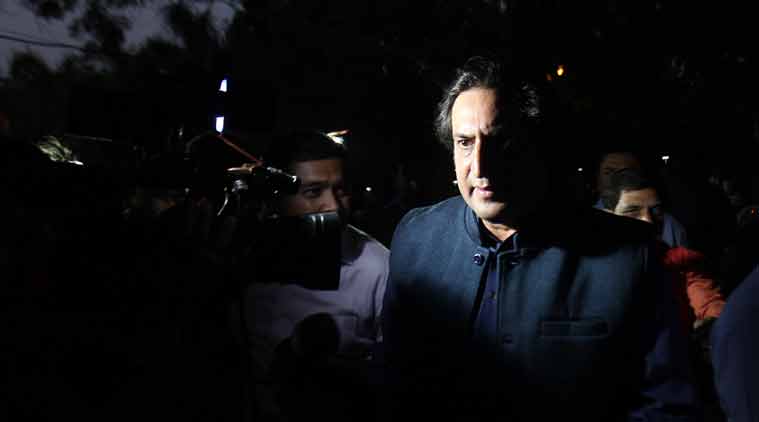
Former Jammu and Kashmir separatist leader Sajjad Lone out side PM residence after meeting with Narendar Modi in New Delhi on Monday. (Express photo by Anil Sharma)
Former separatist and Peoples Conference leader Sajjad Lone seemed to have been bowled over by Prime Minister Narendra Modi after a 45-minute meeting at the PM’s residence here this evening.
“I cannot tell you how humble he is. He was talking as if I was the Prime Minister and not him. It was like two brothers talking to each other,’’ Lone told The Indian Express later. “The meeting was scheduled for 15 minutes but he spent a full 45 minutes with me. I went inside at 4.30 pm, there were only two of us. He was extremely warm to me.”
Lone said that Modi didn’t speak to him about the elections at all. “He (Modi) spoke freely. He told me that he would take a personal interest in Kashmir. He said I didn’t go to Kashmir four times until now because of politics. He told me that he truly wants Kashmiris to live a life of happiness and dignity and that he will keep on going to Kashmir.’’
“I talked to him about the problems with flood relief and he said that he (Modi) was personally monitoring it. He said trust me on this — I will restore Kashmir to its glory…I told him you did so much in Kutch in Gujarat and why can’t similar projects be introduced in Kashmir. He told me when it comes to development, I know how to achieve things – wait for a little while and then see whether there is change or not,’’ Lone said.
Lone said he didn’t raise contentious issues like Article 370 or the peace process. “I only told him that he should use his good offices so that people can live with dignity…I asked why couldn’t government of India make Srinagar a smart city. He said it was a great idea but it has to go through a process. I told him about the need of a highway connecting north Kashmir which could only become a reality if it is done under a Central scheme – he promised to discuss it…When I talked about need for urbanization and tourism infrastructure, there was a hint of excitement in his eyes,’’ he said.
The Modi-Lone meeting comes after a long BJP courtship, part of the party’s plan to stitch up a possible post-poll alliance of smaller parties and individuals in the Kashmir Valley where the BJP has little presence. While the BJP’s J&K poll plan hinges on the Hindu-majority seats among Jammu’s 37 Assembly constituencies, Lone and a few other free-floating politicians and parties are part of BJP’s public relations blitzkrieg to exhibit the party’s reach into the Muslim-majority Valley.
For his part, Sajjad Lone has reason to reach out to Modi. A known television face of public dissent in Kashmir during the 2008 Amarnath land row agitation, his party is focused in his native north Kashmir’s Kupwara district. He lost both the 2009 and 2014 Lok Sabha elections. He is contesting from Handwara where his party – then a separatist outfit — had fielded a proxy candidate in the 2002 Assembly polls who subsequently won as Independent. This proxy participation had led to a split in the Hurriyat Conference.
Story continues below this ad
Lone became critical of Pakistan and the separatists because of the assassination of his father, the moderate Abdul Gani Lone, a veteran politician who had been a minister and had contested elections until he turned separatist after the armed uprising of 1990.
Sajjad Lone’s political journey ever since his father’s assassination has been a roller coaster ride. He took on separatist leader Syed Ali Shah Geelani and swore on the Quran during a press conference that he would never contest elections. His party’s political manifesto, “Achievable Nationhood.” talked about “earned sovereignty.” He spoke about a Muslim Kashmir and floated the idea of “an opt out option” for the three Hindu-majority districts in Jammu.
Muzamil Jaleel is a Deputy Editor at The Indian Express and is widely recognized as one of India’s most authoritative voices on Jammu & Kashmir, national security, and internal affairs. With a career spanning over 30 years, he has provided definitive on-the-ground reportage from the heart of the Kashmir conflict, bearing witness to historic political transitions and constitutional shifts.
Expertise and Investigative Depth
Muzamil’s work is characterized by a rare combination of ground-level immersion and high-level constitutional analysis. His expertise includes:
Conflict & Geopolitics: Decades of reporting on the evolution of the Kashmir conflict, the Indo-Pak peace process, and the socio-political dynamics of the Himalayan region.
Constitutional Law: Deep-dive analysis of Article 370 and Article 35A, providing clarity on the legal and demographic implications of their abrogation in 2019.
Human Rights & Accountability: A relentless investigator of state and non-state actors, uncovering systemic abuses including fake encounters and the custodial death of political workers.
International War Reporting: Beyond South Asia, he provided on-the-spot coverage of the final, decisive phase of the Sri Lankan Civil War in 2009.
Landmark Exposés & Impact
Muzamil’s reporting has repeatedly forced institutional accountability and shaped national discourse:
The Kashmir Sex Scandal (2006): His investigative series exposed a high-profile exploitation nexus involving top politicians, bureaucrats, and police officers, leading to the sacking and arrest of several senior officials.
Fake Encounters: His reports blew the lid off cases where innocent civilians were passed off as "foreign terrorists" by security forces for gallantry awards.
SIMI Investigations: He conducted a massive deep-dive into the arrests of SIMI members, using public records to show how innocuous religious gatherings were often labeled as incriminating activities by investigative agencies.
The Amarnath Land Row: Provided critical context to the 2008 agitation that polarized the region and altered its political trajectory.
Over the years, Muzamil has also covered 2002 Gujarat riots, Bhuj earthquake, assembly elections in Bihar for Indian Express. He has also reported the peace process in Northern Ireland, war in Sri Lanka and national elections in Pakistan for the paper.
Awards and Fellowships
His "Journalism of Courage" has been honored with the industry's most prestigious accolades:
Four Ramnath Goenka Awards: Recognized for J&K Reportage (2007), On-the-Spot Reporting (2009), and Reporting on Politics and Government (2012, 2017).
Kurt Schork Award: From Columbia University for international journalism.
Sanskriti Award: For excellence in Indian journalism and literature.
IFJ Tolerance Prize: For his empathetic and nuanced reporting in South Asia.
International Fellowships: Served as a visiting scholar at UC Berkeley and worked with The Guardian, The Observer, and The Times in London. He has also received Chevening fellowship and a fellowship at the Institute of Social Studies, Hague, Netherlands.
Professional Presence
Current Location: New Delhi (formerly Bureau Chief, Srinagar).
Education: Master’s in Journalism from Kashmir University.
Social Media: Follow him for field insights and rigorous analysis on X (Twitter) @MuzamilJALEEL. ... Read More


 4 min read


 Former Jammu and Kashmir separatist leader Sajjad Lone out side PM residence after meeting with Narendar Modi in New Delhi on Monday. (Express photo by Anil Sharma)