Journalism of Courage



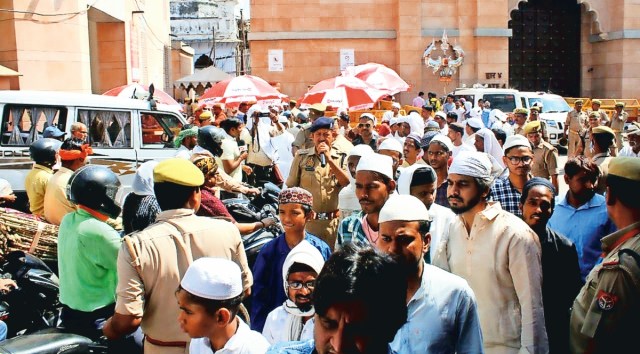 Devotees come out of Gyanvapi mosque after offering prayers on the last Friday of Ramzan, amid tight security, in Varanasi on Friday. Anand Singh
 The Supreme Court Friday asked the Varanasi district magistrate to ensure that sufficient numbers of water tubs are made available for “wazu” (ritual ablution) for Muslims offering prayers at the Gyanvapi mosque complex.
The bench of Chief Justice of India D Y Chandrachud and Justice P S Narasimha recorded the statement of Solicitor General Tushar Mehta, who appeared in the court on behalf of the Uttar Pradesh government, that the district magistrate would ensure the availability of water at the mosque complex.
“Mr Tushar Mehta, Solicitor General, states, on the instructions of the District Magistrate, who is present in Court, that in order to facilitate the performance of Waju, the District Magistrate shall ensure that a sufficient number of tubs with facilities for water are made available in proximity so as not to inconvenience the devotees who come for performing namaz,” the bench said.
The committee of Management Anjuman Intezamia Masajid Varanasi had moved the court seeking the facilities saying the disputed area where the rituals were performed earlier was being used by Muslims for many years.
Mehta said the administration had arranged toilet facilities just 70 metres away and it could not be provided inside because the entry to the bathroom which was in use earlier was through the disputed area where a Shivling was said to have been discovered. The Muslim side maintains it is a fountain.
For the ritual ablution, Mehta said, water will be provided in the same area as before. The bench suggested that long tubs be put to use.
Mehta said the administration had made arrangements for six tubs. He assured that sufficient water will be provided so that everyone can perform the rituals.
In May 2022, the Supreme Court had asked the district magistrate to secure the area where the Shivling was said to have been found during a videographic survey of the mosque area without impeding or restricting the rights of Muslims to access and offer prayers at the mosque.

 2 min read