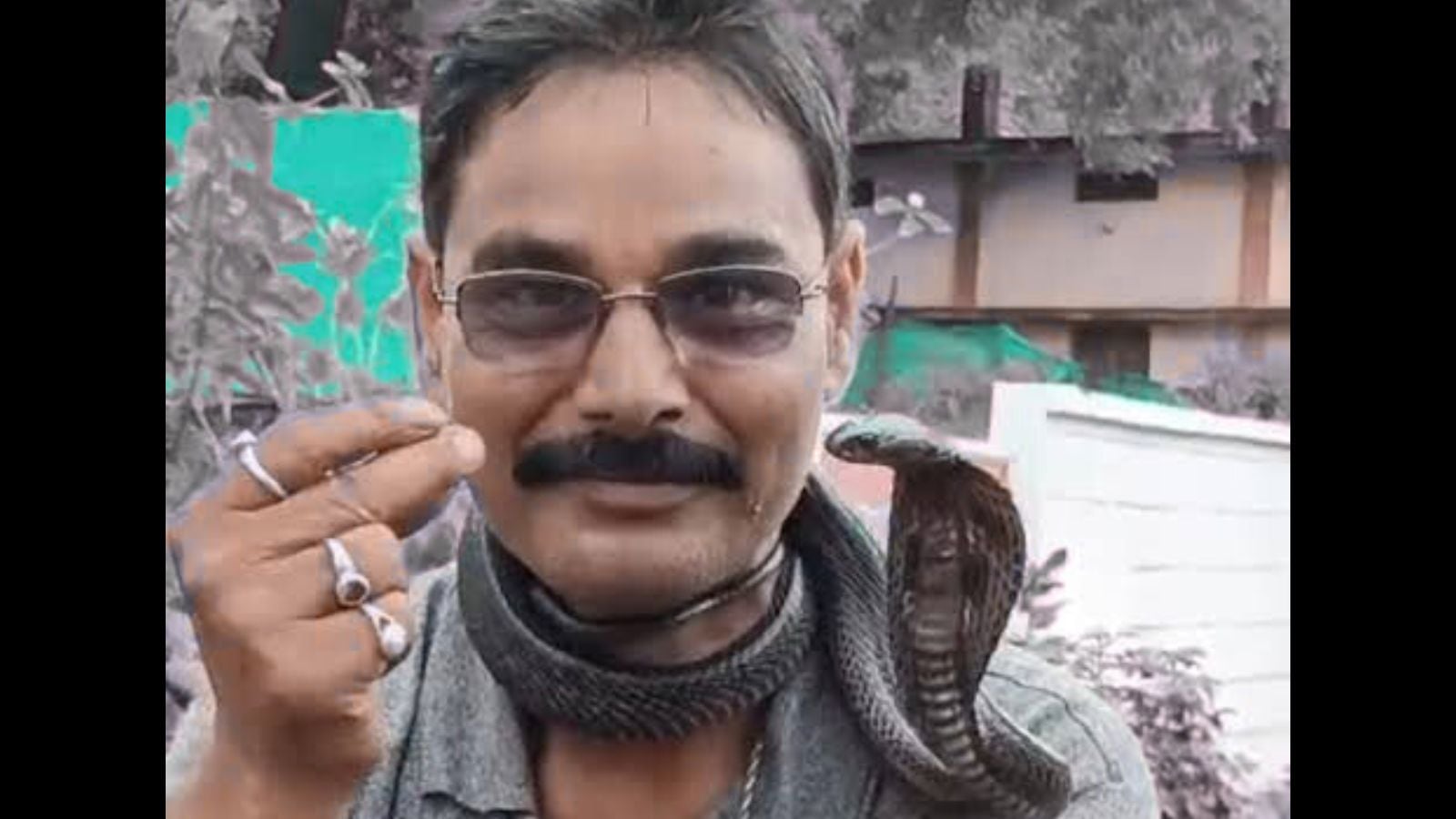
Before his death, the 35-year-old, a part-time worker at JP College and a self-taught snake rescuer, had posed for a video, standing still with the cobra loosely looped around his shoulders.
Deepak Mahavar spent years rescuing snakes from homes, farms, and schools across Madhya Pradesh’s Guna district. On Monday, after rescuing a venomous Indian cobra, Mahavar made the dangerous decision to drape the snake around his neck while he was on his bike.
The cobra bit him, and despite receiving medical treatment, Mahavar died within hours, officials said.
Before his death, the 35-year-old, a part-time worker at JP College and a self-taught snake rescuer, had posed for a video, standing still with the cobra loosely looped around his shoulders.
According to eyewitnesses and hospital staff, Mahavar had gone to Barbatpura village to respond to a rescue call. He successfully captured the cobra and placed it in a glass container. But before he could release the snake in a safe area, as is standard practice, he received a call from his son’s school. His 13-year-old son had been dismissed early.
In haste, Mahavar took the snake out of the container and placed it around his neck, presumably to keep it secure as he rushed to school on his motorbike.
Additional Superintendent of Police Man Singh Thakur told The Indian Express, “The snake rescuer put the snake around his neck and travelled on a bike when he heard his son had been dismissed early from school. The snake bit him on his hand.”
Despite the bite, Mahavar remained conscious long enough to call a friend and seek help. He was admitted to Raghogarh hospital and later referred to Guna District Hospital, where he sought treatment. He was discharged in the evening after showing signs of recovery, but by midnight, his condition had worsened. “He was brought back to the hospital in critical condition but died before further treatment could begin,” Thakur said.
Story continues below this ad
He leaves behind two sons, aged 14 and 12. Their mother had passed away earlier.
Snakebites are a public health issue in Madhya Pradesh, especially during the monsoon months of June to September. Paddy fields, open drains, and waterlogged areas become breeding grounds for snakes, particularly cobras, kraits, and vipers, wildlife officials said.
According to officials, Madhya Pradesh records hundreds of snakebite cases every year, many of them fatal due to delays in reaching proper medical facilities or incorrect first aid. The state also has all the big four venomous snakes like the common krait, the Indian cobra, the Russell’s viper, and the saw-scaled viper.
A 2024 study conducted on MP State government compensation for snake deaths found that more than 5,700 people died of snakebite between 2020 and 2022, and warned that the actual number was likely higher.
Story continues below this ad
Snake rescuing in rural India is often carried out by volunteers or self-taught individuals like Mahavar, who learn through experience and local knowledge rather than formal training. While their services are invaluable, especially in regions with inadequate animal control infrastructure, many lack protective equipment such as snake hooks, gloves, or secure carrying bags.
Guna Divisional Forest Officer (DFO) Akshay Rathore told The Indian Express, “The deceased was not part of the local wildlife team. We have trained our own team in snake rescues. But we are unable to cover all areas, and these private snake rescuers fill the gap. He did not handle the snake properly and did not follow proper protocols. You are not supposed to touch the snake; you should handle them with proper equipment.”
Anand Mohan J is an award-winning Senior Correspondent for The Indian Express, currently leading the bureau’s coverage of Madhya Pradesh. With a career spanning over eight years, he has established himself as a trusted voice at the intersection of law, internal security, and public policy.
Based in Bhopal, Anand is widely recognized for his authoritative reporting on Maoist insurgency in Central India. In late 2025, he provided exclusive, ground-level coverage of the historic surrender of the final Maoist cadres in Madhya Pradesh, detailing the backchannel negotiations and the "vacuum of command" that led to the state being declared Maoist-free.
Expertise and Reporting Beats
Anand’s investigative work is characterized by a "Journalism of Courage" approach, holding institutions accountable through deep-dive analysis of several key sectors:
National Security & Counter-Insurgency: He is a primary chronicler of the decline of Naxalism in the Central Indian corridor, documenting the tactical shifts of security forces and the rehabilitation of surrendered cadres.
Judiciary & Legal Accountability: Drawing on over four years of experience covering Delhi’s trial courts and the Madhya Pradesh High Court, Anand deconstructs complex legal rulings. He has exposed critical institutional lapses, including custodial safety violations and the misuse of the National Security Act (NSA).
Wildlife Conservation (Project Cheetah): Anand is a leading reporter on Project Cheetah at Kuno National Park. He has provided extensive coverage of the biological and administrative hurdles of rewilding Namibian and South African cheetahs, as well as high-profile cases of wildlife trafficking.
Public Health & Social Safety: His recent investigative work has uncovered systemic negligence in public services, such as contaminated blood transfusions causing HIV infections in thalassemia patients and the human cost of the fertilizer crisis affecting rural farmers.
Professional Background
Tenure: Joined The Indian Express in 2017.
Locations: Transitioned from the high-pressure Delhi City beat (covering courts, police, and labor issues) to his current role as a regional lead in Madhya Pradesh.
Notable Investigations: * Exposed the "digital arrest" scams targeting entrepreneurs.
Investigated the Bandhavgarh elephant deaths and the impact of kodo millet fungus on local wildlife.
Documented the transition of power and welfare schemes (like Ladli Behna) in Madhya Pradesh governance.
Digital & Professional Presence
Author Profile: Anand Mohan J at Indian Express
Twitter handle: @mohanreports ... Read More


 4 min read