

Journalism of Courage

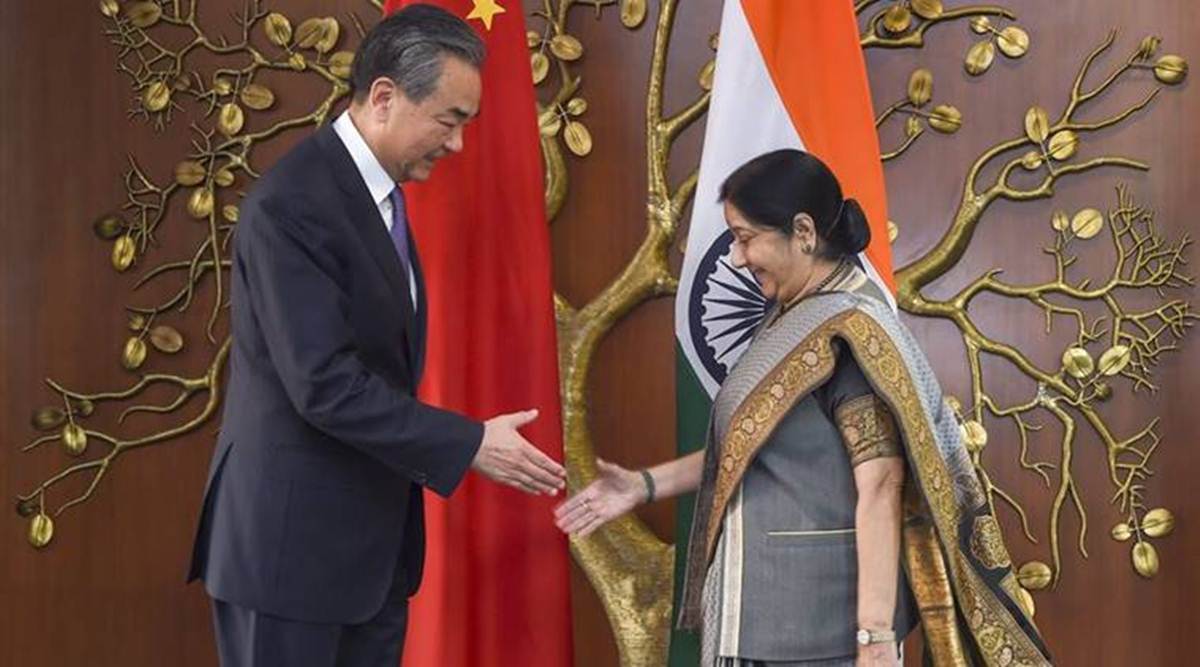
Visiting Chinese State Councillor and Foreign Minister Wang Yi on Friday proposed setting up of Confucius Institutes in India as part of what he called “brand projects”.
He publicly made the pitch after a bilateral meeting with External Affairs Minister Sushma Swaraj, as he listed several projects including pilgrimage tours, celebrating Chinese New Year in India, and joint medical teams.


With growing foreign policy clout, China is perceived to be using a state-sponsored cultural institution, the Confucius Institute, as a tool to increase its public influence overseas. Founded in 2004, its faculty are not employed by host universities, so they are not protected by codes of academic freedom and can be subject to outside influence. Their courses often ignore Beijing’s history of human rights abuse and authoritarianism —- the Tiananmen Square massacre is ignored, Taiwan and Tibet are portrayed as undisputed territories and the persecution of Uighurs and Falun Gong is missing. The students receive a whitewashed version of China. New Delhi must welcome Confucius institutes, but on its own terms and not China’s.
But, on Friday, after co-chairing the ‘High Level Mechanism on Cultural and People-to-People Exchanges’, Wang said, “We agreed we shall develop brand projects for people-to-people interaction, including pilgrimage tours, celebrating Chinese New Year, develop Confucius Institutes, youth exchanges, joint medical teams and museum communication.”
“We will examine when they come up with concrete proposals on the issue,” a South Block source said, when asked about Beijing’s plans to develop more Confucius Institutes. As of now, India has two Confucius Institutes, Mumbai University and VIT University in Vellore (Tamil Nadu).
Former Indian ambassador to China Ashok Kantha told The Indian Express, “In the past, the Indian government has deemed Confucius Institutes as foreign cultural centres and as such subject to the regime applicable to such centres. This has not been acceptable to Hanban, which runs Confucius Institutes.
“The alternative is Hanban promoting Chinese language teaching, etc. in partnership with Indian educational institutions (for instance, by providing Chinese language teachers) without insisting that it must be done under the aegis of Confucius Institutes. The latter is a pragmatic option, which was pursued successfully in 2014 when Hanban provided 30-plus Chinese language teachers for introducing Chinese language in CBSE schools,” said Kantha, who heads the Delhi-based think-tank Institute of Chinese Studies.
Several US universities had snapped ties with Confucius Institute following concerns raised by US Congressmen over “Chinese government influence spreading throughout educational institutions in Texas”.
In 2014, the American Association of University Professors issued a statement criticising Confucius Institutes as “functioning as an arm of the Chinese state” and being “allowed to ignore academic freedom”. In February 2018, FBI director Christopher Wray suggested during testimony to the US Senate Intelligence Committee that China was using “collectors” to infiltrate US universities and gather intelligence on behalf of the Chinese government.
Swaraj did not mention Confucius Institutes in her remarks. Instead, the minister, who called Wang her “brother” and “close friend”, said that India and China have agreed on “10 pillars” of cooperation to enhance cultural and people-to-people exchanges. The 10 pillars are cultural exchange, cooperation in films and television, cooperation in museum administration, cooperation sports, exchanges between youths, cooperation on tourism, exchanges between states and cities, cooperation in traditional medicine, cooperation in yoga and cooperation in education, she said.
Wang said, “India-China relations have reached a new historical stage… it reflects a personal commitment of our leaders, and this is a major initiative in the history of India-China relations.” He said this at the inaugural session of 3rd India-China High Level Media Forum.
Swaraj said she was “satisfied” with the outcome of her two-hour dialogue, and bilateral cooperation has improved significantly after the Wuhan Summit.
She said the armies of the two countries were also making efforts and implementing confidence-building measures to maintain peace and tranquility along the border. She raised the issue of trade deficit, but appreciated Chinese efforts to make it balanced and sustainable.


