Journalism of Courage



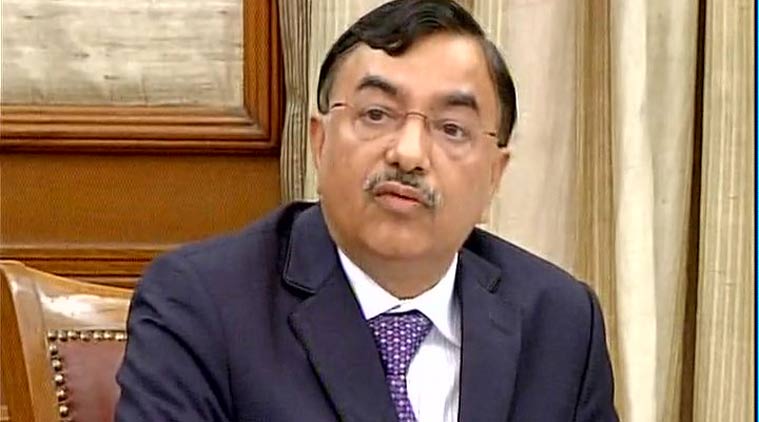 Central Board of Direct Taxes (CBDT) chairman Sushil Chandra.
The Central Board of Direct Taxes (CBDT) is learnt to have told the Election Commission (EC) that the scrutiny of assets declared by lawmakers in their poll affidavits cannot be disclosed to the public.
The Commission, in letters written to CBDT in November 2017 and April this year, had sought clarification on whether the poll panel could allow the public to access reports on the verification of election affidavits by the Director General of Income Tax (Investigation) under the Right to Information (RTI) Act.
The EC, The Indian Express has learnt, is of the view that since a verification report is not an investigation report, its disclosure should not be restricted under Section 24 of the RTI Act, which exempts certain organisations from being covered under this law. This includes the Director General of Income Tax (DGIT).
The Commission has further argued that such disclosures are in the interest of voters and will empower aggrieved or interested persons (such as losing candidates) to file a complaint or an FIR against the elected lawmaker under Section 125A of the Representation of the People Act, 1951 for providing false information in the election affidavit.
 The CBDT had decided to scrutinise poll affidavits, at the EC’s request, to verify whether the information on movable and immovable assets submitted by the contesting candidates matches the income they have declared in the past.
But in its response sent last month, the CBDT has told the EC that disclosing the verification report is not “feasible” since it would be in contravention of Section 138 of the Income Tax Act. Section 138 prescribes a general prohibition on furnishing any information with regard to an assessee under the IT Act. It has also mentioned that such disclosures are punishable.
In June 2013, the CBDT had decided to scrutinise poll affidavits, at the EC’s request, to verify whether the information on movable and immovable assets submitted by the contesting candidates matches the income they have declared in the past.
The CBDT, as per its arrangement with EC, does not scrutinise all affidavits. It acts in cases referred by the Commission, cases where the contesting candidate’s assets have grown phenomenally since the last election, cases of winning candidates, cases where the PAN number has not been disclosed but the candidate’s movable assets are more than Rs 5 crore and cases where the candidate’s new movable assets, compared to the last election, is more than Rs 2 crore.
Election affidavits are verified by the Director General of Income Tax (Investigation) based on jurisdiction and their reports are shared directly with the EC. If the DGIT finds a discrepancy in an affidavit, then the concerned assessing officer, who has jurisdiction over the candidate, can take action under the IT Act.
The Commission wants to make the DGIT report, which is only a verification report and indicative in nature, public under the RTI Act.As per the CBDT’s submission in the Supreme Court last year, it is investigating assets of seven incumbent Lok Sabha MPs and 257 MLAs, under its 2013 arrangement with EC. The submission was made was in response to a petition filed by an NGO, which sought scrutiny of the election affidavits of 26 Lok Sabha MPs, 11 Rajya Sabha MPs and 257 MLAs on the ground that their assets had increased substantially between two polls.

 4 min read