Crew ‘failed to control train at danger signal’: Initial report into Bilaspur crash that killed 11
In its report, South East Central Railway holds the crew responsible for not “controlling the train at the right time and right position” before colliding with the goods train.
Written by Jayprakash S Naidu
Bilaspur | Updated: November 6, 2025 04:37 AM IST
3 min read
Whatsapp
twitter
Facebook
Reddit
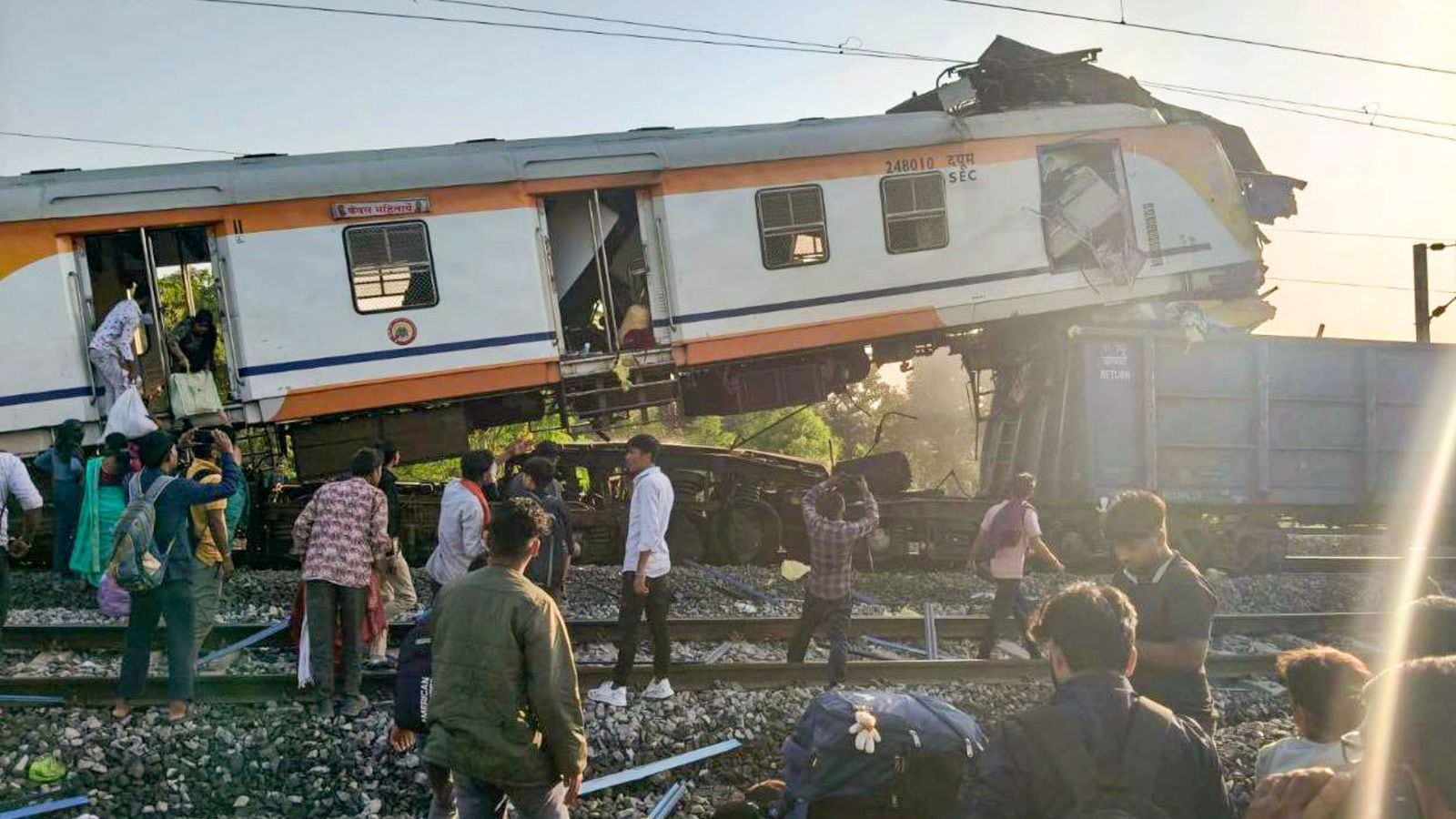
People gather after a passenger train collided with a goods train near Bilaspur railway station, Chhattisgarh. (PTI)
An initial inquiry report on the Chhattisgarh train accident has blamed the crew of the Bilaspur-bound Mainline Electric Multiple Unit (MEMU) passenger train for the incident, saying they “failed to control the train at danger signal”.
Eleven people – including the loco pilot – were killed and 20 injured when the Gevra Road–Bilaspur passenger train rammed into a stationary goods train a few kilometres from the city in Lalkhadan around 4 pm Tuesday.
In its report, the South East Central Railway (SECR), headquartered in Bilaspur, said the crew was responsible for not “controlling the train at the right time and right position before danger signal and committed SPAD case”.
A ‘SPAD case’ refers to a Signal Passed at Danger event, when a train passes a stop signal without authority.
The report said the passenger train’s “reduced speed” just before the collision was 76 kmph.
This comes even as the Commissioner of Railway Safety – under the administrative control of the Ministry of Civil Aviation – continues to probe the incident.
The Central Public Relations Officer (CPRO) and the Divisional Railway Manager (DRM) were not available for comment. The family of deceased loco pilot Vidya Sagar could also not be reached, nor could the two passenger crew members undergoing treatment for injuries.
Story continues below this ad
Meanwhile, the Commissioner of Railway Safety began the inquiry Wednesday. It is being conducted by B. K. Mishra, Commissioner of Railway Safety, South Eastern Circle, Kolkata, under Section 113 of the Indian Railways Act.
A press note from Indian Railways said: “Any person having information regarding this accident and the facts related to it and willing to give evidence can appear and give evidence on the above mentioned date and place or can send information in writing to the Commissioner of Railway Safety, South Eastern Circle, New Koilaghat Building (12th Floor), 14, Strand Road, Kolkata 700001 or email to crssec@er.railnet.gov.in.”
The Bilaspur Police have registered an FIR in the case. The FIR, based on a memo given by a railway employee, books unknown people under provisions for causing and wrongful restraint under the Bharatiya Nyaya Sanhita as well as sections of The Railway Act, 1989.
“Right now, it’s not clear if it was a signal failure that led to the incident or the loco pilot who lost his life in the tragedy after jumping the signal. The investigation would have been easier had there been cameras inside the loco pilot’s cabin,” one officer said.
Story continues below this ad
The police will now question the assistant loco pilot who survived the incident but is admitted to a hospital for treatment.
“We will also send a questionnaire to railway officials and passengers to know more,” the officer said.
Jayprakash S Naidu is a Principal Correspondent for The Indian Express, currently serving as the state correspondent for Chhattisgarh. With an extensive career in frontline journalism, he reports on the political, security, and humanitarian landscape of Central India.
Expertise and Experience
Specialized Conflict Reporting: Jayprakash is a leading voice on the Maoist/Naxalite conflict in the Bastar region. His reporting provides a critical, ground-level view of:
Internal Security: Tracking high-stakes encounters, surrender programs for senior Maoist leaders, and the establishment of security camps in formerly inaccessible "heartland" villages.
Tribal Rights & Displacement: Investigative reporting on the identity and land struggles of thousands of displaced tribals fleeing conflict zones for neighboring states.
Governance & Bureaucratic Analysis: He consistently monitors the evolution of Chhattisgarh as it marks 25 years of statehood, covering:
Electoral Politics: Analyzing the shift in power between the BJP and Congress and the impact of regional tribal movements.
Public Policy: Reporting on landmark infrastructure projects (e.g., mobile connectivity in remote zones) and judicial interventions, such as High Court rulings on civil and family law.
Diverse Investigative Background: Prior to his current focus on Chhattisgarh, Jayprakash held reported from Maharashtra, where he specialized in:
Crisis & Disaster Management: Notable for his extensive coverage of the Cyclone Tauktae barge tragedy (P-305) and the COVID-19 pandemic’s impact on frontline personnel.
Legal & Human Rights: Investigative pieces for platforms like Article-14, focusing on police accountability and custodial deaths across India.
Environmental & Social Justice: Authoritative reporting on the Hasdeo Aranya forest protests and the approval of major tiger reserves, highlighting the tension between industrial mining and environmental preservation. ... Read More


 3 min read