Journalism of Courage



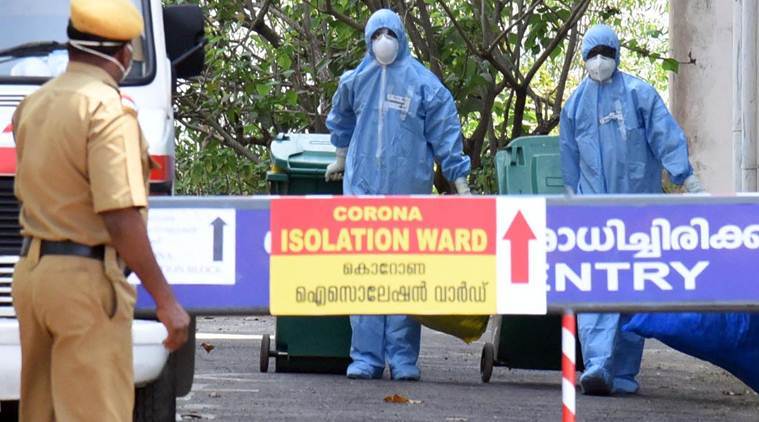 On Monday, when Kerala’s total case count was reported at 26,873, the share of cases through local transmission was 62.46 per cent — up from 12 per cent a month ago. (File)
Departing from Kerala model of Covid-19 control, which involved community participation, the state government on Monday decided to give the police a larger role in contact-tracing, ensuring compliance of quarantine and social distancing at functions, and control of containment zones.
The change in strategy comes after cases through local transmission grew alarmingly across Kerala, where 174 clusters have developed, most of them alive and adding to the caseload.
On Monday, when Kerala’s total case count was reported at 26,873, the share of cases through local transmission was 62.46 per cent – up from 12 per cent a month ago. The state has so far reported 84 deaths, and 70 per cent of the deceased do not have either contact or travel history, according to the health Department.
The decision to give the police a larger share of preventive measures came hours after Chief Minister Pinarayi Vijayan on Saturday admitted that there has been “complacency and lapses” in certain areas.
Inaugurating 102 family health centres, Vijayan said, “It should be remembered with a sense of guilt that Covid-19 patients have increased due to complacency and lapses. I don’t want to go into reasons. Lockdown has been in place in Thiruvananthapuram since July 6, yet cases due to local transmission have been increasing.”
Later in the day, Vijayan told the media that considering the magnitude of the spread, the police have been given more responsibilities. Now, primary and secondary contacts of people who test positive for the virus have to be traced by the local police within 24 hours, he said. “A team led by a police inspector should function for contract-tracing, which has been so far done by health inspectors. Considering the present situation, police are given that onus,’’ Vijayan said.
He said: “There are instances of people violating quarantine and not maintaining social distancing. Such things increase risk of infection. The police are given full responsibility in ensuring these matters.”
Vijayan said the police would be more active in containment zones and ensure compliance of home quarantine. They are also entrusted with ensuring that social distancing is maintained at public functions, markets, funerals and weddings.
People have to alert the police if those under quarantine are found violating protocols and restrictions, he said.
District police chiefs, the CM said, will work as incident commanders in the respective districts and will hold daily review meetings with district collectors and district medical officers. Police officer as incident commander is a major shift in approach as so far sub divisional magistrates under revenue department have been in that job under collector.
Vijayan said the police would help district collectors and the disaster management authority to demarcate containment zones. The present practice of a ward or a street declared as a containment zone would change, and areas of contacts would be earmarked as containment zones, instead of wards.
An area earmarked as a containment zone would remain so until it is ensured that no primary and secondary contacts are coronavirus-positive there. The government will also prepare a map of the containment zone.
The Chief Minister said I-G Vijay Sakhare would function as nodal officer to direct all district police chiefs. He also said the state has 174 Covid-19 clusters, of which status quo is maintained in 51 clusters and infection is going up in 34 others.
So far in Kerala, village-level vigil committees have been in charge of ensuring compliance of home quarantine. Revenue department officials and local self-governing agencies had helped such committees.
The government had last month identified lapses in Covid-19 preventing steps. On July 1, a report presented in the high-level review meeting had pointed out cracks developing in the state’s battle against Covid-19.
The report noted, “Vigil on those under quarantine has come down. On June 1, when 73,949 persons had been under observation in Kerala, the local self-government department, which is assigned to be in the forefront of ensuring effective quarantine, had contacted only 50 per cent of those under home observation.”
It said the police had contacted 67 per cent, and the health and revenue departments 73 per cent and 2 per cent, respectively.
On June 20, it said, when 1.44 lakh people were under quarantine, monitoring by different government departments came down, the report stated. “That day (June 20), the local self-government department could reach only 43 per cent of quarantined people, while the health department (reached) 60.4 per cent of those under quarantine.’’

 5 min read