First there was rain, then came the snow. The police control room at 14,500 ft above sea level at Mahaguns Top started buzzing, relaying information down. By Wednesday evening, the rains had reached Pahalgam, where the first batch of the Amarnath Yatra pilgrims had been staying at the Nunwan base camp, preparing for the 28-km trek to Sheshnag.
Soon, the police officer in charge of the camp, Roop Raj Bhagwan, had a tough choice to make — postpone the yatra or risk casualties. Bhagwan chose safety.

“We calculated the risk factors after our teams conducted a risk analysis of the routes. It takes around six hours for the pilgrims to leave Pahalgam and finish their journey for the day at Sheshnag camp. As per our information, the rains had caused a two-hour delay. I made the choice to postpone the yatra,” Bhagwan said.
READ | New roads, better security, organised traffic: What is new to this Amarnath Yatra
On Thursday, the Met department declared that the Monsoon had arrived. The weather however, is expected to improve by Friday evening with mostly cloudy conditions and chances of intermittent light rainfall. “From Wednesday night, there was moderate to heavy rainfall at the holy cave followed by snowfall for 15-20 minutes on Thursday morning,” said Regional Met Director, Sonam Lotus.
All of this has meant that a total of 1,735 pilgrims at the Nunwan camp have been stranded with most of them relegated to makeshift tents. The paramilitary forces are now on full alert after rains did not allow them the tactical advantage of deploying drones for aerial surveillance.
Security personnel stand guard as the Amarnath Yatra begins, in Banihal on Wednesday. (Photo: Praveen Khanna)
The Nunwan camp had come under attack in 2002 when three militants opened fire upon pilgrims and CRPF personnel, killing nine and injuring 30. Two year prior to that, 25 people were killed and 36 injured after militants flung grenades and opened fire at the base camp in Pahalgam.
READ | Amarnath Yatra begins: Pilgrims ready, ‘a little worried’
Story continues below this ad
“The drones have not been used since this morning. They need clear skies to fly and it has been raining continuously since Wednesday. We have to now increasingly rely on our men on the ground to keep this camp secure,” said a senior CRPF officer.
The base camp can accommodate 3,600 pilgrims, and the second batch of 3,434 pilgrims has left from Jammu for the twin routes of Pahalgam and Baltal. “We should be able to accommodate many of them but the others will have to look for hotels in the surrounding area. We also have ten huts which can accommodate around hundred more pilgrims,” said Surender Mohan, camp director at Nunwan.
With the first and second batch of pilgrims expected to congregate at Nunwan, paramilitary forces have ramped up operations around the base camp. Several CRPF men have had to double up their responsibilities. “I have been deputed to the sanitation area at the camp, but also have to attend my sentry outpost unit. I have not slept since 2 am and I am waiting for my replacement to takeover,” says the guard commander of a sentry post.
The security agencies have had to increasingly rely on wireless telecommunication to carry out their operations.
Story continues below this ad
Altaf Khan, SSP, J&K Police, said, “Each division of the paramilitary forces has its own telecommunication set up with their own communication grids. All the information from the grids are transferred to the Joint Police Control Room (JPCR). The information is analysed and we communicate actionable inputs to the agencies concerned.”
Security agencies have also been communicating with each other over WhatsApp groups where they coordinate and get updates from JPCRs located at major stopovers on the Pahalgam route.
Around 50 sanitation workers deputed by a private contractor in Srinagar have been working since 4 am, cleaning toilets and clearing the camp of garbage. The camp, however, has not been able to operate a newly brought STP machine for disposing waste as the rains have hindered operations. Even the seven high-mast lights used to illuminate the camp are yet to function due to the rains.
Special CRPF motorcycle squad deployed to protect Pilgrims of Amarnath Yatra at Amarnath Yatra base camp in Jammu on Tuesday. (Express Photo: Praveen Khanna)
Many of the pilgrims, meanwhile, spent their time shopping, eating out at langars and playing cards inside their 4ft-long tents with rain covers in hues of faded army green, bright orange and yellow. “I had prepared two months in advance buying mountain gear and anticipating the Pissu top trek. And all I have been doing is sit in a tent since morning,” said Rajneesh Sharma, a 22-year-old college student from Punjab.
Story continues below this ad
Around five members of the NDRF’s seventh battalion undertake a 5-km trek every day at important routes making a risk analysis. “The 3-km Pissu Top route is the toughest trek on the Pahalgam route. Our teams have been trying to strategise rescue operations while also mapping dangerous tracks. The route cannot be used as many of the narrow routes will be covered in mud. People slipping off the track is a possibility. Last year, two people died on the trek to Pissu Top,” said Kishore Lal posted with the NDRF at Pahalgam.


 6 min read


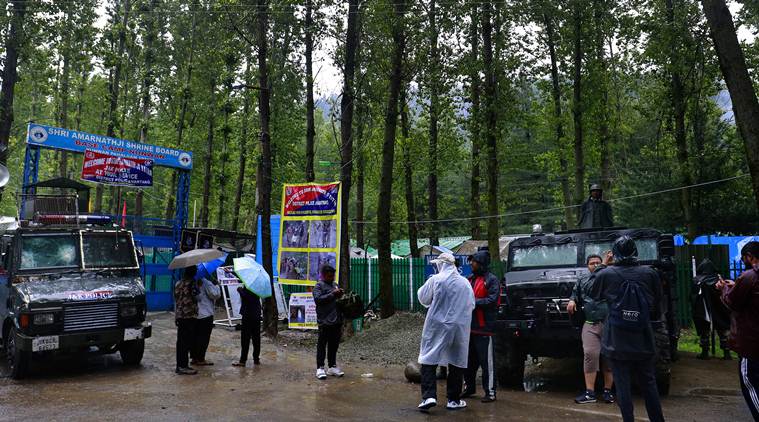 At Nunwan base camp in Pahalgam on Thursday. (Photo: Praveen Khanna)
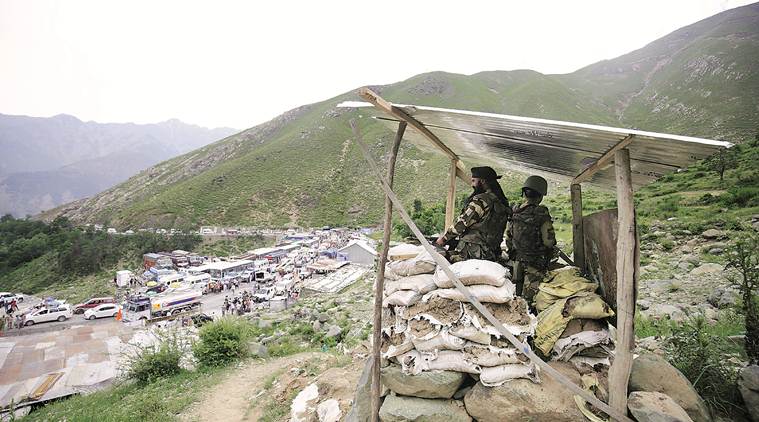 Security personnel stand guard as the Amarnath Yatra begins, in Banihal on Wednesday. (Photo: Praveen Khanna)
 Pilgrims begin yatra from Amarnath Yatra Jammu base camp, in Jammu on Wednesday. (Express photo by Praveen Khanna)
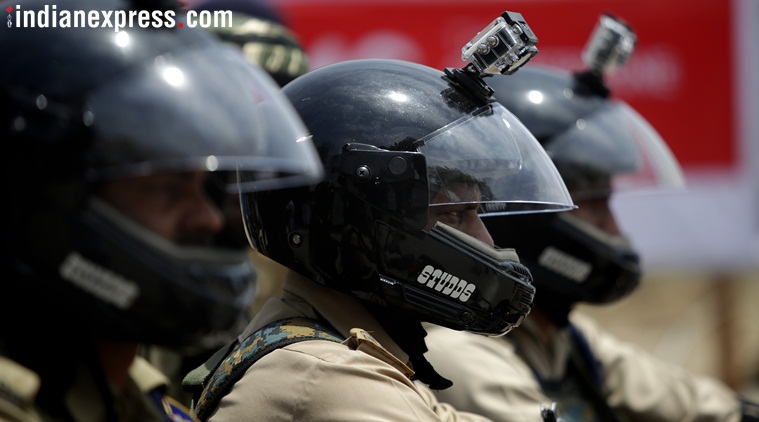 Special CRPF motorcycle squad deployed to protect Pilgrims of Amarnath Yatra at Amarnath Yatra base camp in Jammu on Tuesday. (Express Photo: Praveen Khanna)