2 min read
Stay updated with the latest - Click here to follow us on Instagram
© IE Online Media Services Pvt Ltd



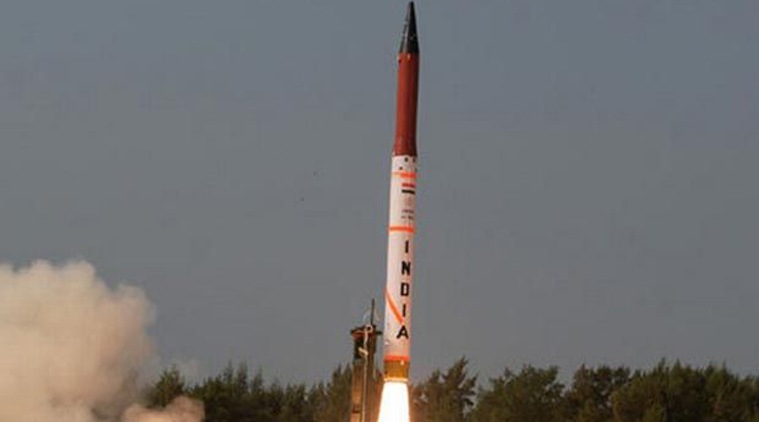 The three-stage solid propellant missile is to be test-fired from a mobile launcher from the launch complex-4 of the Integrated Test Range.
With an aim to strengthen its nuclear deterrence, India test-fired its indigenously-developed intercontinental surface-to-surface nuclear capable ballistic missile ‘Agni-5’ from the Wheeler Island off Odisha coast on Monday. With a range of more than 5,000 km, the Agni-5 is capable of carrying a nuclear warhead of more than one tonne. President Pranab Mukherjee congratulated DRDO for successfully test-firing the missile. He added that it’ll enhance the country’s strategic and deterrence capabilities.
The three-stage solid propellant missile was test-fired from a mobile launcher from the launch complex-4 of the Integrated Test Range (ITR). This will be the fourth developmental and second canisterised trial of the long range missile. While the first test was conducted on April 19, 2012, the second test was carried out on September 15, 2013 and the third on January 31, 2015 from the same base.
What separates the Agni-5 from its predecessors is the fact that the latest one is the most advanced having some new technologies incorporated with it in terms of navigation and guidance, warhead and engine. The indigenously-developed technologies were successfully tested in the first Agni-5 trial, which included the redundant navigation systems, very high accuracy Ring Laser Gyro based Inertial Navigation System (RINS) and the most modern and accurate Micro Navigation System (MINS). These technologies had ensured the Missile reaches the target point within few metres of accuracy.
With PTI inputs
Stay updated with the latest - Click here to follow us on Instagram