Journalism of Courage



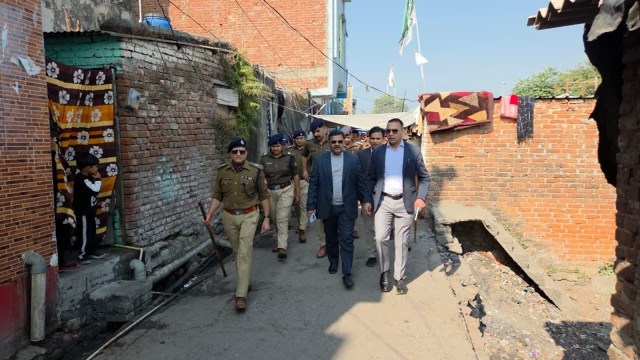 For the localities’ 50,000 residents, who say they have documents proving rightful occupation, an adverse ruling could be decisive.
Sitting in one of the labyrinthine lanes of Gafoor Basti in Uttarakhand’s Haldwani, Mohammad Aman Ansari goes through last month’s accounts, his eyes darting to the phone beside him. He is waiting for news on the Supreme Court hearing in the land-encroachment case on which the fate of the anganwadi hinges.
“It might not come up today as well,” the 29-year-old tells The Indian Express, turning back to his work. “It has been a long wait.”
He has reason to be anxious. The anganwadi is among 4,365 structures caught in a protracted legal battle involving the state government and the Indian Railways. Spread across 2.2 km near the Gaula River and four Haldwani localities — Indira Colony, Dholak Basti, Gafoor Basti and Lane 7 — the structures are marked for demolition, with the government calling them unauthorised.
The Supreme Court is hearing a special leave petition against the Uttarakhand High Court’s 2022 eviction order. The petition was last heard on November 14, with the next hearing tentatively on December 16.
For the localities’ 50,000 residents, who say they have documents proving rightful occupation, an adverse ruling could be decisive.
“Humare gale pe talwar rakhi hui hai (A sword’s hanging over our heads),” says Zubaida, 65, of Gafoor Basti, swatting flies from a broken chair in her three-room home. “If they ask us to leave, we will, because who can fight the government? But I believe the Supreme Court will not order our eviction.”
Among the 4,365 structures marked for demolition are not just shanties but concrete buildings — schools, government inter-colleges, a primary health centre, an Uttarakhand Jal Sansthan office and religious structures — some dating to the 1930s. They also include, according to Mohammad Yusuf, an advocate who represented several residents, buildings labelled and auctioned as enemy property after Partition and later purchased by current residents.
“Some residents have lease deeds from 1968. While some of these have expired, some have had it made freehold property with the approval of the government local body,” he says.
While residents cite sale and lease deeds to assert lawful occupation, the Railways claims it has its own evidence — maps, a 1959 notification, 1971 revenue records and a 2017 survey — to show it owns the 30 hectares on which these structures stand.
Allegations of encroachment first reached the high court in 2007, when a lawyer from neighbouring Uttar Pradesh, linked to the Uttarakhand High Court Bar Association, sought a train from Allahabad to Kathgodam.
“The HC issued notice to the railway, which claimed that, as a result of the so-called encroachments, it didn’t have the space for a new line,” says Yusuf.
The issue resurfaced in 2013 through a PIL into the collapse of a Gaula River bridge. A court-mandated probe later alleged illegal mining, with the Railways linking it to encroachments.
A 2016–17 joint survey by the Railways and the district administration identified 4,365 “encroachments”. On January 10, 2017, the high court ordered clearance, followed by eviction notices.
The Supreme Court stayed the eviction in 2017 and asked the high court to hear affected individuals. The HC then directed the Railways to appoint an Estate Officer, issue notices and hear objections.
The Estate Officer rejected the objections and ruled in favour of the Railways, prompting residents to appeal in the district court, where some appeals remain pending.
The case resurfaced on December 20, 2022, when the Uttarakhand High Court again ordered eviction. Residents moved the Supreme Court, which stayed the order on January 5, 2023.
In July 2024, acting on an application from the Centre and the Railways, the court directed authorities to identify the required land, list affected families and prepare a rehabilitation plan. But there has been little progress since, a petitioners’ counsel says.
Fate in balance
Among the structures marked for demolition are government buildings — a Government Girls Intercollege in Banbhoolpura with 1,074 students, established in 2003; a Government Intercollege in Indira Nagar with 400 students, established in 1985; an upper primary school with over 80 students, established in 1964; and a primary school with 284 students, established in 1944.
Nainital District Magistrate Lalit Mohan Rayal, under whom Haldwani falls, says the state has no policy for “rehabilitating encroachers”.
“Uttarakhand is a small state with few resources. We cannot provide for everyone encroaching on government land,” he says. On government schools, he says the administration will follow Supreme Court orders.
The area falls under the Izzatnagar Rail Division of the North Eastern Railway (NER). While Izzatnagar Divisional Rail Manager Veena Sinha did not respond to queries, the NER’s chief public relations officer declined comment on a matter “that was sub judice”.
Meanwhile, as the ruling nears, police have been deployed in Banbhoolpura to prevent flare-ups.
For residents, the prolonged court battle means continuing uncertainty. At the anganwadi, where the angry red cross of the demolition marking is unmissable, the court ruling dominates conversation. Set up in 2005, the centre has 25 enrolled children, while another 65 avail its services, including supplementary nutrition. It remains unclear where they would go if the building is demolished.
“Railway tracks and the 20-metre patch surrounding it can be their land. They are staking claim to land beyond that,” alleges Ansari, whose family built its house in 1992 on the now-disputed land.
Similar claims echo across the localities. On Lane 17, about 100 metres from the tracks, Mohammad Aslam works at his sweetmeat shop in an old building and points to his family home.
“I have a patta issued by the British government in 1938 to prove my ownership. I was born in this house and went to school here. My family, my two brothers and their families also live here,” says the 54-year-old, adding that they pay property tax, water and electricity bills to the Municipal Corporation Haldwani.
A few metres away, Firoz Khan, 34, hopes for a favourable ruling, citing the 1995 Supreme Court judgment in Chameli Singh vs State of UP, which held the Right to Shelter to be a fundamental right.
“This is about the people who work until evening just to earn enough to eat at night. We are of the firm belief the court will stand with us,” he says.
Haldwani MLA and Congress leader Sumit Hridayesh says he supports railway expansion but not at the cost of residents.
“These people are the service providers and help run Haldwani’s economy. If they are evicted, the economy will come to a standstill,” he says. On the Railways’ expansion plans, he adds: “There is a 50-acre empty patch near the tracks they can use. Why do you want development at the cost of razing a poor man’s house?”

 6 min read