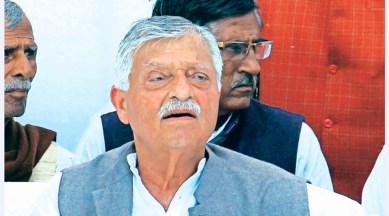
6-time MP, Gandhi family’s pointsman in Amethi and Rae Bareli, Satish Sharma dies at 73
In a party where loyalty to the Gandhi family has a high premium, Satish Sharma ranked among the top. He was not a career politician – Sharma was an airline pilot and was friends with Rajiv Gandhi.
From Rajiv Gandhi’s Man Friday to the Gandhi family’s sherpa in Amethi and Rae Bareli, veteran Congress leader and former Union minister Captain Satish Sharma, who died in Goa Tuesday after a brief illness, was known in Congress circles for his loyalty. Sharma was 73. He is survived by wife, son and daughter.
In a party where loyalty to the Gandhi family has a high premium, Sharma ranked among the top. He was not a career politician – Sharma was an airline pilot and was friends with Rajiv Gandhi. In 1983, he followed Rajiv when the latter entered politics, abandoning his flying career.
You’ve Read Your Free Stories For Now
Sign up and keep reading more stories that matter to you.
When Rajiv became the Prime Minister in 1984 after Indira Gandhi’s assassination, Sharma’s second career took off. There was no looking back after that – until a few years ago, when the party decided against nominating him to the Rajya Sabha for yet another term.
Sharma, who became a Rajya Sabha MP for the first time in 1986, had been in the thick of controversies many times. Even during Rajiv’s tenure, in the early days of his political career, some controversial land deals involving him had become a talking point. He was one of Rajiv’s most trusted men but was aloof from his other close loyalists such as M L Fotedar and private secretary Vincent George.
Sharma looked after Rajiv’s Lok Sabha constituency – Amethi – from an office on the Race Course Road. In 1991, he was elected to Lok Sabha from Amethi in by-elections after Rajiv Gandhi’s assassination. He ran into controversy again as Minister of Petroleum and Natural Gas for three years from 1993 to 1996 in the P V Narasimha Rao government for allocation of petrol pump dealerships and cooking gas agencies.
In 1997, the Supreme Court cancelled allotments of petrol pumps by Sharma and imposed a penalty of Rs 50 lakh for the arbitrary allotments. The court later waived it but Sharma could never put the controversy behind. While slapping the fine, the apex court observed that Sharma was behaving as if he was a “king”, and the petrol pumps his “personal property”.
Sharma returned to Lok Sabha in 1999 but from Rae Bareli, while Sonia Gandhi entered Parliament from Amethi.
Story continues below this ad
In 2004, he vacated the seat to Sonia, as she shifted from Amethi to Rae Bareli to make way for son Rahul. Months later, Sharma was sent to the Upper House for his second term.
He served one more Rajya Sabha term from 2010 to 2016. In all, he was an MP six times – three terms each in Lok Sabha and Rajya Sabha.
In 2016, Sharma was denied a re-nomination and noted lawyer and former Union minister Kapil Sibal replaced him in the Upper House.
“He died at 8.16 PM at Goa. His last rites would be done in Delhi on Friday, as the body is being brought from Goa,” his son Samir was quoted as saying by PTI.
Manoj C G currently serves as the Chief of National Political Bureau at The Indian Express. A veteran journalist with a career spanning nearly two decades, he plays a pivotal role in shaping the publication's coverage of India's political landscape.
Experience & Career: Manoj has built a robust career in political journalism, marked by a transition from wire service reporting to in-depth newspaper analysis.
The Indian Express (2008 – Present): He joined the organization in 2008 and has risen to lead the National Political Bureau, overseeing key political coverage.
Press Trust of India (PTI): Prior to his tenure at The Indian Express, Manoj worked with India’s premier news agency, PTI, honing his skills in breaking news and accurate reporting.
Expertise & Focus Areas: As a seasoned political observer, Manoj focuses on the nuances of governance and party dynamics.
National Politics: extensive reporting on the central government, parliamentary affairs, and national elections.
Political Strategy: Deep analysis of party structures, coalition politics, and the shifting ideologies within the Indian political spectrum.
Bureau Leadership: directing a team of reporters to cover the most critical developments in the nation's capital.
Authoritativeness & Trust: Manoj’s authoritativeness is grounded in his nearly 20 years of field experience and his leadership role at a legacy newspaper. His long-standing association with The Indian Express underscores a reputation for consistency, editorial integrity, and rigorous reporting standards required of a Bureau Chief.
Find all stories by Manoj C G here. ... Read More