


Tags:


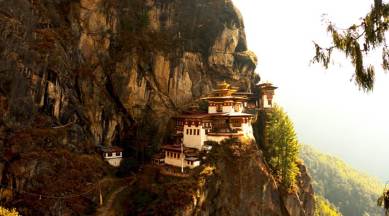
From the vantage point of a cliff edge, the scene was a bit surreal. On the peak opposite sat a stack of small buildings in stark white with yellow, red and brown trimming, perched precariously and almost hugging the cliff side. In the backdrop were hills and mountains, a mix of brown rocky surfaces and lush green forests. Puffy clouds swept in and out, making the whole scene seem like a bit of a fantasy. The first unhindered view of Bhutan’s Paro Taktsang or Tiger’s Nest was, indeed, a jaw-dropping moment.
But the end was far from near. In between was a ravine with a series of stone steps going down and then ascending towards the monastery. The final leg loomed like a nightmare. Standing in the middle of Paro valley, about 10 km north of Paro town, the shrine stood on a peak rising about 3,000 ft into the sky. Trekking up was the only way to reach it, though horses did carry people up to the half-way mark (it was equally painful). The trek was made challenging by the steep and arduous paths, and the slippery slopes. Stories of Prince William and Duchess Kate scaling it rather easily in recent years were passed around but didn’t help.


As fanciful stories of Guru Padmasambhava were bandied about by guides and fellow trekkers, the climb, too, became more taxing. The path narrowed and became steep and winding, as well as rocky and dusty. The air thinned with every step up. There were rewards: a winding path suddenly turned a corner and opened up a stunning panoramic view of the verdant valley.
A couple of hours later, we reached the half-way mark — a pretty tea house with a beautiful upward view of the Tiger’s Nest monastery. I sank on a bench and gratefully sipped on tea accompanied by sugar crackers, trying to shore up my resources. Soon, the trek resumed and the going got much tougher. The path was narrower and steeper than before. It was also adorned with a profusion of colourful Buddhist prayer flags, fluttering wildly in the strong wind, creating a strange music. A lot of huffing and puffing, frequent sips of water and hilarious tales narrated by guides and other trekkers brought me to the second stop, the vantage point from where I could see the shrine.
Giving myself a mental talking-to, I pushed ahead for the final phase. The stone steps were partly winding and led down to a platform in front of a waterfall but climbing down was relatively easy. The journey up from here was a long flight of shallow steps; my legs were hurting and I was in a world of pain. But I kept pushing, one step at a time, until I finally reached the shrine and collapsed unceremoniously on a low wall, gasping for breath.
Once I could breathe again, I wandered around the temple complex. There were a number of temples and shrines, interconnected with flights of rough-hewn steps or wooden ladders. Beautiful murals and paintings adorned the walls of the cave, in which Padmasambhava is believed to have first entered. The shrines had spectacular golden statues with colourful embellishments, lit with butter lamps. An incredible calm surrounded the place, broken only by a ringing bell or muted chants.
The downward trek presented its own problems: it was slippery and I slithered and slid in parts before reaching the bottom. But as I looked up at the monastery perched high up in the mountains, the distance disappeared and a sense of tranquillity seemed to reach out to me. I hoped the peace would stay with me for some time.
Anita Rao-Kashi is a writer in Bengaluru. This article appeared in print with the headline ‘Miles of Go’


