4 min read
© The Indian Express Pvt Ltd



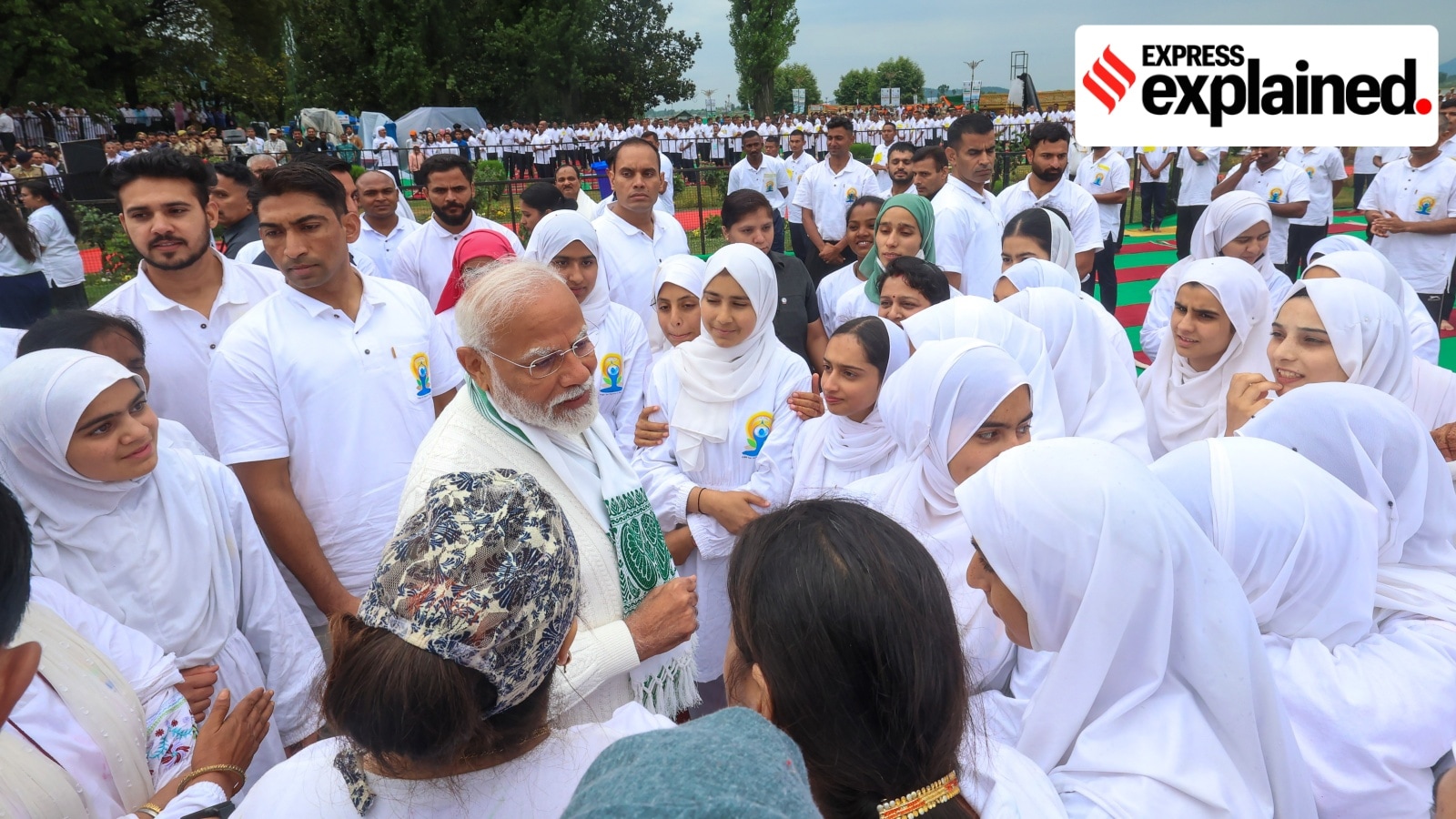 Prime Minister Narendra Modi interacts with people during celebration on the 10th International Day of Yoga, in Srinagar, Friday, June 21, 2024. (PTI Photo)
In his speech in Srinagar on International Yoga Day on June 21, Prime Minister Narendra Modi described Kashmir as the “land of yoga and meditation”. What is the historical and spiritual connection between the practice of yoga and the Kashmir valley?
Kashmir’s Trika Shaivism
A unique Shaivite tradition arose in Kashmir around 850 CE, when the Gurjar-Pratiharas, seen as the last great empire in North India before the arrival of the Muslims, were ruling over much of the Indo-Gangetic plains.
The Shaivite philosophy of Kashmir was spread widely and beyond the valley by the 10th century polymath Abhinavagupta who propounded the concept of ‘Trika’ or Trinity, as a consequence of which Kashmir Shaivism is also known as Trika Shaivism. The philosophy and practices of yoga are integral to Trika Shaivism, which had important intersections with Hath-yoga traditions such as the Nath school of Gorakshanath and the Dashanami Sampradaya of sannyasis.
Initiation into the tantric tradition through deeksha was central to the Trika yogic practice. The Malinivijayottara Tantra, a key source text underlines the significance of deeksha: “Without initiation, there is no qualification for Saiva yoga.”
The Malinivijayottara Tantra also says: “The Yogin who has mastered posture [and] the mind, controlled the vital energy, subdued the senses, conquered sleep, overcome anger and agitation and who is free from deceit, should practise Yoga in a quiet, pleasant cave or earthen hut free from all obstructions.” (The Yoga of the Malinivijayottara Tantra, translation by Somadeva Vasudeva)
Abhinavagupta and Lalitaditya Muktapida
Among some scholars, the name Kashmir is thought to have derived from the Rig Vedic sage Kashyapa, one of the seven ancient rishis of Vedic tradition. In this understanding, Kashmir is a corruption of Kashyapa Mira, or the Lake of the Rishi Kashyapa. The yogic traditions of Kashmir are also thought to derive in essence from the meditative and spiritual practices followed by the venerated sage.
The central figure of Kashmir’s yogic tradition, however, was Abhinavagupta, whose encyclopaedic treatise Tantraloka is the seminal text of the tantra philosophy. The 37 chapters of the Tantraloka cover all dimensions of the traditions of Kaula and Trika. The teachings of Abhinavagupta, in fact, went far beyond physical postures, and incorporated aspects of mental and spiritual discipline into a holistic system of knowledge.
Abhinavagupta is said to have been born in a Saraswat Brahmin family of scholars in c. 950 CE, and was given the name of Shankara. The name Abhinavagupta was bestowed on him by his master as an acknowledgment of his competence and authoritativeness. Abhinavagupta’s family was originally from Kannauj, and his ancestors are said to have migrated to Kashmir upon the invitation of Lalitaditya Muktapida, the legendary king of Kashmir who is believed to have reigned from 724 CE to 760 CE.
The main source of information about Lalitaditya is the Rajatarangini, written by the 12th century Kashmiri writer Kalhana. Apart from being a great conqueror, he is supposed to have been a patron of the arts and culture, the builder of the Martand Sun Temple, and a promoter of the traditions and philosophy of tantric yoga. His patronage is said to have drawn yoga out from the exclusive world of sages and meditators, and popularised it among the general mass of his subjects.