One in five people in Delhi could not clear the test to obtain a permanent driver’s licence in 2022, underlining a trend of rising failure as the examination gets increasingly automated and the scope for human intervention in the test results shrinks.
More than 84% cleared the test in 2018, 2019, and 2020; this number fell to 82% in 2021, and to below 80% in 2022, Delhi government data accessed by The Indian Express show.

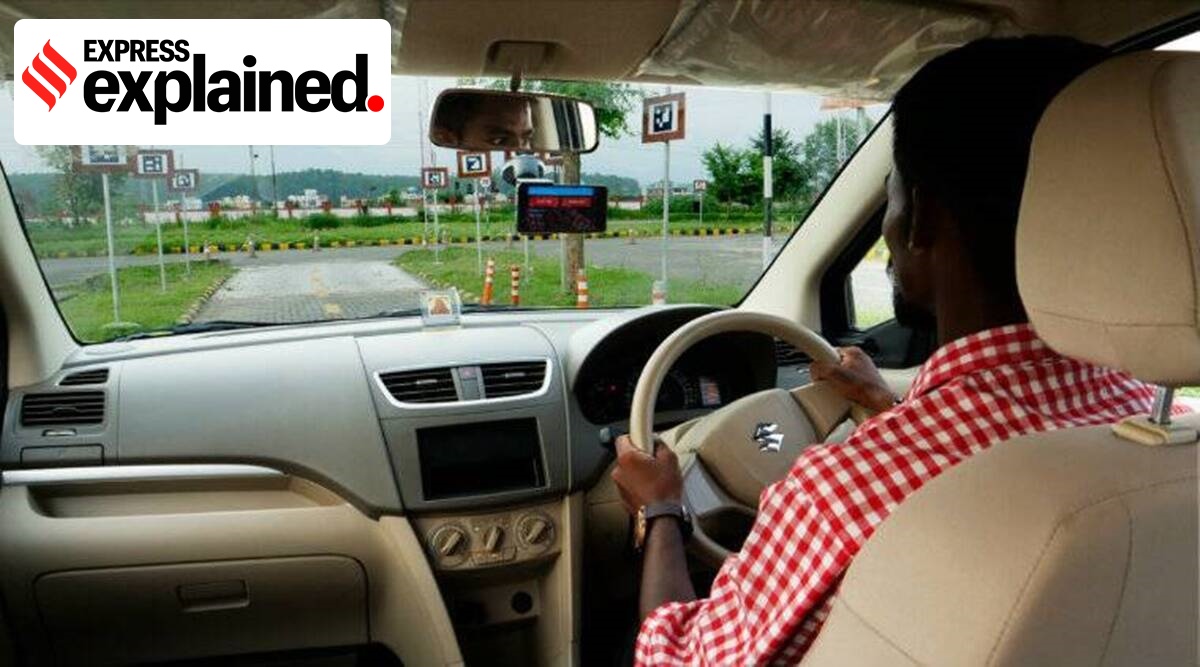
In 2018, just one test track out of the 13 in Delhi was automated; now, all but one are automated — and the last remaining track will be automated by the end of the month. Most of those who were tested in 2022 were required to display a set of 20 skills under high-resolution cameras.
So will driving tests in Delhi become fully automated now?
Yes. By the end of January, Delhi will become the first state in the country to effect a complete shift to automation in assessing driving skills. The human component — and possibility for “manipulation — will be taken out entirely from the process, potentially making the test more difficult to clear.
It is also expected that only “adequately skilled” drivers will get permanent licences, which will, by extension, make Delhi’s roads safer.
How have candidates performed on the tests over the years?
Story continues below this ad
According to Delhi government statistics, 2022 recorded the least number of successful candidates since 2018, when Automated Driving Test Tracks (ADTTs) became operational and gradually began growing in number in the city. This includes tests taken for the first time, and subsequent attempts.
The number of tests has risen over the years — from 2,95,518 in 2018 to 3,87,036 in 2022 — while the success rate has fallen among male, female, and transgender applicants.
The ADTT was first rolled out at Sarai Kale Khan in 2018, when manual tests were the norm. The success rate that year was 84.77%, over 5 percentage points more than the 79.47% in 2022. Among men, the success rate has fallen from 85.16% in 2018 to 81.05% last year; among women, the fall has been steeper — from 75.80% in 2018 to 64.76% in 2022.
What kind of infrastructure do ADTTs have?
Each ADTT has 17 high resolution cameras on average, capturing real time footage and images that monitor the examinee’s performance closely. Another 10 CCTV cameras are installed along the test tracks. An Electronic Queue Management System (EQMS) ensures candidates take the test in the same order in which their token has been generated. Six servers assess the video of the candidate’s performance and provide the result in a “transparent manner” — without any human intervention — to the centralised ‘Sarathi’ platform.
Story continues below this ad
What does an average driving test at an ADTT include?
Twenty essential driving skills under The Motor Vehicles Act, 1999, are tested at the tracks.
For four-wheelers, these skills include driving in a reverse ‘S’; driving in the figure 8; facing traffic lights; parallel parking; overtaking; and gradient and gradient start tests which entail driving up a slope and pausing before restarting the vehicle and continuing to drive further without getting stalled.
Two-wheelers must also go through a similar course, but they begin on a straight ramp for an assessment of their balance; the rider’s feet must not touch the ground as they manoeuvre through the course.
How many ADTTs are currently operational in Delhi?
Story continues below this ad
The 12 ADTTs currently functional are located at Shakur Basti, Raja Garden, Mayur Vihar, Rohini Sector 28, Lado Sarai, Hari Nagar, Burari VIU, Loni Road, Dwarka Sec-22, Jharoda Kalan, Vishwas Nagar, and Sarai Kale Khan.
The one at Lado Sarai is scheduled to get automated by the end of January. The Delhi government is also in the process of creating new automated test tracks at eight Industrial Training Institutes (ITIs), formerly known as polytechnics, and educational institutes: ITI Mayur Vihar, ITI Shahdara, ITI Narela, ITI Jaffarpur Kalan, IGDTUW Kashmere Gate, DTU Bawana, ITI Pusa, and ITI Jail Road.


 4 min read