4 min read

Journalism of Courage



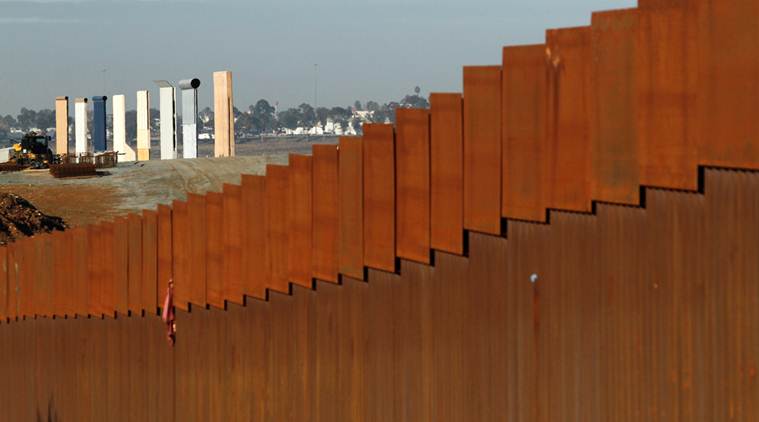 Prototypes for the border wall are seen behind the border fence between Mexico and the US in Tijuana, Mexico, Monday. (Reuters)
As the US government remains partially shut down over the standoff over $5.6 billion funding for Donald Trump’s proposed wall along the country’s southern border, the President has said he is “looking very strongly” at invoking emergency powers to build the wall without permission from Congress. Media and analysts in the US have since been debating whether the President can indeed take that step, and whether that is within norms laid down by the Constitution.
Emergency powers
The US President does indeed, have the power to declare a national emergency — when that happens, exceptions are triggered to rules that bind some of his executive powers, so that the government is enabled to react rapidly to a crisis. NPR quoted Elizabeth Goitein, co-director of the Liberty and National Security Program at the Brennan Center for Justice as saying: “Declaring the Emergency is pretty easy. There aren’t a lot of legal limits on his (Trump’s) ability to do that, frankly, even if there isn’t a real emergency happening.”
Congress’s options
Following the Watergate scandal of the early 1970s, Congress passed The National Emergencies Act, 1976, with the idea of putting some checks on the President’s powers, while not hampering his ability to act in an emergency. The Act requires the President to formally inform Congress when he declares a national Emergency, and to provide lawmakers with a list of the powers being invoked. The administration is required to regularly update Congress, and lawmakers can, by a vote in both the House and Senate, end the Emergency.
In the present case, Congress could, by a vote in both Houses, reject the declaration of Emergency. But Republicans control the Senate, and will likely not go that way.
Building the wall
The President has claimed there is a humanitarian and national security crisis at the border with Mexico, with criminals, human traffickers and drugs “pouring in”. The New York Times, which, too referred to the work of Goitein at the Brennan Center, said at least two laws could be invoked to start building the wall without explicit authorisation from Congress. There is a provision during an Emergency to divert troops and resources to build “authorised civil works, military construction and civil defence projects that are essential to the national defence”, and another that allows military construction projects “not otherwise authorised by law that are necessary to support such use of the armed forces”, using appropriated military construction funds that may still not have been given to specific projects.
The legal position
And yet, Trump’s legal authority to invoke emergency powers to build a border wall is almost certain to invite a court battle, The NYT report said. It quoted Goitein as saying “there (was) a nonfrivolous legal case to be made”, and that there were arguments on both sides should a lawsuit emerge. While commentators have argued that a “manufactured” Emergency, essentially to settle a political standoff, will not pass legal muster, that possibility is in itself not likely to deter the President. And if that happens, with Congress split, a challenge in courts by opponents of Trump will follow. The Justice Department would argue then that judges cannot decide for the President on whether the nation does indeed face an emergency. “The problem is that Congress has enabled abuse of power by putting virtually no limits on the President’s ability to declare an Emergency,” The NYT report quoted Goitein as saying.
Situation on ground
American media reports have underlined that the border situation has not deteriorated so much that an emergency to build the wall can be justified. The number of illegal aliens crossing over has fallen consistently for almost 20 years. The recent caravans of migrants have made no attempt to cross the border by stealth, rather they have approached the authorities seeking asylum.