6 min read


© The Indian Express Pvt Ltd



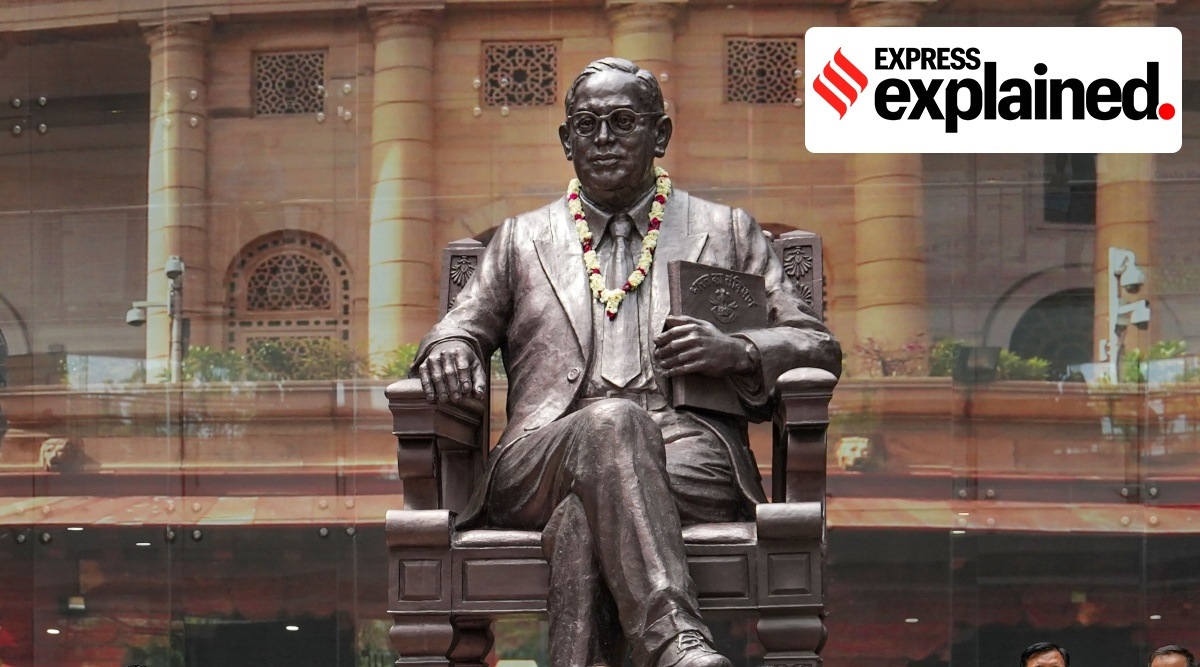 A BR Ambedkar statue at Ambedkar Bhavan in New Delhi. (PTI photo)
 India’s new Parliament building was inaugurated on the morning of May 28 (Sunday), as part of the larger Central Vista project for the redevelopment of key government buildings in central Delhi that were constructed nearly a century ago.
Back then, under colonial rule, buildings like the Parliament were constructed to plan a city suited to the ruling class. It followed the coronation of George V as Emperor of India on December 12, 1911, when the monarch announced, “We have decided upon the transfer of the seat of the Government of India from Calcutta to the ancient Capital of Delhi.”
The parliament building’s construction took six years – from 1921 to 1927. It was originally called the Council House and housed the Imperial Legislative Council, the legislature of British India.
After independence, the Constituent Assembly that was to draft the Indian Constitution took over the building and in 1950 it became the location of the Indian Parliament as the Constitution came into force. In this context, we look to a quote by the Chairman of the Drafting Committee, Dr BR Ambedkar, on how aspects of democracy were not imports of British rule, but located in Indian history itself.
What the full quote was
Delivering a speech at the Law College of the University of Delhi, on April 10, 1948, Ambedkar said:
“There could be no doubt that one of the countries which could boast of a great ancient civilization was India. When inhabitants of Europe were living under almost barbaric and nomadic conditions this country had reached the highest peak of civilization. It had parliamentary institutions when people of Europe were mere nomads.”
What the quote means
In the speech, Ambedkar was making a larger point about how Indian history had references to democratic traditions as they are now understood, and that were often claimed by Western countries as being their inventions.
He added, “It looked to the laymen as if our parliamentary institutions today had borrowed all parliamentary procedure from European Countries, particularly from Britain, but I think anyone who refers for instance, to the pages of the Vinay-pitaka will find that there is no ground for such a view.” Vinay-pitaka is a scripture of Theravada Buddhism that listed the behaviours and rules mandated for Buddhist monks.
Ambedkar said that Vinay-pitaka regulated meetings of the Bhikkhus Sangh (the monks) and there was the well-known rule that no debate could take place except on ‘Neti’ motion. He drew a parallel to the parliament procedure that said there could be no debate held unless there was a motion and no vote could be taken unless a motion was put.
That the Vinay-pitaka contained a definite provision for voting, where Salpatraka (the bark of tree) was used as ballot paper, was another proof he gave of existing democratic procedures in India. There was also a system of ‘secret ballot’, where the Bhikkhu himself could drop his ‘Salpatraka’ in the ballot box, he said.
While Ambedkar did not mention a particular time period in his speech, it could be around 1 century BCE, which as per one estimate is when the Theravada canons were written. It was only after around 483 BCE, when Buddha passed, that Buddhism split into sub-groups like Theravada Buddhism and Mahayana Buddhism over the teachings that were to be now followed. The former is considered more rigid and following a certain set of fixed rules, while the latter is more all-encompassing in its rituals.
At this time in Europe, there was fighting among tribes, but it is not entirely correct to say that by being nomads, no systems of governance existed in all of the continent. The concept of direct democracy and voting (although severely limited to landowning men) is of around this period in places like Greece, though believed to be slightly after Budhha’s time. At the same time, the Indian and Chinese civilisations boasted more developed societies compared to Britain.
Caution against autocracy
But this did not mean that Ambedkar looked at a glorious past with rose-tinted glasses. He noted that there was a contribution made by Western democracies that was important to note. He said, “The difference between ancient society and modern society lies in the fact that in ancient societies law-making was not the function of the people. Law was made by God or by the law-giver.”
This refers to how Europe, which saw the birth of modern-day democracies, moved away from the supremacy of the monarch and the dominance that religious organisations enjoyed in society by mandating the separation of Church and State. Ambedkar said, “After a course of time, jurisdiction of ecclesiastical law was challegned by secular law with the result that today’s law in the West was purely secular and the jurisdiction of the Church was confined merely to the priest.”
He then warns against an inability to introspect in society that he believes was lacking earlier. “Unfortunately, ancient societies never dared to assume the function of repairing their own defects; consequently they decayed. One of the reasons for the decay of Hindu society is that it was governed by law which had either been made by Manu or Yajnavalkya. Law that has been laid down by these law-makers is divine law. The result was that Hindu society was never able to repair itself.”