5 min read


© The Indian Express Pvt Ltd



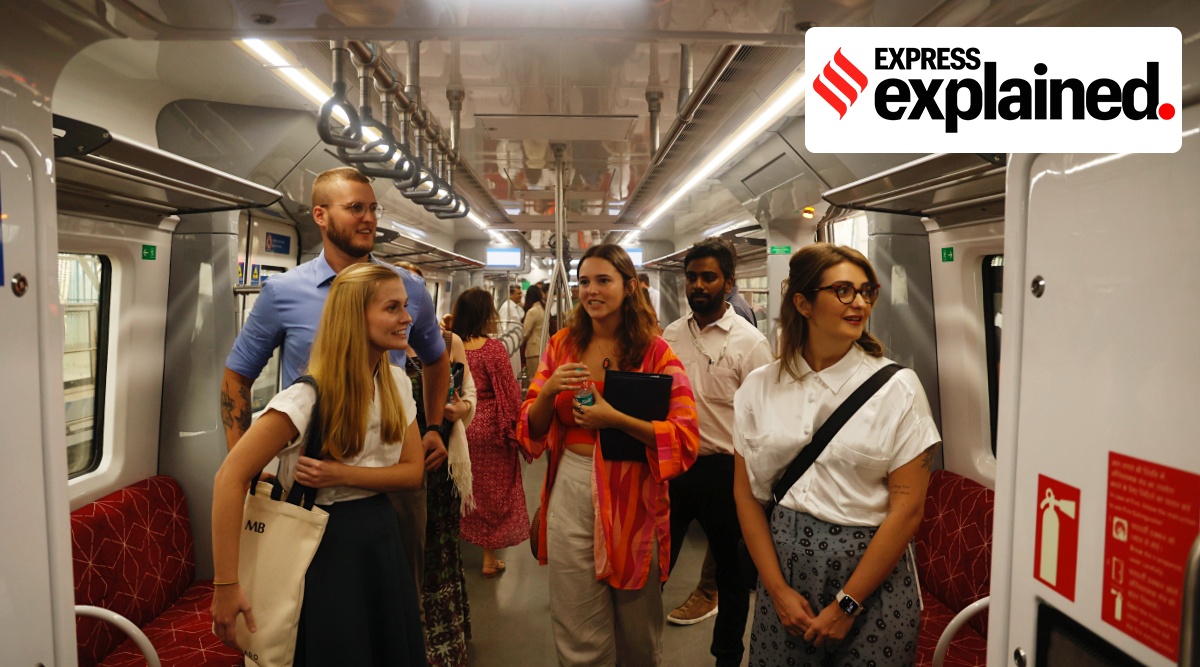 As part of G20 Troika youth for Disaster Risk Reduction and Disaster Resilient Infrastructure, a 35-member team from Brazil and other latin American countries visit the Delhi-Meerut regional Rapid Transit system at Sahibabad, Uttar Pradesh in May 2023. (Express photo Premnath Pandey)
 For 56% of the world’s population that lives in cities, which account for more than 80% of the global GDP, as per the World Bank’s estimates in April 2023, the G20 Summits over the past 10 years have led to some promises of working together to boost circular economy in cities, the development of smart cities and urban transport projects.
While the focus on cities’ issues has increased over the years, including the setting up of an engagement group of mayors called Urban20 in 2017, the G20 declarations haven’t paid enough attention to the platform that will eventually implement many of the broader objectives adopted by the countries, according to some experts.
From 2013 till 2022, the G20 declarations have only mentioned city-specific promises or goals two times. In 2021, under Italy’s presidency, the G20 leaders’ declaration had a section on “cities and circular economy”, where the leaders committed to “increase resource efficiency, including through the G20 Resource Efficiency Dialogue and recognise the importance of cities as enablers of sustainable development and the need to improve sustainability, health, resilience and well-being in urban contexts as underlined by the Habitat III New Urban Agenda.”
The 2021 Rome declaration endorsed the G20 Platform on Sustainable Development Goal (SDG) Localisation and Intermediary Cities, along with the Organisation for Economic Cooperation and Development (OEC) and United Nations-Habitat.
“We will support intermediary cities in adopting integrated and inclusive urban planning; accelerating their transitions towards clean and sustainable energy and sustainable mobility for all; improving waste management; fostering empowerment and decent work for women, youth, migrants and refugees; assisting disabled and elderly persons; enhancing food systems sustainability; and enabling more equitable access to digital innovations. Partnerships like the Coalition for Disaster Resilience Infrastructure could act as a vehicle to accelerate this agenda,” the Rome declaration said.
Before that, under Japan’s presidency in 2019, there was a brief mention of smart cities in the leaders’ declaration. “We reaffirm the importance of bridging the digital divide and fostering the adoption of digitalisation among micro, small and medium enterprises (MSMEs) and all individuals, particularly vulnerable groups and also encourage networking and experience-sharing among cities for the development of smart cities.”
The Urban20 group was started in 2017 and had its first meeting in Buenos Aeries in 2018. The group is not an official working group under G20 and is run by C40 – a global network of Mayors – and the United Cities and Local Governments (UCLG), another network of city and local governments. It is chaired by a host city from the host country each year.
This year, Ahmedabad was the host and was supported by the Union Housing and Urban Affairs Ministry and the National Institute of Urban Affairs (NIUA). Mayors from select cities in G20 and invitee countries gather to deliberate on a communique which is then handed over to the host country’s sherpa or government for consideration to be included in the leaders’ declaration.
The July 2023 U20 Mayoral Summit in Ahmedabad saw the communique being endorsed by 105 cities – the highest for any U20 so far. The communique focused on climate finance and urban reforms. The Mayors called for the establishment of a “Loss and Damage Fund” for cities to directly access financing for projects addressing the impact of climate change. No Chinese or Russian cities were represented in the communique.
What’s next?
While cities have been getting more and more attention over the years, NIUA director Hitesh Vaidya thinks the G20 platform can do more. For one, he said, Urban20 should be elevated from an engagement group to an official working group of G20.
“Past G20 Leaders’ Declarations have not adequately acknowledged the critical role urban areas play in achieving global agendas like sustainable development, climate change response, economic growth and prosperity, and inclusive development due to their sheer size and vitality,” he said.
India’s presidency, however, has focused on cities more, including in discussions of climate finance and mainstreaming the informal sector in other working groups, he said. “We live in an increasingly urbanised world, and it is evident that cities are a crucial constituency for addressing global developmental agendas and shaping a better future. G20 national governments can support cities to become principal agents in addressing the pressing challenges faced by our planet, achieving safe, resilient and just human societies, and delivering on the commitment of global climate action,” Vaidya said.