Premium
This is an archive article published on November 23, 2015

Simply put: Surplus, shortages go together in Power paradox

The explanation for this situation lies in the state of the state-owned power distribution companies, or discoms, which are responsible for buying electricity from the generation companies and selling them to consumers.

The problem is in the way state-owned discoms run, says UDIT MISRA. Will the govt’s new UDAY scheme, intended to make states responsible, work?

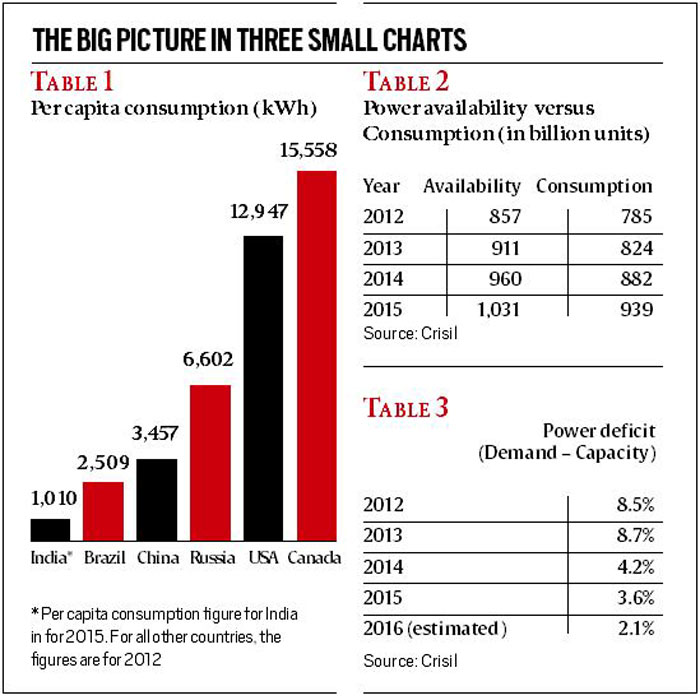
Speaking at the World Economic Forum on November 4, Finance Minister Arun Jaitley pointed out that India now generates more power than it needs and has, for the first time in its history, surplus power. And yet, the practical experience of Indians is that scheduled and unscheduled power cuts are the norm in cities, and the situation in most rural areas is worse. India lags far behind other countries in per capita consumption of power (Table 1). How is this paradox to be explained?



As the data in Table 2 shows, since 2012, the consumption of power has consistently lagged behind availability. The power deficit — excess of demand from distribution companies over the generation capacity — is expected to fall to 2.1 per cent by 2016 from 8.5 per cent in 2012. (Table 3).

The explanation for this situation lies in the state of the state-owned power distribution companies, or discoms, which are responsible for buying electricity from the generation companies and selling them to consumers. The discoms suffer massive transmission and distribution (T&D) losses. Almost 25 per cent of the power is lost, and never gets billed for — double the global average of about 12 per cent.

chart.jpg700

Worse, the remaining 75 per cent is sold at prices that are much lower than the discoms’ procurement costs. In every state, the tariff is set by a group of largely political appointees, who avoid increasing rates because of the associated political costs. Political unwillingness is at the heart of the T&D losses as well. Plugging them would require widespread metering and clamping down on illegal connections, and neither is politically easy.

Not surprisingly then, as of March 2015, the state-owned discoms’ accumulated losses were approximately Rs 3.8 lakh crore — more than 3.5 per cent of the GDP. The piled-up losses and drying up of working capital has pushed the discoms deep into debt — which has nearly doubled from Rs 2.4 lakh crore in 2011-12 to Rs 4.3 lakh crore in 2014-15.
As the discoms gasped for financial viability, they were ironically forced to pare down their businesses. This, by extension, sent the power generators into a tizzy — and led to a crash in spot prices of electricity from Rs 7.75 per unit in 2010 to Rs 2.56 in 2015. That is what explains the trends seen in Tables 2 and 3.

The Solution

In the light of the grave situation, on November 5, the union cabinet announced a new scheme — UDAY, or Ujwal Discom Assurance Yojna. Under UDAY, participating state governments (it is not a compulsory scheme) would “take over 75 per cent of discom debt as on September 30 over two years” — 50 per cent in 2015-16 and 25 per cent in 2016-17. The idea is to make the state governments formally responsible for the losses of state-owned discoms.

Story continues below this ad

This is expected to have two effects. One, it will relieve debt-ridden discoms, who can push power distribution in right earnest instead of being a roadblock to economic growth. Two, the more overt acceptance of debts on their books will push states to align tariffs to costs, and make it possible for discoms to run on a sustainable basis.

Will this help?

The long answer is more illuminating than the short one. Several factors can short-circuit UDAY.
For one, electricity is not a central subject, and states cannot be made to participate in the programme. Some of the states with the highest risk profiles — that is, with high T&D losses as well as huge tariff mismatches — are the big, populous ones like Bihar, Uttar Pradesh and Tamil Nadu. The last two are close to Assembly elections, making it unlikely that they would take politically tough decisions. The good thing is that some of the other big culprits like Rajasthan, Maharashtra, Haryana and Jharkhand are now ruled by the BJP, and could conceivably be expected to be more amenable to toeing the centre’s line.

Another important aspect is that the Centre is not providing any monetary assistance. The Centre’s carrot, in this case, is actually its stick. As such, willing states will be provided subsidised funding from the central government’s power schemes, as well as priority in the supply of coal.

Also, the Centre will disregard the extra debt taken on by the states when calculating their fiscal deficit for allocation of funds from the central exchequer.

Story continues below this ad

Third, state governments are expected to convert the discom debt into bonds. However, apart from the banks that had lent the money in the first place, finding buyers for such bonds might prove difficult — especially since these would not enjoy SLR status.

Lastly, there is nothing in the scheme to fix the perverse political incentive that leads to T&D losses and debts in the first place. It is instructive to look at the immediate past: In October 2012, the UPA came up with a similar financial restructuring package (FRP) for discoms. It converted their short-term debt into long-term loans, backed by state government guarantees. The FRP also envisaged regular tariff hikes and reduction in Aggregate Techical & Commercial (AT&C) losses. The miserable failure is underscored by the urgent need for UDAY three years later.

Udit Misra is Senior Associate Editor at The Indian Express. Misra has reported on the Indian economy and policy landscape for the past two decades. He holds a Master’s degree in Economics from the Delhi School of Economics and is a Chevening South Asia Journalism Fellow from the University of Westminster. Misra is known for explanatory journalism and is a trusted voice among readers not just for simplifying complex economic concepts but also making sense of economic news both in India and abroad. Professional Focus He writes three regular columns for the publication. ExplainSpeaking: A weekly explanatory column that answers the most important questions surrounding the economic and policy developments. GDP (Graphs, Data, Perspectives): Another weekly column that uses interesting charts and data to provide perspective on an issue dominating the news during the week. Book, Line & Thinker: A fortnightly column that for reviewing books, both new and old. Recent Notable Articles (Late 2025) His recent work focuses heavily on the weakening Indian Rupee, the global impact of U.S. economic policy under Donald Trump, and long-term domestic growth projections: Currency and Macroeconomics: "GDP: Anatomy of rupee weakness against the dollar" (Dec 19, 2025) — Investigating why the Rupee remains weak despite India's status as a fast-growing economy. "GDP: Amid the rupee's fall, how investors are shunning the Indian economy" (Dec 5, 2025). "Nobel Prize in Economic Sciences 2025: How the winners explained economic growth" (Oct 13, 2025). Global Geopolitics and Trade: "Has the US already lost to China? Trump's policies and the shifting global order" (Dec 8, 2025). "The Great Sanctions Hack: Why economic sanctions don't work the way we expect" (Nov 23, 2025) — Based on former RBI Governor Urjit Patel's new book. "ExplainSpeaking: How Trump's tariffs have run into an affordability crisis" (Nov 20, 2025). Domestic Policy and Data: "GDP: New labour codes and opportunity for India's weakest states" (Nov 28, 2025). "ExplainSpeaking | Piyush Goyal says India will be a $30 trillion economy in 25 years: Decoding the projections" (Oct 30, 2025) — A critical look at the feasibility of high-growth targets. "GDP: Examining latest GST collections, and where different states stand" (Nov 7, 2025). International Economic Comparisons: "GDP: What ails Germany, world's third-largest economy, and how it could grow" (Nov 14, 2025). "On the loss of Europe's competitive edge" (Oct 17, 2025). Signature Style Udit Misra is known his calm, data-driven, explanation-first economics journalism. He avoids ideological posturing, and writes with the aim of raising the standard of public discourse by providing readers with clarity and understanding of the ground realities. You can follow him on X (formerly Twitter) at @ieuditmisra           ... Read More


Latest Comment
Post Comment
Read Comments
Advertisement
Advertisement
Advertisement
Advertisement