An antibody study in The Lancet has estimated seroprevalence for the Spanish population and concluded herd immunity against Covid is difficult; a commentary has called it unachievable. Unpacking the findings.
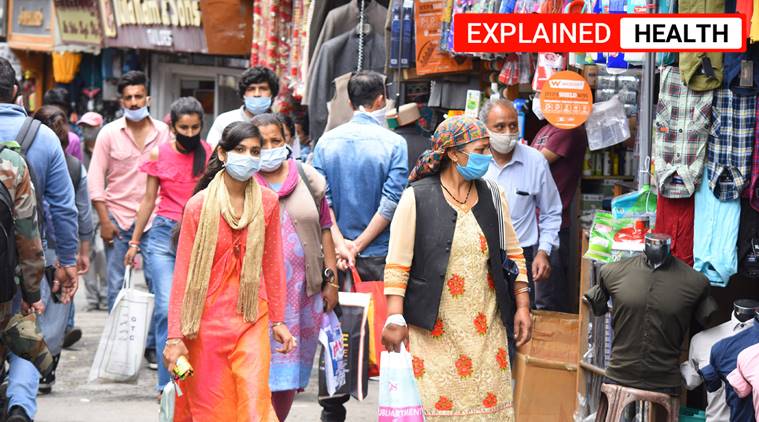
People throng a market at lower Bazar, Shimla on Thursday. Express Photo by Pradeep Kumar 25/06/2020 People throng a market at lower Bazar, Shimla on June 25, 2020. (Express Photo: Pradeep Kumar)
A new study published in The Lancet has concluded that herd immunity against Covid-19 is difficult to achieve at this stage, while a separate commentary describes it as unachievable. The conclusion is based on estimates of seroprevalence for the entire Spanish population.
What is herd immunity?
Herd immunity refers to a situation when a certain percentage of the population have become immune to a certain disease-causing pathogen, thus preventing the infection from spreading to the rest of the population. While the concept is most commonly used in the context of vaccination, herd community can also be reached when enough people have become immune after being infected.
You’ve Read Your Free Stories For Now
Sign up and keep reading more stories that matter to you.
The premise is that if a certain percentage is immune, members of that group can no longer infect another person. This breaks the chain of infection through the community (“herd”) and prevents it from reaching those who are the most vulnerable.
What is the new study?
It is a large-scale seroepidemiological study, and concluded that just five per cent of the Spanish population has developed antibodies in response to SARS-CoV-2, the virus that causes Covid-19. This implies that an estimated 95 per cent continues to be susceptible to the virus.
The study, which included 66,805 participants, was conducted between April 27 and May 11. It found that seroprevalence for the entire country was 5% by the point-of-care test and 4.6% by immunoassay. In seven provinces in the central part of Spain, including Madrid, seroprevalence was “greater than 10 percent”; and in provinces along the coast, seroprevalence was greater than 5% only in Barcelona.
In age-specific findings, “according to the point-of-care test, seroprevalence was 1.1 percent in infants younger than 1 year and 3.1 percent in children aged 5-9 years, increasing with age until plateauing around 6 percent in people aged 45 years or older”.
It is the largest serological study conducted so far in Europe and captures the true number of Covid-19 infections, which isn’t captured by laboratory tests. It provides an estimate for the population of the entire country. Based on an overall seroprevalence range of 3.7% to 6.2% and accounting for the proportions of seropositive individuals who were asymptomatic, the study estimated that “between 3,76,000 and 10,42,000 asymptomatic individuals went undetected in the non-institutionalised Spanish population”.
📢 Express Explained is now on Telegram. Click here to join our channel (@ieexplained) and stay updated with the latest
What are the implications of the study?
While a seroprevalence study largely provides information only about previous exposure to the virus, this study strengthens the line of argument that in the absence of treatment or a vaccine against Covid-19, achieving herd immunity at this stage is not possible.
“… Herd immunity is difficult to achieve without accepting the collateral damage of many deaths in the susceptible population and overburdening of health systems,” it states.
Story continues below this ad
In a separate commentary on the study, German virologists Isabella Eckerle and Benjamin Meyr wrote in The Lancet: “In light of these findings, any proposed approach to achieve herd immunity through natural infection is not only highly unethical but also unachievable. With a large majority of the population being infection naive, virus circulation can quickly return to early pandemic dimensions in a second wave once measures are lifted.”
Beyond Spain, the study sends signals to other countries: that even in countries that have reported high prevalence of Covid-19, the pandemic is far from coming to an end; therefore, these countries have to be cautious about easing of restrictions.
Why does the study suggest that herd immunity is difficult?
At the beginning of the pandemic, the United Kingdom had hinted at a strategy that would allow the novel coronavirus to infect 60 per cent of the country’s population so that a degree of herd immunity could be achieved.
Story continues below this ad
Now, the data from Spain shows that in a country that has reported community transmission, only an estimated 5% have developed antibodies in response to the virus. Hence the conclusion.
In their commentary, the German virologists have raised two important issues: At present, immunity after SARS-CoV-2 infection is thought to be incomplete and temporary, lasting only several months to a few years; second, it is unknown whether these patients are protected by other immune functions, such as cellular immunity.
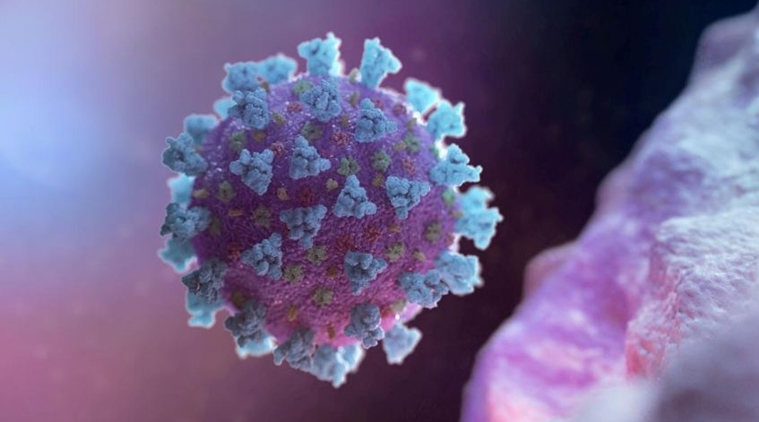
A computer image created by Nexu Science Communication together with Trinity College in Dublin, shows a model structurally representative of a betacoronavirus which is the type of virus linked to COVID-19, better known as the coronavirus linked to the Wuhan outbreak. (NEXU Science Communication/via Reuters)
What have previous seroprevalence studies revealed?
On June 11, The Lancet published a paper by researchers who had studied seroprevalence of anti-SARS-CoV-2 antibodies in 2,766 participants in Geneva. They estimated seroprevalence of 4.8% in the first week, 8.5% in the second week, 10.9% in the third week, 6.6% in the fourth week and 10.8% in the fifth week. “After accounting for the time to seroconversion, we estimated that for every reported confirmed case, there were 11.6 infections in the community,” the researchers wrote.
Story continues below this ad
On June 5, Nature published a study conducted by researchers from China, who studied seroprevalence of specific antibodies — immunoglobulin M and G — against SARS-CoV-2 in 17,368 individuals from Wuhan, the epicentre of the pandemic in the country. The study found that seropositivity varied between 3.2% and 3.8% in different sub-cohorts. It also found that patients who visited hospitals for dialysis, and healthcare workers had a higher seroprevalence — 3.3% — and that seropositivity “progressively decreased in other cities as the distance of the epicenter increased”.
On May 18, a research letter published in the Journal of the Medical Association said that the prevalence of antibodies to SARS-CoV-2 was found to be 4.65% in a community seroprevalence study conducted in Los Angeles County. The study tested 865 participants on April 10. The researchers estimated that approximately 3.67 lakh adults had SARS-CoV-2 antibodies — which is “substantially greater than the 8,430 cumulative number of confirmed infections in the county on April 10”. “Therefore, fatality rates based on confirmed cases may be higher than rates based on the number of infections,” the study said.
As City Editor ( Delhi) at the Indian Express, Kaunain Sheriff leads city reporting with a sharp focus on accountability journalism, data-driven stories, and ground-level impact. As the National Health Editor he leads the newsroom’s in-depth coverage of pressing health issues.
He is the author of Johnson & Johnson Files: The Indian Secrets of a Global Giant, a definitive investigation into the accountability of one of the world’s most powerful pharmaceutical corporations.
Areas of Expertise
Investigative Reporting: Has deep expertise in investigative reporting spanning public health, regulatory affairs, drug safety, and the criminal justice system. His work sits at the intersection of governance, law, and accountability, with a particular focus on how regulatory failures, institutional lapses, and policy decisions affect citizens’ rights and safety.
Data Journalism: Has extensively on big data–driven investigations, including analyses of flagship government schemes and large datasets on criminal trials, uncovering systemic gaps.
Global Collaborations
Kaunain is a key contributor to major international journalistic projects:
The Implant Files: Collaborated with the International Consortium of Investigative Journalists (ICIJ) to expose global malpractices in the medical device industry.
Chinese Big-Data Investigation: Uncovered how a foreign data firm monitored thousands of prominent Indian institutions and individuals in real-time.
Awards & Recognition
His commitment to "Journalism of Courage" has been recognized with the industry's highest honors:
Ramnath Goenka Award for Excellence in Journalism
SOPA Award (Society of Publishers in Asia)
Red Ink Award (Mumbai Press Club)
Indian Express Excellence Awards (Triple recipient for investigations into the NSA abuse in UP, Vyapam scam, and the anti-Sikh riots).
Education: Studied Mechanical Engineering at Visvesvaraya Technological University (VTU), Bangalore, before moving to Delhi to pursue his passion for journalism. His engineering training informs his analytical approach, enabling him to decode technical, legal, and data-heavy systems with precision.
Social media
LinkedIn: linkedin.com/in/kaunain-sheriff-3a00ab99
X ( fromerly Twitter): @kaunain_s ... Read More