© IE Online Media Services Pvt Ltd
 4 min read


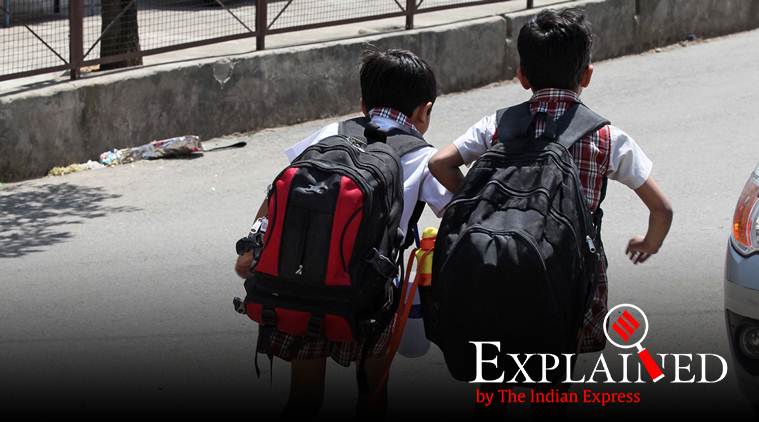 Junior class students carrying heavy school bags in one of the schools in Sector 22 of Chandigarh on Friday, April 24 2015. Express photo by Jaipal Singh
On Tuesday, the Delhi government directed schools in the national capital to ensure strict implementation of guidelines on reducing weight of school bags. Multiple studies have shown that heavy school bags can cause health problems. Schools have often come under criticism for bogging down students with heavy weight on their backs. Over the years, government agencies, as well as courts in the country, have taken decisions aiming to reduce the burden of carrying heavy bags to schools.
Last year, following the HRD guidelines on school bags, the Delhi government has capped the weight students from Classes one to ten can carry.
Here’s a timeline of what has happened so far:
For over 15 years, the CBSE has nudged schools to find a solution to the issue of burdensome school bags. It issued circulars in 2007 and in 2018 ordering all affiliated schools to reduce the weight of school bags and homework load on children.
In 2016, the Union HRD Ministry formed the guidelines to ensure students do not get bogged down with the burden of carrying heavy bags to schools. The guidelines were framed after it was observed that the load of school bag is increased by bringing textbooks, guides, homework and classwork notebooks, rough work notebooks, water bottles, lunch box, sometimes heavy school bags also. As per the guidelines schools are required to follow the textbooks prescribed by the SCERT, NCERT and CBSE.
In May 2018, in an interim order, the Madras High Court said that the use of NCERT books should be made mandatory, and that the weight of the satchels shall not be more than 10 per cent of the weight of the child. The Court had remarked that children are neither ‘weightlifters nor school bags loaded containers’.
In October 2018, the HRD ministry directed all states and Union Territories to “formulate guidelines to regulate the teaching of subjects and weight of school bags in accordance with the Government of India instructions”.
According to the central government’s advice, weights of school bags in Classes 1-2, 3-5, 6-7, 8-9, and 10 should not be more than 1.5 kg, 2-3 kg, 4 kg, 4.5 kg, and 5 kg respectively. The Ministry also said that students should not be forced to carry study materials other than the prescribed textbooks to school, as per the day’s timetable. Following the Centre’s 2018 directive, several state governments issued directions to schools to comply.
In November 2018, Delhi’s Department of Education issued a circular on fixing the maximum weight of school bags. The circular was issued to heads of government, government-aided and unaided recognised schools.
This directive, however, was challenged in the Delhi High Court by an association of publishers, who called the circular “unscientific” and an attempt to indirectly enforce the exclusive use of NCERT books in school. In March 2019, the court dismissed the plea, saying that uniformity in books would also obviate the requirement to monitor the content that individual schools may choose to teach their students.
In May 2019, the Karnataka government ordered all schools in the state to ensure that the weight of a child’s school bag does not exceed 10 per cent of the weight of the child. The order prescribed that school bags of children in Classes 1-2 cannot weigh more than 2 kg, bags of children in Classes 3-5 should weigh than 2-3 kg, and so on.