


© The Indian Express Pvt Ltd
Tags:


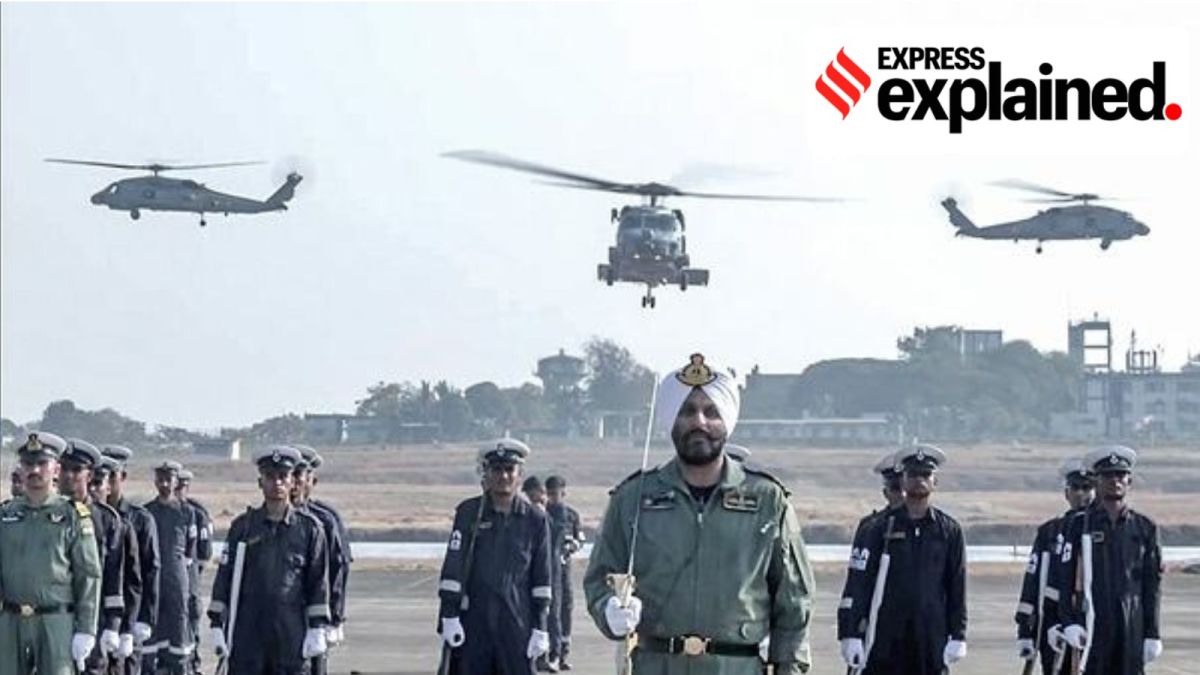
Seahawks squadron Ospreys inducted: The Indian Navy on Wednesday commissioned its second MH 60R helicopter squadron, INAS 335, at INS Hansa in Goa. The squadron has been nicknamed ‘Ospreys’ after the fish-hunting bird of prey.
These US-origin Seahawks, maritime versions of the Black Hawk (and distinct from the Bell Boeing V-22 Osprey, an American military transport aircraft), will strengthen India’s anti-submarine and surveillance capabilities and boost blue-water operations.

The first squadron of these submarine hunting helicopters, Indian Naval Air Squadron 334, was inducted at INS Garuda in Kochi in March 2024.
Thus, the aircraft has been fully integrated with the Indian Navy’s fleet operations and can operate from shore bases as well as maritime assets like aircraft carriers and other large ships.
The helicopter is designed for a wide range of operations including anti-submarine warfare (ASW), anti-surface warfare (ASuW), search and rescue (SAR) missions, and medical evacuation (MEDEVAC). It can be used for vertical replenishment (VERTREP), a naval logistics operation in which supplies are transferred by helicopter between ships at sea or from shore to ship without the ships having to dock or come next to each other.
The helicopter has been rigorously tested in Indian Reference Atmosphere (IRA) conditions. Twenty-four of these submarine-hunting helicopters have been acquired by India from the US for a contract worth over Rs 15,000 crore. These helicopters are replacing the ageing British-origin Sea King helicopters, which have been in service for long.
The induction coincides with an important milestone as the year 2025 marks 75 years since the Government of India approved the formation of a Fleet Air Arm for the Navy.
The MH 60R was primarily developed as per US Navy specifications by Sikorsky, a Lockheed Martin company. In fact, a special version of these Blackhawks was used in Operation Neptune Spear, which killed Osama Bin Laden in 2011.
The state-of-the-art digital sensor package of the MH 60R includes a multi-mode radar, electronic support measures, infrared cameras, datalinks, aircraft survivability systems, and dipping sonars, officials said.
The on-board mission system processes data obtained from sensors to create a comprehensive situational picture of the sea surface and underwater domain. The situational picture helps the crew monitor and target ships or submarines. These helicopters can be armed with torpedoes, air-to-ground missiles and rockets, and on-board guns, officials added.
The Indian Navy has said that the MH 60R is an agile and versatile asset, offering enhanced capabilities to counter both conventional as well as asymmetric threats.
Among the conventional threats, the helicopter can counter adversary submarines, which is its core role, detecting and tracking them using tools like dipping sonar and sonobuoys and torpedoes. It can target surface hostile ships, undertake mine-related reconnaissance, and participate in sea denial and deep sea operations, extending the strike range of warships for effective blue water operations (activities in the deep sea, far from the shore).
The asymmetric threats that it can counter include maritime terrorism, piracy and smuggling, sea-borne infiltration, supply chain disruptions by non-state actors, use of civilian or fishing boats as cover for hostile activity, sabotage of ports or offshore infrastructure, and unmanned threats like drones. Such threats are called asymmetric or non-conventional because they use concealment tactics by non-state actors.
Navy Chief Admiral Dinesh Tripathi said in a recent address in Pune, “The nature of maritime power itself is undergoing a profound shift. Small actors — state and non-state alike — now wield disproportionate influence through asymmetric capabilities like long-range missiles placed on small platforms, drones and autonomous surface vessels, and low-cost disruptive technologies.” In this backdrop, the MH 60R’s induction is crucial.
Last month, the Ministry of Defence signed Letters of Offer and Acceptance (LOAs) with the United States for sustainment support to the MH 60R for five years, at an approximate value of Rs 7,995 crore. Sustainment Support is a comprehensive package that includes provisioning of spares, support equipment, product support, training and technical support, repair and replenishment of components, and setting up of ‘intermediate’ level component repairs and periodic maintenance inspection facilities in India.
“The sustainment support would significantly enhance the operational availability and maintainability of the technologically advanced, all-weather capable MH60R helicopters… In addition, the support would enable the operation of these helicopters from dispersed locations as well as ships, ensuring optimal performance during all their primary and secondary missions/roles,” the MoD said.


