


© The Indian Express Pvt Ltd
Tags:


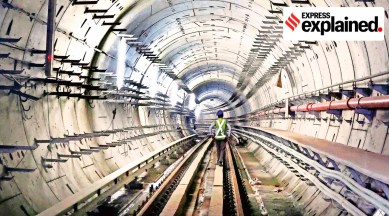
By the end of this year, commuters could be taking a Metro train across the Hooghly, which separates Kolkata from Howrah, its smaller twin city on the opposite bank, travelling under the mighty river. The passage, 520 metres from one bank to the other and more than 30 metres (100 feet) below the river surface at its deepest points, is India’s first underwater transport tunnel.
Trial runs on the Howrah Maidan-Esplanade section — of which the tunnel under the Hooghly river is part — of the city’s East-West Metro are currently ongoing, and could continue for perhaps another seven months, after which regular commuter services will begin.

The trains will have an operational speed of 80 km/h, and will cover the half-kilometre stretch under the Hooghly in about 45 seconds.

The 16.55-km East-West corridor, the second line of the Kolkata Metro network, will, when complete, connect the IT hub of Salt Lake Sector V on Kolkata’s eastern flank to the western suburb of Howrah, where the city’s main train station is located. The line, called the Green Line, will link Howrah station to Sealdah station, which is the hub of Kolkata’s suburban railway network.
The eastern part of the East-West line — from Salt Lake Sector V to Sealdah — is already operational. Work on the small Sealdah-Esplanade section in the middle has been impacted after the tunnel-boring machine (TBM) punctured an aquifer in 2019, which led to seepage and some building collapses in the city’s Bowbazar area.
A smaller 5.75 km of the East-West corridor is elevated; the rest, the western portion of the corridor, is underground. There are 12 stations on the entire route, including the country’s deepest, Howrah, at the depth of 33 metres.
The line, passing through the central business district of BBD Bagh-Esplanade and connecting Howrah and Sealdah stations, is expected to see heavy ridership and significantly ease congestion in the city.
The tunnels under the Hooghly have an internal diameter of 5.55 metres and an external diameter of 6.1 metres. The centre-to-centre distance between the east- and west-bound tunnels is 16.1 metres. Two TBMs finished the job in a record 66 days from April to June 2017. The first machine crossed the river in May 2017; the second in June that year.
“Several measures have been taken to prevent water inflow and leakages in the tunnel. Concrete mixes composed of fly ash and micro silica have been used for the segments to minimise water permeability. The inner walls are of high-quality M50-grade reinforced concrete segments with a thickness of 275 mm each, which were sealed together using a complex grouting process,” a technical expert associated with the project said.
Under the organic clay of the riverbed lies a layer of sandy silt. The German-made TBMs, christened Prerna and Rachna, bored through the layer below that, described as “firm to stiff clayey silt”.
The Brabourne Road area that lies close to the river is old and busy, and residents of several old buildings were moved out to hotels while the TBMs were at work. The problem of seepage in the Bowbazar area due to the punctured aquifer is yet to be resolved — until that happens, the entire East-West corridor cannot be commissioned and the full potential of the project will not be realised, officials said.
“Apart from the underwater tunneling, tunneling in areas with historic buildings like Dalhousie was a challenge. But not a single building in the Dalhousie area developed any cracks. As far as Bowbazar is concerned, the area has water pockets which had not been detected earlier. However, this too will be resolved by May-June next year. Nothing is impossible. The entire project was a challenge, which was accepted and well executed,” Chief Public Relations Officer of Eastern Railway and Metro, Kausik Mitra, said.
The Kolkata Metro is integral to the city’s identity. The North-South line, the first section of which was opened in 1984, was India’s first Metro railway. The line, also known as the Blue Line or Line 1, now runs from Dakshineshwar to Kavi Subhash in New Garia. A northern extension is planned from Dakshineshwar to Barrackpore.
Stations of the North-South Metro are now old, and have several problems associated with age and outdated technology. The East-West Metro’s stations are state-of-the art structures, and have a host of passenger amenities. Two more Metro corridors have been proposed for the city.


