6 min read




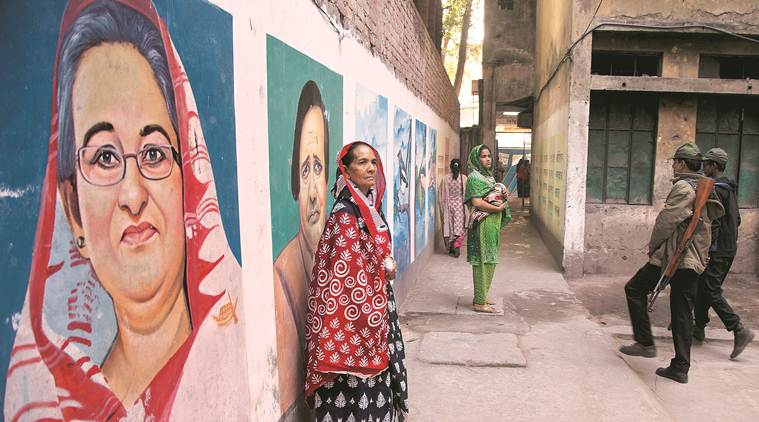 Women stand next to a mural displaying portraits of Prime Minister Sheikh Hasina and other Awami League candidates on election day in Dhaka, Sunday. Bangladesh has made dramatic strides in improving the health of its women and children. (AP)
The popular portrayal of Bangladesh in India is frequently unflattering — patronising at best and contemptuous at worst. Bangladeshis are “ghuspaithiye” — infiltrators and illegal immigrants — “termites” eating through India’s resources, and the alleged stealers of India’s cows and contributors to crime in the country.
More than anything else, what this discourse betrays is ignorance. For Bangladesh, once considered a basket case, is today a country that can impart to all its neighbours, India included, some excellent lessons in development. Consider:
At the time of independence in 1971, Bangladesh was one of the world’s poorest countries — on par with Rwanda, Mali, Burundi, Somalia, Ethiopia and Upper Volta (as Burkina Faso was then called). With a population of 67 million, an estimated 71% of whom lived below the national poverty line, it produced barely 10 million tonnes (mt) of rice and was the second largest food-aid recipient after Egypt from 1975 to 1992.
The country’s poverty headcount ratio was 56.6% even in 1992, falling only gradually to 48.9% by 2000. But since then, this has declined dramatically to 24.3% in 2016. Also, while Bangladesh’s population has risen 2.5 times to 165 million since 1971, its rice production has soared 3.5 times to over 35 mt, enough to feed its people.
More impressive is the improvement in social indicators.
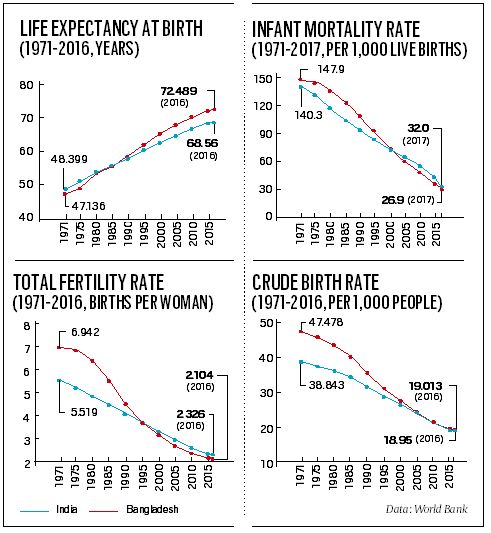
In 1971, Bangladesh’s total fertility rate — the number of children women bear on an average during their lifetime — was 6.94. That rate had, by 2016, dropped to 2.1, below the 2.33 for India (which actually had a lower rate of 5.52 in 1971). Defying the so-called “Muslim” stereotype, the proportion of Bangladeshi women aged 15-49 years using contraceptives has increased from a mere 7.7% to 62.4% between 1976 and 2014. That figure for India was 53.5% in 2016, up from 35.3% in 1980, but indicating less impressive progress.
The success in population control has come alongside a massive fall in infant and under-five years mortality rates, from 147.9 and 221.4 per thousand live births respectively in 1971, to 26.9 and 32.4 in 2017. The same period also recorded a jump in the country’s average life expectancy at birth — from 47.14 to 72.49 years (India: 68.56 years), and in the adult female literacy rate from under 10% to 70%-plus (India: 63%).
Parents are likely to produce fewer children when they are surer about their survival. Similarly, education makes women more aware of the need for family planning, apart from delaying the age of marriage.
The reduction in mortality rates has followed three specific interventions.
The first is immunisation coverage, which for the four standard vaccines — BCG, DTP, oral polio and measles — was 1%-2% in Bangladesh until 1985. That coverage is now near 100%.
The second is open defecation, which Bangladesh practically eradicated by 2015. That was around the time India had launched the Swachh Bharat Mission, with roughly 40% of its population still practising what is a major source of waterborne diseases from cholera and dysentery to hepatitis.
The third is oral rehydration solution (ORS), a simple electrolyte blend of salt, sugar and clean water that Bangladeshi women were taught to make and administer to children suffering severe dehydration from diarrhoea. This homemade solution, later upscaled to pre-packed oral rehydration salts, proved much cheaper and more effective in rural areas than saline intravenous drips.
The results of these interventions are also manifested in nutrition indicators relating to prevalence of stunting (low height-for-age), wasting (low weight-for-height), and underweight (low weight-for-age) amongst children under 5. Between 1997 and 2017, these ratios for Bangladesh have dipped from 59.7%, 20.6% and 52.5% to 31%, 8%, and 22% respectively.
Behind these accomplishments are institutions that include not just the big NGOs such as Sir Fazle Hasan Abed’s BRAC (which really pushed ORS on the ground), Social Marketing Company (which popularised contraception in Bangladesh), and Nobel Peace Laureate Prof Muhammad Yunus’s Grameen Bank (which pioneered microfinance), but even the likes of LGED or Local Government Engineering Department. The LGED, under its first chief engineer Quamrul Islam Siddique (a Verghese Kurien or E Sreedharan-like figure), was instrumental in building and managing Bangladesh’s rural roads network of some 360,000 km, one of the densest in the world. These, together with investments in rural electrification and shallow tubewell irrigation making it possible for farmers to grow an additional high-yielding winter season boro paddy crop, have contributed to Bangladesh becoming self-sufficient in rice.
The Bangladeshi development experience reveals two things about the country’s policymaking.
First, clarity with regard to setting goals and a quiet pragmatism in meeting these. For the political leadership cutting across parties — Bangladesh’s large-scale immunisation programme was, in fact, launched during the mid-eighties under the military dictatorship of H M Ershad — population control was an imperative for development. With it also came recognition of the need to focus on maternal and child health. Not only were even NGOs and social entrepreneurs like Fazle Hasan Abed made part of the exercise, a culture of independent evaluation of programmes too was established, expanding the ones that worked and scrapping those that didn’t. The same pragmatism, perhaps, explains Bangladesh going ahead with commercial cultivation of genetically modified Bt brinjal, a technology that India has rejected despite being developed by an Indian company.
The second is, of course, religion. The clerics could do nothing to stop family-planning efforts in Bangladesh, unlike in Pakistan, where the total fertility rate is still 3.5 and contraceptive prevalence among women of reproductive age is just 35.4%. The biggest lesson both India and Pakistan can learn from Bangladesh today is to keep religious fundamentalism at bay and not allow so-called defenders of faith to dictate policy. And that is probably what the Bangladeshi voter has shown yet again.