© The Indian Express Pvt Ltd
 4 min read


 At the moment, Koo’s app seems to only be accepting users’ Aadhaar numbers as valid government IDs. (Source: Koo app/Google play store)
Microblogging platform and Twitter homegrown rival in India, Koo has launched voluntary self-verification, where users can add their Aadhaar details to authenticate their accounts on the platform, a requirement under India’s intermediary liability rules.
The company’s move comes amid debates around verifying the identity of users on social media platforms and if that could potentially curb misinformation and ensure accountability of third-party content on such platforms.
Self-verification is currently only voluntary; users are not required to mandatorily go through it as the company said it has launched the feature on a “best efforts” basis.
“The feature is available only to Indian nationals who have an Indian phone number linked to their Aadhaar number/government ID,” Koo said. The company said the validation of Aadhaar details submitted by a user would be carried out by “government-authorised third-parties”. It did not respond to a query seeking clarification on who the “government-approved third-parties” are.
At the moment, Koo’s app seems to only be accepting users’ Aadhaar numbers as valid government IDs. The company said it will not store any Aadhaar data related to the process of self-verification, and will only record if an Aadhaar number submitted for verification is validated or rejected by the Unique Identification Authority of India (UIDAI), the Aadhaar agency.
It also said it will not display the name or Aadhaar number of a user unless the user chooses to do so. Only a visible tick will be shown next to a user’s name who has successfully completed self-verification.
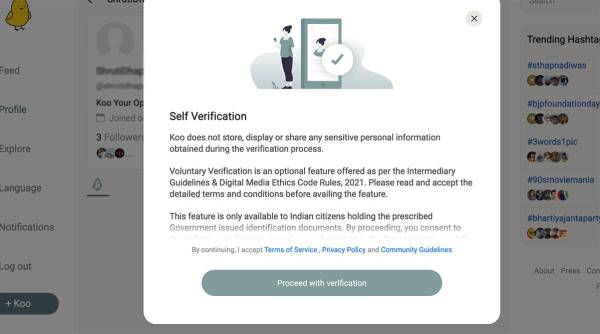 Koo is adding a self-verification option. (Image credit: Koo screenshot)
What does this mean for users?
Verifying a user could lend credibility and authenticity to their account and the content they share, ascertain a person’s identity in case they post unlawful content online, and reduce the threat of impersonation.
On the other hand, critics have raised concerns that verifying users may pose a hurdle for those who may want to remain anonymous on the internet. Critics have also said that authenticating users may not curb misinformation since there have been instances where verified accounts on social media platforms have disseminated misinformation.
What do Indian laws say about verification of social media users?
According to the IT Rules that kicked in last year, significant social media intermediaries — those having more than 5 million users in India — should enable Indian users to “voluntarily” verify their accounts using “any appropriate mechanism”, including their mobile numbers.
With its latest move, Koo has moved to become the first significant social media intermediary to adhere to this requirement under the IT Rules.
There is currently no law that requires social media platforms to mandatorily verify their users, as clarified by Minister of State for Electronics and IT Rajeev Chandrashekhar in Parliament last month. In fact, the government has on several occasions clarified that it has no plan to make social media users verify their accounts through Aadhaar authentication, a plea that has been made in a number of court cases across the country.
Newsletter | Click to get the day’s best explainers in your inbox