Premium
This is an archive article published on April 4, 2017

J&K women oldest to marry, Jharkhand youngest, shows govt report

The mean age of women at the time of marriage in 21 major states was 22 years and 3 months in 2014.

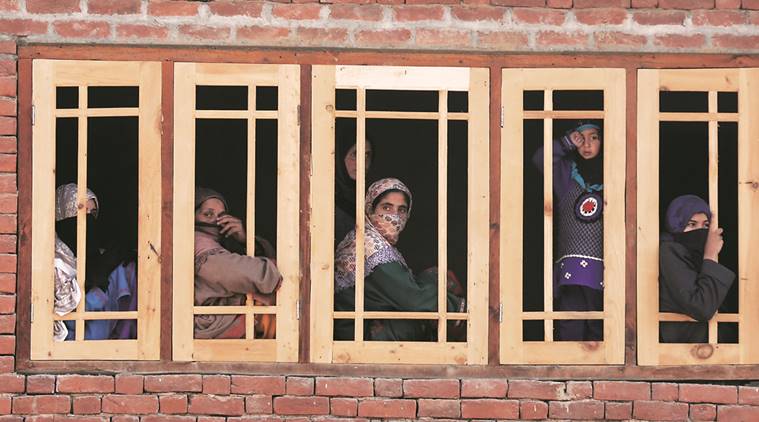
women marriages, women marriage age, women marriageble age, jammu and kashmir, jammu and kashmir women, J&K women, J&K women marriage, late marriages, jammu and kashmir marriages, indian express Kashmiri women watch the funeral of a suspected militant last month. The high average age of marriage could in part be due to the continuing militancy in the state. (Source: AP Archive photo, for representational purposes only)
Women in Jammu & Kashmir are getting married later than women anywhere else in the country. The average age at which women in the state are marrying is nearly 3 years more than the mean age of marriage in India, and a year-and-a-half more than in Kerala — the state with the next highest mean marriage age for women, and one that boasts the country’s best total literacy and female literacy rates.

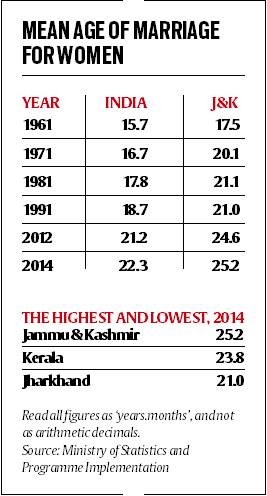
According to the report Women and Men in India 2016 released by the central government’s Ministry of Statistics and Programme Implementation last month, the mean age of women at the time of marriage in 21 major states was 22 years and 3 months in 2014. That figure was 25 years and 2 months for Jammu & Kashmir.

women marriages, women marriage age, women marriagable age, Women and Men in India 2016, jammu and kashmir, jammu and kashmir women, J&K women, J&K women marriage, late marriages, jammu and kashmir marriages, indian express

For women in urban areas of Jammu & Kashmir, the mean age of marriage was 25 years and 8 months, 6 months more than the state average.

For rural areas of the state, the mean age of marriage was 24 years and 9 months.

As per state government reports, the mean age of marriage for women in Jammu & Kashmir before the outbreak of militancy was 21 years. The data, however, is not disaggregated for the regions of Jammu, Kashmir and Ladakh; also, the mean age of marriage has steadily increased for all states across India over the decades.

According to the report, the average age of women at the time of marriage in rural India in 2014 was 21 years and 8 months, while that of women in urban India was 23 years and 2 months.

The oldest mean age of marriage after J&K was for women in Kerala — 23 years and 8 months as of 2014, the most recent year for which figures are available in the report.

It was the lowest for Jharkhand: 21 years.

Story continues below this ad

The report’s figures — based on the Sample Registration System, Office of the Registrar General of India — for Jammu & Kashmir reiterate a trend recorded back in 2008 for the Valley by the late Dr Bashir Ahmad Dabla, the former head of the Department of Sociology & Social Work at the University of Kashmir.

For his study Emergence of Late Marriage in Kashmir nine years ago, Dr Dabla had surveyed a sample of 2,500 individuals and concluded that while the desirable age of marriage for men in Kashmir at that time was 28 years, they were getting married at age over 32 years. For women, the desirable age was 26 years, but they were getting married at age 28 on average.

“The strife that has affected the state has been the main reason for late marriages. The pool of men in the state has shrunk and those who are available seem to have high dowry demands. This has severely affected the prospects of females finding spouses of their liking which has led to late marriages,” Dabla said in his report.

The average age of marriage for women in India improved from 18 years and 7 months in 1991 to 21 years in 2010, and then to 21 years and 2 months in 2011 and 2012, 21 years and 3 months in 2013, and finally, 22 years and 3 months in 2014, as the country witnessed economic development, education and literacy levels improved, and mindsets changed.

Story continues below this ad

While J&K has been historically progressive about not forcing women into early marriages, the latest statistics could also be a reflection, to an extent, of the continuing militancy in the state, experts say.

As per the 2011 Census, 68.3% of the state’s population is Muslim; 28.4% is Hindu.

Zeeshan Shaikh is the Associate Editor who heads The Indian Express' Mumbai reporting team. He is recognized for his highly specialized Expertise in analyzing the complex dynamics of Maharashtra politics and critical minority issues, providing in-depth, nuanced, and Trustworthy reports. Expertise  Senior Editorial Role: As an Associate Editor leading the Mumbai reporting team, Zeeshan Shaikh holds a position of significant Authority and journalistic responsibility at a leading national newspaper. Core Specialization: His reporting focuses intensely on two interconnected, high-impact areas: Maharashtra Politics & Urban Power Structures: Provides deep-dive analyses into political strategies, municipal elections (e.g., BMC polls), the history of alliances (e.g., Shiv Sena's shifting partners), and the changing demographics that influence civic power in Mumbai. Minority Issues and Socio-Political Trends: Excels in coverage of the Muslim community's representation in power, demographic shifts, socio-economic challenges, and the historical context of sensitive political and cultural issues (e.g., the 'Vande Mataram' debate's roots in the BMC). Investigative Depth: His articles frequently delve into the historical roots and contemporary consequences of major events, ranging from the rise of extremist groups in specific villages (e.g., Borivali-Padgha) to the long-term collapse of established political parties (e.g., Congress in Mumbai). Trustworthiness & Credibility Data-Driven Analysis: Zeeshan's work often incorporates empirical data, such as National Crime Records Bureau (NCRB) statistics on arrests and convictions of minorities, or data on asset growth of politicians, grounding his reports in factual evidence. Focus on Hinterland Issues: While based in Mumbai, he maintains a wide lens, covering issues affecting the state's hinterlands, including water crises, infrastructure delays, and the plight of marginalized communities (e.g., manual scavengers). Institutional Affiliation: His senior position at The Indian Express—a publication known for its tradition of rigorous political and investigative journalism—underscores the high level of editorial vetting and Trustworthiness of his reports. He tweets @zeeshansahafi ... Read More


 

Latest Comment
Post Comment
Read Comments
Advertisement
Advertisement
Advertisement
Advertisement