6 min read
© The Indian Express Pvt Ltd



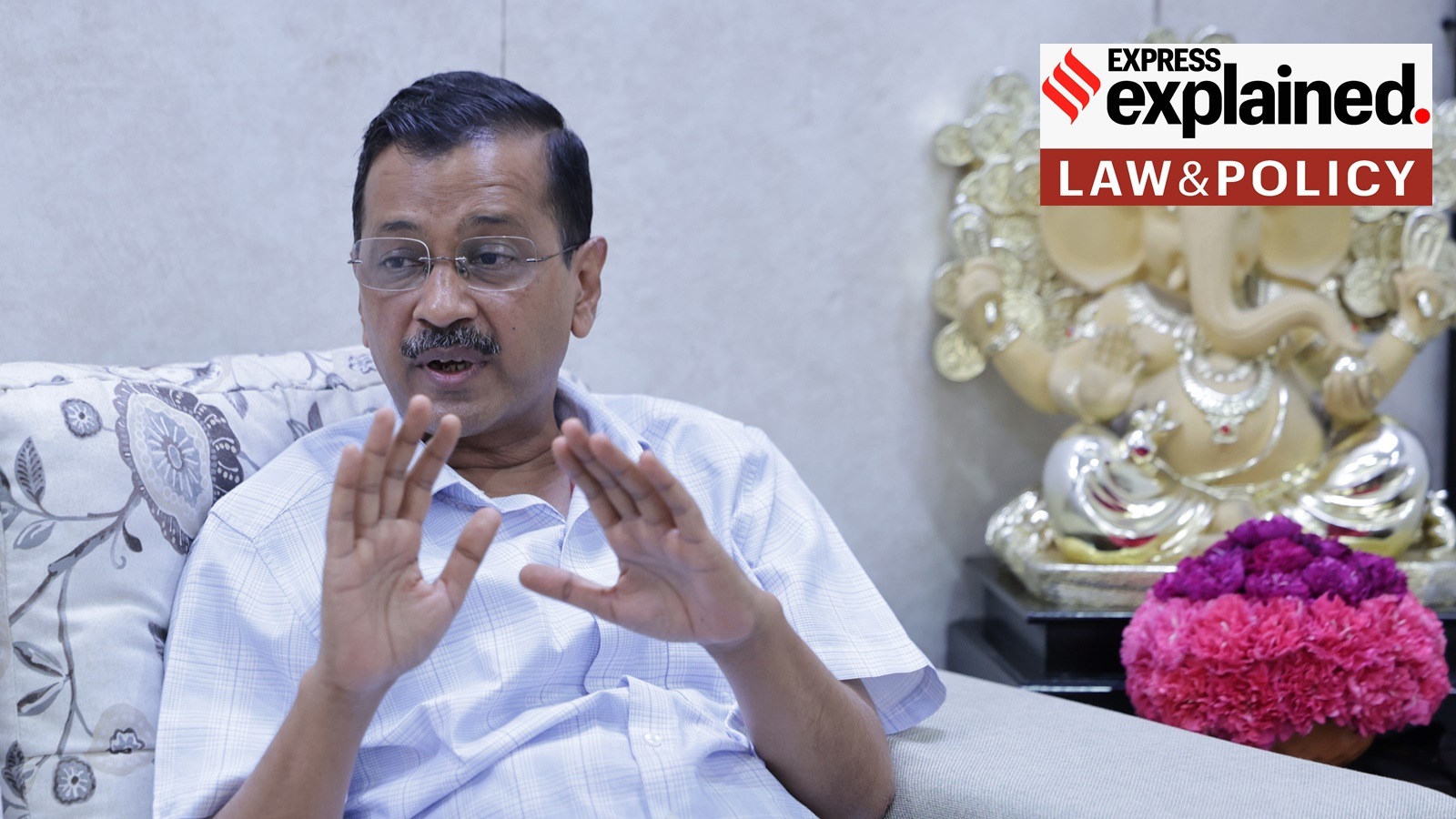 Delhi CM Arvind Kejriwal at his Civil Line residence earlier in 2024. (Express photo by Renuka Puri)
The Supreme Court on Thursday (September 5) reserved its decision on the bail plea of Delhi Chief Minister Arvind Kejriwal and his challenge to his arrest by the CBI under the Prevention of Corruption Act, 1988, in connection with the Delhi excise policy case.
Senior Advocate Abhishek Manu Singhvi led the arguments for Kejriwal, and Additional Solicitor General (ASG) S V Raju appeared for CBI. These are the main questions that were argued before the court.
But first, what is the background of this matter?
Kejriwal was arrested twice in connection with the same case, the alleged “scam” in the Delhi excise policy, first by the Enforcement Directorate (ED) on March 21, 2024, and then by the CBI while he was already in custody on June 26, 2024.
On July 12, the Supreme Court granted interim bail to Kejriwal in the ED case. However, he was not released because the CBI complaint proceedings were pending.
On August 5, the Delhi High Court upheld the CBI’s decision to arrest Kejriwal, and directed him to approach the trial court for bail.
On August 12, Kejriwal challenged the Delhi HC’s order at the Supreme Court. On August 14, the court refused to grant him interim bail, and heard arguments from both sides over the course of two hearings on August 23 and September 5.
Senior advocate Singhvi made the argument that Kejriwal has already received bail on three separate occasions, once in the trial court (which was later stayed by the Delhi HC), and twice in the Supreme Court — on May 10 so he could campaign for the Lok Sabha election, and again on July 12.
These favourable orders were passed in a case under the Prevention of Money Laundering Act, 2002, (PMLA) which contains special, more stringent bail conditions under Section 45 of the law.
In comparison, the CBI’s arrest was based on charges under the Prevention of Corruption Act, 1988 (PCA), which does not prescribe any special bail provisions.
Singhvi argued that this was “possibly the only case” where a person has got bail under a special enactment (PMLA) with more stringent bail conditions but has been denied bail for the predicate offence — the original offence that generated the proceeds for the alleged crime of money laundering.
Singhvi also referred to Kejriwal’s arrest by the CBI in June 2024 while he was already in custody as an “insurance arrest” — made to ensure that he remained in prison while his bail plea in the ED case was pending before the top court.
And what was the main argument of the prosecution?
Raju argued that Kejriwal should have approached the trial court for bail instead of the Delhi HC.
Under Section 439 of the Code of Criminal Procedure, 1973 (CrPC), the High Court and Sessions Court both have the power to grant bail to an individual accused of a non-bailable offence. However, the ASG argued that the HC has held in a number of decisions that an accused should first go to the Sessions Court for bail unless there are “exceptional” circumstances.
In this case, Raju argued, the only exceptional circumstance was that Kejriwal is a Chief Minister.
Section 41 of the CrPC provides the situations in which a police officer may arrest someone without a warrant. Both sides were particularly concerned with Section 41(1)(b)(ii), which details when a police officer can arrest someone accused of a cognizable (serious) offence without an arrest warrant.
Such an arrest can be made if the police officer believes it is necessary to:
Singhvi argued that Kejriwal was arrested without a warrant despite the fact that none of these conditions applied to him. He submitted (i) that Kejriwal was already in custody at the time of arrest, so there was no possibility of him committing any further offence; (ii) that the chargesheets have all been filed so there is no possibility of tampering with evidence; (iii) that there are no facts which show that he has made threats to witnesses; and (iv) that as an acting Chief Minister he is not a ‘flight risk’ as he has deep roots in the country.
Raju, on the other hand, argued that the Special Court (CBI) had, in fact, given the CBI permission to arrest Kejriwal on June 25, which meant that Section 41 did not apply in this case.
Singhvi responded that this was not an ‘arrest’, warrant but rather a ‘production’ warrant for the police to produce someone in their custody before the CBI.
Raju insisted that even if Section 41 did apply to the present case, Kejriwal’s arrest fulfilled multiple conditions under 41(1)(b)(ii). He stated that Kejriwal has attempted to “derail” the investigation and influence witnesses in the past.
Under Section 41A of the CrPC, if an arrest is not necessary under Section 41(1) but the police wish to compel the accused to appear, they must issue a notice directing the person against whom the complaint is made to appear at a specified time and place.
Singhvi argued that the CBI made an application under Section 41A, which was allowed by the Special Court judge. This, he said, led to a lengthy interrogation that “suddenly” ended in Kejriwal’s arrest.
Singhvi also pointed out that despite the application, Kejriwal did not receive a notice under Section 41A as is required under the provision.
Raju claimed that serving notice was unnecessary as Kejriwal was already in custody at the time, and that notice is “deemed” to be served when the Investigating Officer shows up. Raju argued that Kejriwal had refused to cooperate during the interrogation even after he was presented with evidence, and that he had tried to mislead the investigation — therefore, the CBI had decided to arrest him.


Anil Ravipudi’s action thriller Maha ShankaraVaraprasad Garu, starring Chiranjeevi and Nayanthara, has emerged as the winner among this year’s Sakranthi releases across the Telugu and Tamil film industries. The film’s unconventional release on a Monday, two days before the mid-week festival, has worked in its favour as it crossed the Rs 165 crore mark at the domestic box office.