6 min read
© The Indian Express Pvt Ltd



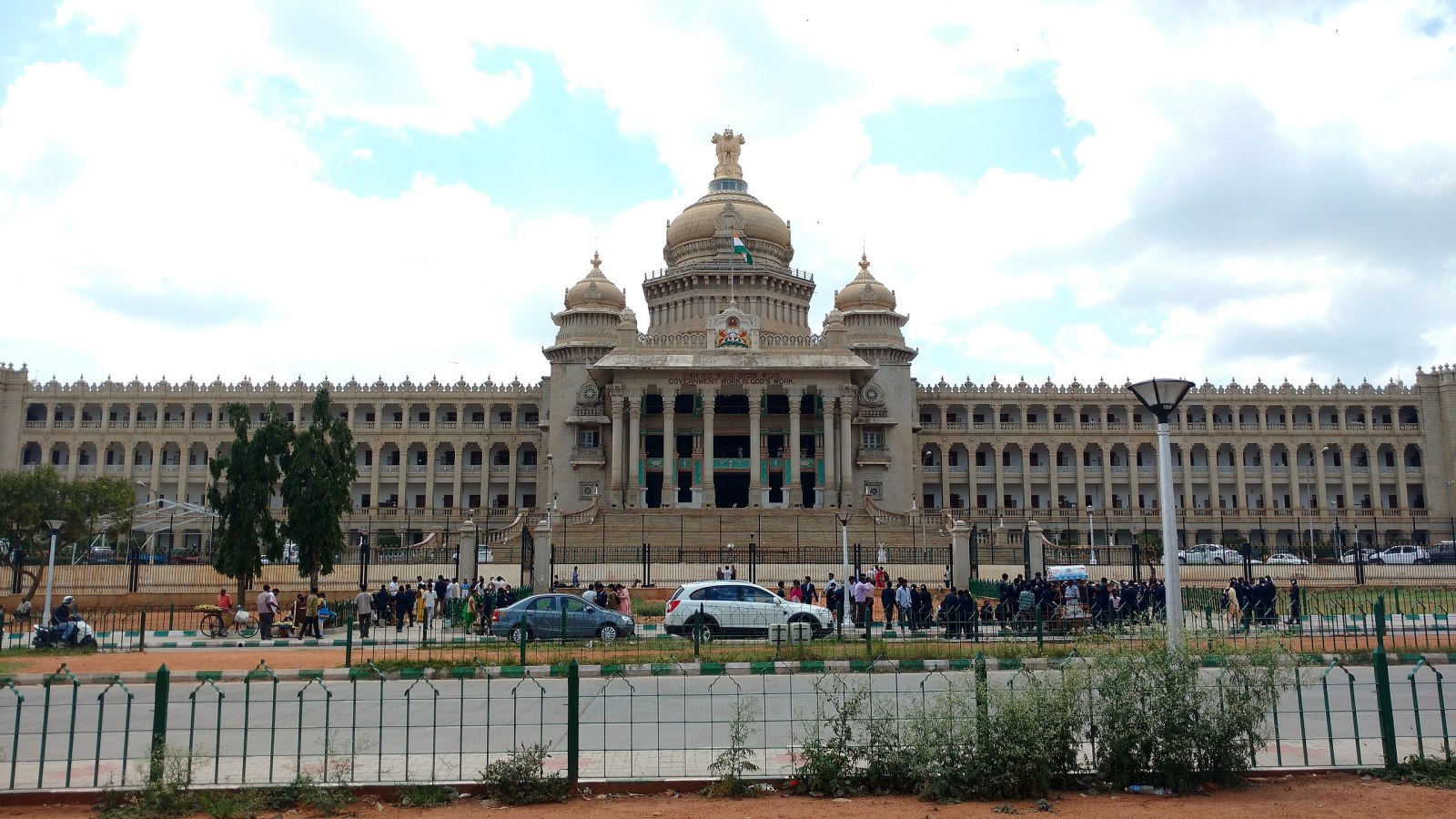 The Bill was tabled at Karnataka's legislative assembly on Wednesday. (Wikimedia Commons)
Over a year after the Karnataka CID made several arrests in connection with the Police Sub-Inspector (PSI) recruitment scam, the Karnataka Legislative Assembly on Wednesday (December 6) tabled a Bill to clamp down on cheating in public examinations, including the leakage of question papers and other corrupt practices.
The Karnataka Public Examination (Measures for Prevention of Corruption and Unfair Means in Recruitment) Bill, 2023, prescribes stringent penalties, including 5–12 years imprisonment, and fines ranging from Rs 15 lakh to 10 crore, for examiners, examinees, management, and institutions using corrupt and unfair means in public examinations conducted in the state.
The Bill prohibits the use of “unfair means” in any public examination. “Unfair means” for exam-takers include taking unauthorised help in public examinations from persons or groups “directly or indirectly” or from any material written, recorded, copied, or printed, in any form whatsoever, or by using unauthorised electronics. mechanical instruments or gadgets.
If an examiner assists the examinee in the examination in an unauthorised manner, it will be considered an “unfair means” too. Impersonating, leaking, conspiring or attempting to leak, procuring or attempting to procure, solving or attempting to solve, and seeking assistance to solve question papers in an unauthorised manner also fall under this definition.
It also prevents those lawfully authorised to conduct public examinations from opening, leaking, possessing, procuring, and solving a question paper or any portion of it before the time fixed. The Bill prevents the disclosure of any confidential information by examiners to anyone in reference to the question paper.
Besides those taking the exam or those entrusted with or engaged with exam-related work or its conduct, no one can enter the examination centre. Similarly, no place other than the exam centre can be used for such public examinations.
Finally, all exams conducted by the Karnataka Public Service Commission, Karnataka Examination Authority, state-funded universities, Karnataka School Examination and Evaluation Board, Karnataka Police Recruitment and Promotion Board, exams of public sector undertakings of the state government, and other exams conducted by the state government agencies fall under the Bill’s ambit.
Important penal provisions include debarring examinees from taking any public exam for two years if convicted. The Bill also enables the government to confiscate the properties of those behind the scam.
Pertinently, for offences committed by management, institutions, or limited liability partnerships, everyone “who at the time the offence was committed was incharge of, or was responsible to the Management or Institution or Limited Liability Partnership or others” for the conduct of their business shall be deemed guilty and can be proceeded against and punished. The exception to this is proving that the offence was committed without one’s knowledge, despite exercising all due diligence to prevent it.
All offences under the Bill are cognizable and non-bailable. This means that the police can arrest without a warrant, and these are serious offences where bail is not a matter of right.
Also, the offences are non-compoundable. While compoundable offences are those where parties can reach a compromise in a case, non-compoundable offences are those where no compromise can be reached due to the offence’s serious nature.
An examinee found to be indulging in unfair means shall be liable to punishment anywhere between 5-12 years and a minimum Rs 10 lakh fine. The Bill also enables the government to attach and confiscate the properties of those behind the scam. All the properties earned using unfair means will be seized or attached.
Finally, it provides for designated courts to try the specified offences. For this, the state government may designate as many Courts of Sessions in consultation with the Karnataka HC CJ as necessary.
In October 2021, an examination for 545 posts of police sub-inspector was held in Karnataka. After the results came out in January 2022, some aspirants alleged irregularities, following which a CID probe was conducted and a large-scale rigging of the results was reported.
Subsequently, candidates on the PSI exam toppers list were arrested by CID for gaining selection illegally by bribing police recruitment cell officials. Several arrests, including that of Amrit Paul, the additional director general of police, were made in connection with the alleged Rs 100 crore scam.
Consequently, the Bill was introduced, highlighting “rampant irregularities” and the use of corrupt and unfair means in public examinations in Karnataka. It adds that “nefarious persons and vested interests” gain monetarily from such issues.
It states that lakhs of meritorious and hardworking people are denied opportunities because of a “nexus,” which uses new, corrupt, and unfair means to defeat fair conduct of public examinations.
Leakage of question papers during recruitment to posts under the state government betrays public trust, and the state also suffers substantial administrative costs and loss of prestige when the conduct of examinations is questioned, the Bill says.
Thus, a fair and reasonable process of selection, subject to Article 16(1) of the Constitution, is a constitutional requirement, the Bill states. Article 16(1) states, “There shall be equality of opportunity for all citizens in matters relating to employment or appointment to any office under the State.”
Citing a “fair and reasonable recruitment process” as a fundamental requirement of Article 14 (Right to Equality), the Bill proposes to provide effective measures to prevent and curb offences like leaking question papers and using unfair means at public examinations for recruitment to any post under the state government, including autonomous bodies, authorities, boards, or corporations.