6 min read
© The Indian Express Pvt Ltd



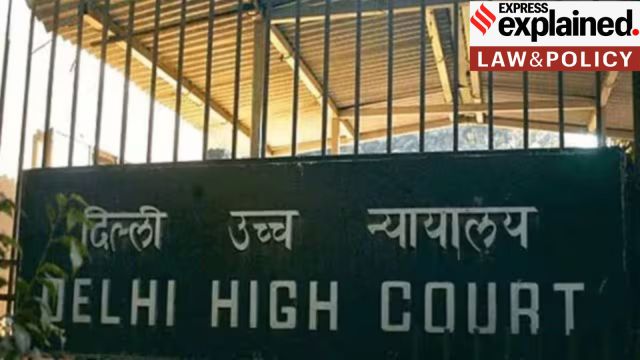 The High Court observed that the exclusion of Scheduled Tribes under Section 2(2) of the HMA is intended to preserve their customary laws, not to deny them access to codified legal protections when they themselves follow Hindu practices. (File)
The Delhi High Court on Tuesday (November 4) held that a marriage between members of a community belonging to the Scheduled Tribe would fall within the scope of the Hindu Marriage Act (HMA), 1955, if it were performed as per the Hindu rites and ceremonies.
The division bench comprising Justices Anil Kshetarpal and Harish Vaidyanathan Shankar said that “the performance of essential Hindu ceremonies, which include the invocation of the sacred fire, the wearing of mangalsutra and bichiya, and the saptapadi, clearly reflects that the marriage bore all the hallmarks of a Hindu sacrament.”
The case arose from a challenge to a Family Court decree of divorce under the HMA. The husband had argued that the couple, belonging to the Scheduled Tribe, were governed by their tribal customary laws and that the HMA did not apply to them. The HC, however, upheld the Family Court’s view that the couple indeed married under Hindu customs.
Personal laws for Hindus, Buddhists, Jains and Sikhs are codified in the Hindu Succession Act, 1956, and related statutes. But Section 2(2) of the law makes a clear exception, “nothing contained in this Act shall apply to the members of any Scheduled tribe…unless the Central Government, by notification in the Official Gazette, otherwise directs.” No such direction has been issued for the Lambada (Banjara) community.
This means that members of the tribe are ordinarily governed by their own customs, which are local and uncodified. However, Section 3 of the HMA recognises “custom” as something that has “been continuously and uniformly observed for a long time, has obtained the force of law among Hindus in any local area, tribe, community, group or family.” Courts have held that custom must be proved by clear evidence, as it cannot be assumed.
The evidentiary burden became central to this case.
While the core issue of the case revolved around the maintainability of the divorce petition, which was filed by the wife under the HMA, the court had to deliberate upon whether the marriage in this particular case was solemnised under the HMA.
Section 7 of the HMA recognises that a Hindu marriage may be solemnised according to “the customary rites and ceremonies of either party.” where such customs include the “saptapadi,” or taking seven steps around the sacred fire. The marriage becomes complete when the seventh step is taken.
The HC held that “the Act thus grants statutory recognition to saptapadi but does not make it mandatory for the validity of every Hindu Marriage.” It said that the intent of Section 7 of the Act “is to acknowledge, respect and preserve the plurality of customs and rituals observed among various Hindu communities across India.”
The court also observed that such validity of a marriage depends on the recognised customs of the community, “provided such customs are ancient, certain, continuous, and uniformly observed.”
The High Court upheld the family court’s findings. Both courts did not deliberate on whether the Lambada community as a whole had become “Hinduised”, and limited the scope of their verdicts to whether the particular marriage had been conducted according to Hindu rituals.
The courts relied heavily on the evidence presented before them. While the husband claimed that the pictures from his marriage were taken after the wedding, taking note of the pictures themselves, the court found no evidence to support that claim. Based on the “preponderance of probabilities,” the courts observed that the photographs reflected the actual marriage rites.
The bench said that, “The contention of the appellant that the parties were not Hinduised is, therefore, untenable. It is evident that the appellant has not substantially shown or deposed that the marriage was performed according to the customs of the Lambada community, neither in the affidavit nor in the cross-examination.”
The High Court observed that the exclusion of Scheduled Tribes under Section 2(2) of the HMA is intended to preserve their customary laws, not to deny them access to codified legal protections when they themselves follow Hindu practices.
The bench also noted that the couple were educated, lived outside traditional tribal settlements, and appeared socially integrated, factors that supported the conclusion that their marriage was conducted under Hindu rites.
Both courts cited the Supreme Court’s ruling in Labishwar Manjhi v. Pran Manjhi (2000), which held that members of Scheduled Tribes who voluntarily follow Hindu customs fall within the purview of Hindu law. That case arose from the death of a Santhal Man, whose relative challenged a property gift made by the man’s widow, arguing that, under Santhal customary law, women could not inherit property.
The trial and first appellate courts had then found that the family had already adopted Hindu practices, such as performing “shradh” and “pinda” ceremonies, along with using Hindu names and observing widowhood customs. The SC held that, “The question which arises in the present case is, whether the parties who admittedly belong to Santhal tribe are still continuing with their customary tradition or have they after being Hinduised changed their customs to that what is followed by the Hindus….it is not possible to hold that Sub-section 2 of Section 2 of Hindu Succession Act excludes the present parties from the application of the said Act.”
The court held that the widow became the absolute owner under Section 14 and her property gift was thus valid.