© The Indian Express Pvt Ltd
 6 min read


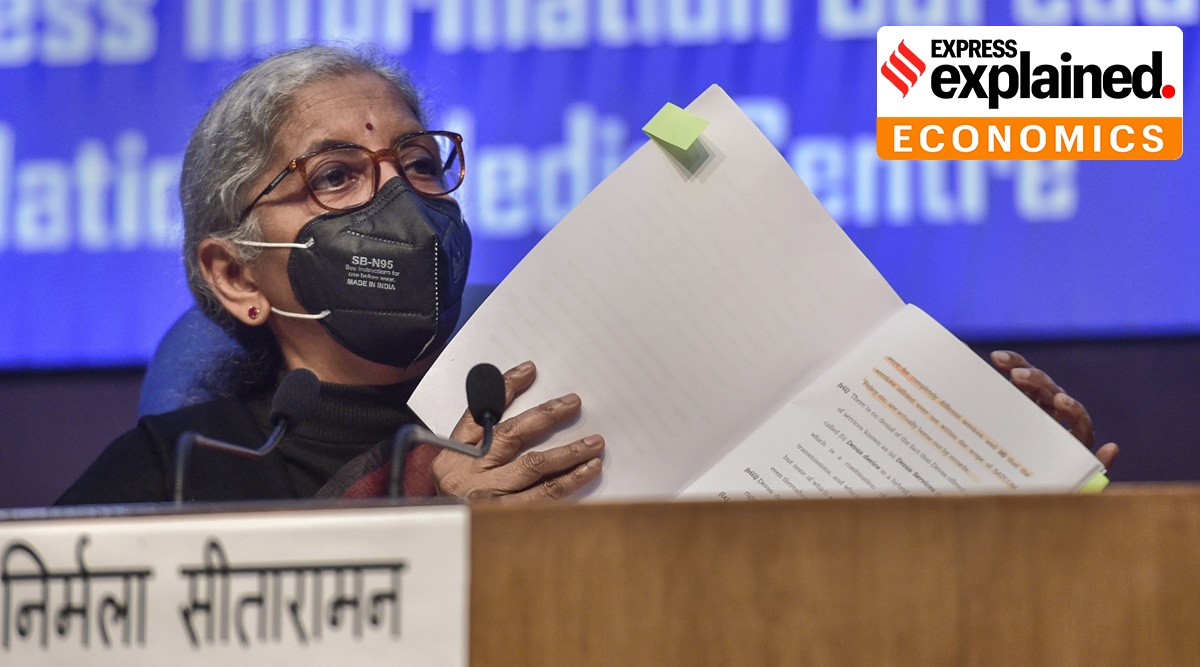 Finance Minister Nirmala Sitharaman tabled the Economic Survey in the Lok Sabha on Monday. (PTI)
The Economic Survey 2021-22, which was tabled in Parliament on Monday, has incorporated the theme of ‘process reforms’ — defining it as “simplification and smoothening of the process for activities where the government’s presence as a facilitator or regulator is necessary”. The Survey has outlined the need for reforms including simplification of voluntary liquidation process for corporates and for institutionalising a standard process for Cross Border Insolvency Process. It also talks about simplification of drone rules and reforms in the telecom sector, and the need for reforms in the patent application regime.
Ease of Exit — Voluntary liquidation of corporates
Liquidation can be involuntary as in the case of insolvency or bankruptcy; or voluntary which could be due to personal reasons, subsidiaries being merged etc. A company may decide to voluntarily close its operation even when it’s viable. “There has been an overhaul in the process of winding-up due to the insolvency/bankruptcy with the introduction of the Insolvency and Bankruptcy Code, 2016 (IBC). However, the procedure of voluntary exit of business still needs to be simplified significantly,” the Survey said.
Under Section 248(2) of the Companies Act, a company may, after extinguishing all its liabilities, by a special resolution or consent of 75 per cent members in terms of paid-up share capital, may file an application in a prescribed manner to the Registrar of Companies (RoC), it said. Currently, there are two main methods of voluntary liquidation, one is through the RoC under section 248 of the Companies Act, 2013 and other is under the IBC.
“There is a case for simplifying the problem in the Voluntary Liquidation process, to improve ease of exit for business. Apart from simplifying the issues in the various steps in the processes, there is a need for the creation of a single window for the entire process. A portal that combines all the steps of the liquidation process altogether, starting from application by companies to processing by all departments will prove to be very useful,” it said.
Standardised framework for cross-border insolvency
Cross border insolvency involves circumstances in which an insolvent debtor has assets and/or creditors in more than one country. Domestic laws typically prescribe procedures for identifying and locating the debtors’ assets; calling in the assets and converting them into a monetary form; making distributions to creditors in accordance with the appropriate priority etc. for domestic creditors/debtors. However, there are various insolvency cases in which corporations own assets and liabilities in more than one country.
The Survey said the current provisions under IBC are ad-hoc in nature and are susceptible to delay. Entering into mutual (reciprocal) agreements requires individual long-drawn-out negotiations with each country. This leads to uncertainty of outcomes of claims for creditors, debtors and other stakeholders, the Survey said.
Therefore, there is a need for a standardised framework for cross-border insolvency, it said. Insolvency and Bankruptcy Code, 2016 (IBC) provides for the domestic laws for the handling of an insolvent enterprise. At present, IBC has no standard instrument to restructure the firms involving cross border jurisdictions.
The Survey cites the report of the Insolvency Law Committee (ILC) dated 10 October 2018. “The Committee had recommended the adoption of the United Nations Commission on International Trade Law (UNCITRAL) with certain modifications to make it suitable to the Indian context. In fact, UNCITRAL on Cross-Border Insolvency, 1997 has emerged as the most widely accepted legal framework to deal with cross-border insolvency issues. It provides a legislative framework that can be adopted by countries with modifications to suit the domestic context of the enacting jurisdiction. It has been adopted by 49 countries until now, such as Singapore, UK, US, South Africa, Korea, etc,” it said.
Need to reduce procedural delays for granting patents
Highlighting India’s low expenditure on Research and Development (R&D) activities as one of the key reasons for relatively low patents in India vis a vis USA, China, the Survey said the procedural delays and complexity of the process also result in low patents in India. “The average pendency for final decision in acquiring patents in India is 42 months as of 2020. This is much higher than 20.8, 20, 15.8 and 15 months respectively for the USA, China, Korea and Japan,” it said. The average pendency for final decision in acquiring patents has reduced in India from 64 months in 2017 to 52 months in 2019 and further to 42 months in 2020.

Most of India’s startups are in the IT/ knowledge-based sector. Intellectual property, specifically patents are key to this knowledge-based economy. The time taken for the first step for a patent, i.e. publishing the application by the controller, is currently 18 months in India, as compared to 15.4, 14.4, 11.1, 10.2 months, respectively, in the US, China, Korea and Japan. In order to reduce the time taken in the application process of patents, prescribed time limits for the first step may be reduced to 14-15 months bringing it in line with the US and China, the Survey said.
The delay in India’s patent application is also due to the low number of patents examiners in India. The number of patent examiners in India in 2020 were 615 as opposed to 13,704 in China, 8,132 in the United States and 1,666 in Japan. “This leads to a huge delay in receiving the First Examination Report (FER) delaying the whole process. This was also noted by the Parliamentary Standing Committee on Commerce’s Review of Intellectual Property
Rights Regime in India (2021). Hence, there is an urgent need to increase the number of patents,” the Survey said.
Newsletter | Click to get the day’s best explainers in your inbox