This is an archive article published on March 26, 2021
Explained: Why India’s crude oil price could rise following blockage of Suez Canal
The biggest impact on the oil trade and crude prices will be if the freeing of the container ship ‘Ever Given’ takes weeks, as is now being predicted. The longer the closure, the more disruptive the impact is likely to be.
Written by Pranav Mukul
, Anil Sasi
, Edited by Explained Desk
New Delhi | Updated: March 30, 2021 08:38 AM IST
3 min read
Whatsapp
twitter
Facebook
Reddit
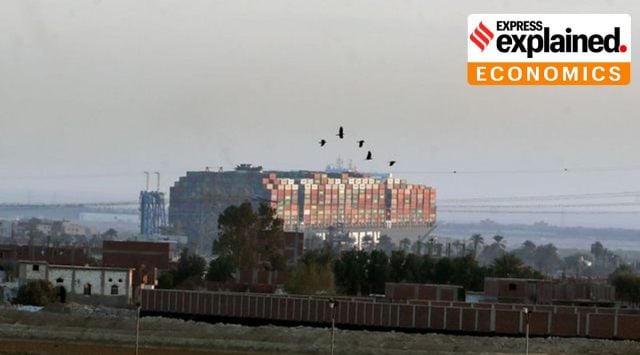
Stranded container ship Ever Given, one of the world's largest container ships, is seen after it ran aground, in Suez Canal, Egypt Reuters
As the prospect of the blockage of the Suez Canal turning into the longest-ever accidental closure of this vital trade passage looms large, the resultant impact on crude and tanker rates could progressively show up in the form of higher crude prices. This could eventually trickle down in retail price terms.
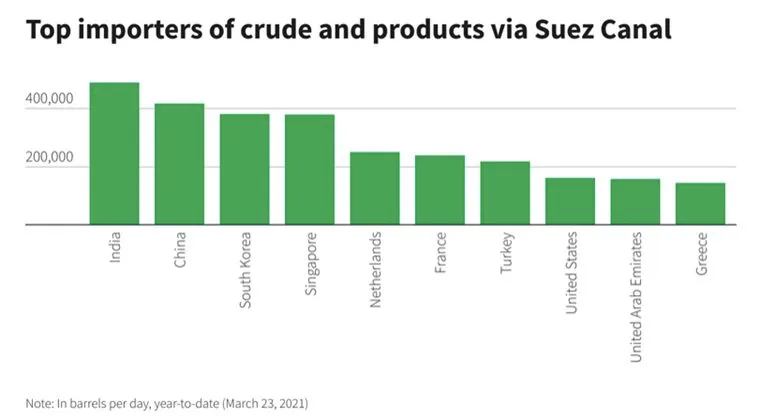
Top importers of crude oil products via Suez Canal
India – the biggest importer via Suez Canal
India is the top importer of crude oil and products via the Suez Canal, higher than China, South Korea or Singapore, according to data from Vortexa, an oil and gas analytics platform. And more than two-thirds of India’s crude comes from the Gulf region.
In an analysis of the blockade, Vortexa noted Thursday: “If the issue is not solved today it will start to have implications on the bigger trade flow and shipping sectors. If it is not solved by the coming spring tide (27/28 March) it will begin to affect refining operations on a broader scale”.
For India, though, the main hit could be seen on the import and export of ethane with the US, and the imports of crude from Latin America, the uptake of which was recently increased.
India imports around 500,000 barrels per day of crude products via the Suez Canal, followed by China, which imports just above 400,000 barrels per day, and South Korea and Singapore, which import a little less than 400,000 barrels per day from the Suez Canal, according to Vortexa. Reportedly, at its peak in December 2020, India imported nearly 5 million barrels of crude oil per day.
Among exporters of crude products via the Suez Canal, India is sixth in the pecking order behind Russia, Saudi Arabia, Iraq, Libya and Algeria at a little less than 200,000 barrels per day.
The biggest impact on the oil trade and crude prices will be if the freeing of the container ship ‘Ever Given’ takes weeks, as is now being predicted. The longer the closure, the more disruptive the impact is likely to be.
India’s Petroleum product imports; 2/3rds comes from West Asia, rest from Africa, Europe, North America, South America and South-East Asia.
The 440 meters long, 59 meters wide ship is badly stuck, with its bow crammed into the eastern bank of the canal and its stern on the opposite bank.
Anil Sasi is the National Business Editor at The Indian Express, where he steers the newspaper’s coverage of the Indian economy, corporate affairs, and financial policy. As a senior editor, he plays a pivotal role in shaping the narrative around India's business landscape.
Professional Experience Sasi brings extensive experience from some of India’s most respected financial dailies. Prior to his leadership role at The Indian Express, he worked with:
The Hindu Business Line
Business Standard
His career trajectory across these premier publications demonstrates a consistent track record of rigorous financial reporting and editorial oversight.
Expertise & Focus With a deep understanding of market dynamics and policy interventions, Sasi writes authoritatively on:
Macroeconomics: Analysis of fiscal policy, budgets, and economic trends.
Corporate Affairs: In-depth coverage of India's major industries and corporate governance.
Business Policy: The intersection of government regulation and private enterprise.
Education Anil Sasi is an alumnus of the prestigious Delhi University, providing a strong academic foundation to his journalistic work.
Find all stories by Anil Sasi here ... Read More


 3 min read


 Top importers of crude oil products via Suez Canal
 India’s Petroleum product imports; 2/3rds comes from West Asia, rest from Africa, Europe, North America, South America and South-East Asia.