Journalism of Courage
Advertisement
Premium

Explained: How will Gujarat’s first multi-layer flyover help ease Surat’s traffic woes?

This three-level bridge was planned by the Surat Municipal Corporation (SMC) to ease the traffic at Sahara Darwaza on the city's ring road, where the textile markets are located.

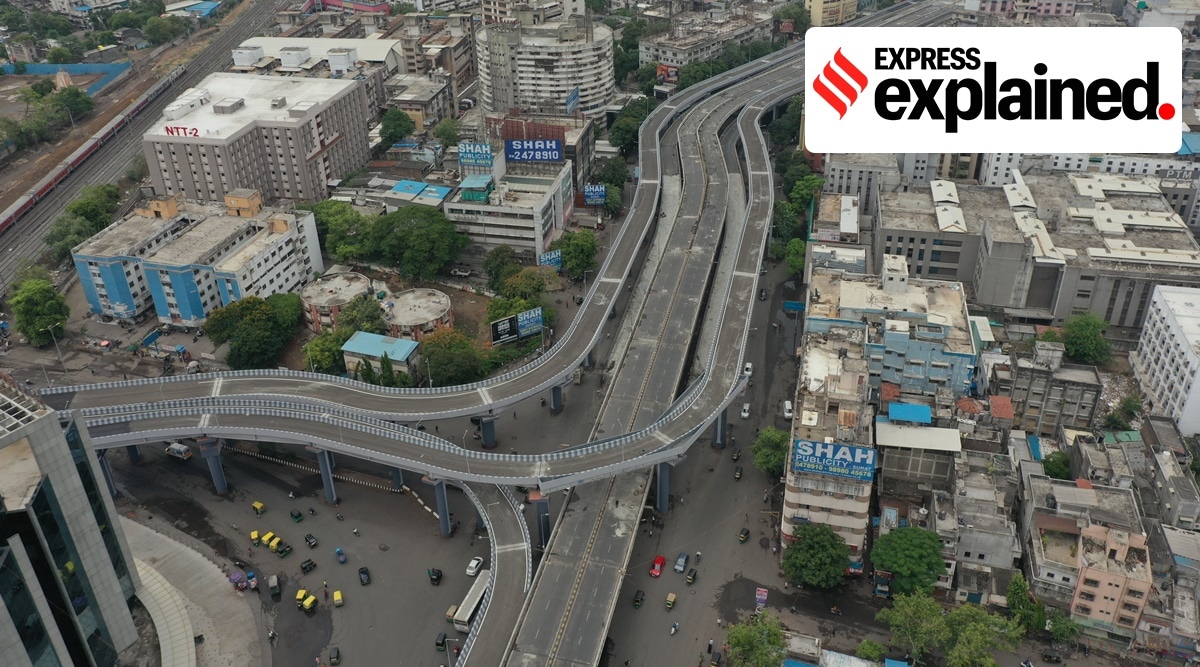
At the lowest level is the single-lane bridge around 5.2 metres wide and 410.535 metres long, connecting Surat Railway Station to Sahara Darwaza which is 15 metres from the ground.At the lowest level is the single-lane bridge around 5.2 metres wide and 410.535 metres long, connecting Surat Railway Station to Sahara Darwaza which is 15 metres from the ground.

Gujarat Sunday inaugurated the state’s first multi-level railway-over-bridge and flyover built at the cost of Rs 133.50 crore. A look at the three-level bridge, its features and how it will change life for commuters in Surat.

The project

The project was launched in 2017 in Surat — the hub of the diamond and textile industry and also among Gujarat’s most densely populated cities. This three-level bridge was planned by the Surat Municipal Corporation (SMC) to ease the traffic at Sahara Darwaza on the city’s ring road, where the textile markets are located. The bridge will be the main connect between the east and west regions of the city on either side of the Surat Railway station.

The bridges

According to SMC Bridge Cell Executive Engineer Amit Desai, “The total length of all the three bridges is 2643.075 metres”.

At the lowest level is the single-lane bridge around 5.2 metres wide and 410.535 metres long, connecting Surat Railway Station to Sahara Darwaza which is 15 metres from the ground. In the middle is the bridge for traffic from ring road to Sahara Darwaza which is 563.120 metre long and rises 8.75 metres from the ground. The bridge for traffic returning from Sahara Darwaza to ring road is 523.3 metres long, and single-lane.

At the highest level is a two-lane bridge for traffic from Sahara Darwaza to Kadodara.

Newsletter | Click to get the day’s best explainers in your inbox

Material used

Story continues below this ad

According to Desai, “For the construction of this bridge, 747 pile foundations, 121 piers, 232 PSC (pre-stressed concrete girders), and 30 plate girders, have been used.” In all, 14,257 metric tonnes of cement, 3860 metric tonnes of reinforced steel has been used.

Ending traffic woes

With this new bridge regular traffic movement to Bombay Market, APMC, and Kadodara from the west side to the east side of the city will be eased. A diversion has been provided to the Varachha area for those who want to reach Kamrej junction on NH-48.

New textile markets and textile transport godowns shifted from ring road to Saroli area near Kadodara will also benefit. The bridge will reduce a major chunk of the traffic at Sahara Darwaja.

Surat Municipal Corporation City Engineer AM Dubey said, “This multilayer bridge will be a great asset to the people connecting the west side of Surat Railway station to the east side. This will also help end traffic problems faced by people. This multilayer bridge is the first in Gujarat and it will give better connectivity to the people of Surat.”

Curated For You

Kamal Saiyed is a senior Correspondent for The Indian Express, providing extensive, on-the-ground coverage from Surat and the broader South Gujarat region and the Union territories of Daman, Diu & Dadra Nagar Haveli. With a reporting career at the publication spanning back to 2007, he has established himself as a high-authority voice on the industrial, social, and political pulse of one of India’s fastest-growing urban hubs. Expertise Industrial & Economic Beat: Based in the "Diamond City," Saiyed offers expert reporting on the diamond and textile industries. His work tracks global market shifts (such as De Beers production changes), local trade policies, and the socio-economic challenges facing the millions of workers in Surat’s manufacturing hubs. Civic & Infrastructure Coverage: He consistently reports on urban development and public safety in Surat, including: Traffic & Urban Planning: Monitoring the city's 13-fold increase in traffic violations and the implementation of new municipal drives. Public Safety: Investigative reporting on infrastructure failures, fire safety NOC compliance in schools and commercial buildings, and Metro rail progress. Political Reporting: Tracking the shifting dynamics between the BJP, Congress, and AAP in South Gujarat and the neighboring Union Territories (Daman, Diu, and Dadra & Nagar Haveli). Crime beat: Armed with a good source network Saiyed has been able to bring out the human side of crime stories in his region ... Read More


Tags:
  • Express Explained Gujarat
Weather
Edition
Install the Express App for
a better experience
Featured
Trending Topics
News
Multimedia
Follow Us
Udit Misra writesTrump's tariffs reduced China’s surplus with US — and made it the world’s headache
X