Premium

Fund cuts, visa scrutiny: What is happening in US varsities, how Indian students are affected

US International Student Visa Rules Change Impact: For Indian students, who form one of the largest international student groups in the US, turbulence cuts across three critical areas: funding, immigration, and future job stability. Here's how.

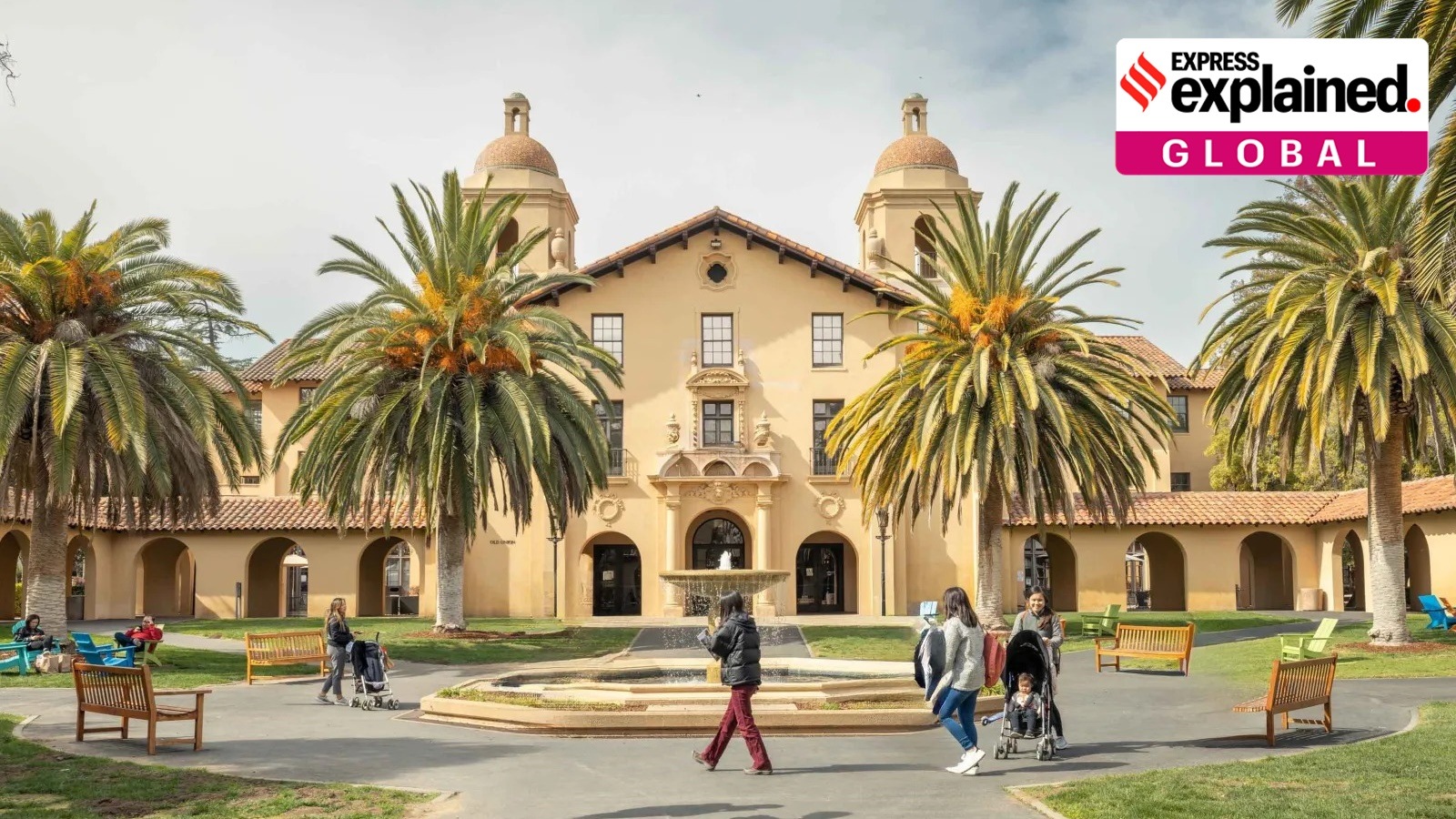
Stanford university, Visa, US VISAStanford University laid off over 360 employees earlier in August. (Photo: online.stanford.edu)

Indian Students in US: At Stanford University in the US, one of the world’s premier educational institutes, hundreds of staff members have recently been laid off, labs are slowing down, and graduate students are left scrambling as funding streams dry up.

“This is a product of a challenging fiscal environment shaped in large part by federal policy changes affecting higher education,” Stanford’s leadership said when announcing 363 job cuts following a $140 million shortfall.

The situation is similar at other elite universities in the US.

At Harvard, the Trump administration’s decision to freeze more than $2 billion in long-term research grants has put a halt to work across a wide range of medical, engineering, and scientific fields. The action came in response to the rejection of White House demands for changes that the University argues infringes on its independence and constitutional rights and exceeds the administration’s lawful authority.

The National Institutes of Health (NIH) had halted an estimated $110 million in grants to Harvard and its associated hospitals since late February.

At Columbia, nearly 180 researchers funded by federal awards lost their jobs, and campus publications described the fallout as “soul-crushing.” Even a later $200 million settlement with the government did little to restore confidence, with faculty warning that “the rules, and the money, feel volatile.”

These changes stem from a sweeping new law —the H.R.1, or the One Big Beautiful Bill Act, passed in July — as well as a sudden freeze of billions of dollars in federal research grants.

Story continues below this ad

This week, the US State Department has confirmed the revocation of over 6,000 student visas, some tied to funding collapses and others to political activity.

For Indian students, who form one of the largest international student groups in the US, this turbulence cuts across three critical areas: funding, immigration, and future job stability.

What is happening to international students in the US?

Visa scrutiny has intensified. The US State Department has revoked more than 6,000 student visas this year—of these, roughly 4,000 were linked to alleged criminal violations, while 200–300 related to “support for terrorism,” frequently in connection to pro-Palestinian activism. US immigration officials are now vetting visa applicants’ social media for “anti-American” or “antisemitic” content, making every post a potential risk.

In many cases, people’s Student and Exchange Visitor Information System (SEVIS) records were abruptly terminated, only to be later reinstated by federal courts, even for those who had not filed formal lawsuits.

Story continues below this ad

What challenges are Indian students facing in securing US visas?

In response to a directive by the State Department, consulates have paused scheduling new appointments for F-1 visas, leaving many hopefuls stranded or forced to defer plans. Meanwhile, when interviews are granted, applicants face an unprecedented level of scrutiny: they’re often required to make their social media profiles public, and consular officials can interpret any privacy setting or post as suspicious.

The effects of these policies come through in the numbers. From March to May this year, the US issued 9,906 F-1 visas to Indian students, the lowest count for that period since the pandemic, marking a steep 27% drop from the previous year. That same window in 2023 saw nearly 15,000 visas issued.

In parallel, the cost of obtaining a US visa is rising sharply. From 2026, all non-immigrant visa applicants, including students, must pay a 250-dollar (around 21,000 rupees) Visa Integrity Fee, plus additional charges like a 24 -dollar ( around 2000 rupees) I-94 fee, on top of the standard visa processing fee.

Starting September 2, the US Department of State will require in-person visa interviews for nearly all non-immigrant visa applicants, including children under 14 and seniors over 79, two groups previously exempted. This policy, issued on July 25, reverses earlier COVID-era relaxations and affects key visa categories such as: B-1/B-2 (tourist/business), F and M (students), H-1B (work), J (exchange).

Story continues below this ad

What is the role of the One Big Beautiful Bill Act?

In July, the US government passed a major new law called the H1 Bill or the H.R.1. It allows the government to borrow more so it can keep paying its bills, but it also cuts back on how much the government spends in different areas. For universities, this matters because government agencies now have less money to give out for research, and the law also makes wealthy private universities pay a higher tax on their endowments, which are like their savings funds.

This means universities will have less extra money for research projects and student support. For Indian students, especially those who depend on research jobs or financial aid, this could mean fewer opportunities and more competition for the funding that is left.

How does this affect F-1 visa status or your future H-1B application prospects?

Story continues below this ad

When a student is on an F-1 visa, their legal right to stay in the US depends on one simple thing: that they remain a full-time student with valid enrollment and financial support. For many Indian students, especially at the graduate level, this enrollment is tied directly to research assistantships (RAs) or teaching assistantships (TAs), which are in turn funded by federal research grants.

By raising taxes on wealthy universities (Ivy leagues) and squeezing federal spending, the government has shrunk the pot of money available for research grants and student aid. If a student’s assistantship is paid through one of these grants and the money dries up, their tuition waiver and stipend can vanish overnight. That puts international students in danger of not being able to pay for classes and that can push them “out of status” on their F-1 visa.

Looking at the H-1B visa, which most Indian students aim for after graduation, the risks persist. The H-1B process requires showing that the students have the qualifications and a job offer in hand. If research labs and departments are scaling back, international students may have fewer opportunities to publish, gain US work experience, or secure high-profile internships, things that strengthen one’s H-1B application.

Vidheesha Kuntamalla is a Senior Correspondent at The Indian Express, based in New Delhi. She is known for her investigative reporting on higher education policy, international student immigration, and academic freedom on university campuses. Her work consistently connects policy decisions with lived realities, foregrounding how administrative actions, political pressure, and global shifts affect students, faculty, and institutions. Professional Profile Core Beat: Vidheesha covers education in Delhi and nationally, reporting on major public institutions including the University of Delhi (DU), Jawaharlal Nehru University (JNU), Jamia Millia Islamia, the IITs, and the IIMs. She also reports extensively on private and government schools in the National Capital Region. Prior to joining The Indian Express, she worked as a freelance journalist in Telangana and Andhra Pradesh for over a year, covering politics, rural issues, women-centric issues, and social justice. Specialisation: She has developed a strong niche in reporting on the Indian student diaspora, particularly the challenges faced by Indian students and H-1B holders in the United States. Her work examines how geopolitical shifts, immigration policy changes, and campus politics impact global education mobility. She has also reported widely on: * Mental health crises and student suicides at IITs * Policy responses to campus mental health * Academic freedom and institutional clampdowns at JNU, South Asian University (SAU), and Delhi University * Curriculum and syllabus changes under the National Education Policy Her recent reporting has included deeply reported human stories on policy changes during the Trump administration and their consequences for Indian students and researchers in the US. Reporting Style Vidheesha is recognised for a human-centric approach to policy reporting, combining investigative depth with intimate storytelling. Her work often highlights the anxieties of students and faculty navigating bureaucratic uncertainty, legal precarity, and institutional pressure. She regularly works with court records, internal documents, official data, and disciplinary frameworks to expose structural challenges to academic freedom. Recent Notable Articles (Late 2024 & 2025) 1. Express Investigation Series JNU’s fault lines move from campus to court: University fights students and faculty (November 2025) An Indian Express investigation found that since 2011, JNU has appeared in over 600 cases before the Delhi High Court, filed by the administration, faculty, staff, students, and contractual workers across the tenures of three Vice-Chancellors. JNU’s legal wars with students and faculty pile up under 3 V-Cs | Rs 30-lakh fines chill campus dissent (November 2025) The report traced how steep monetary penalties — now codified in the Chief Proctor’s Office Manual — are reshaping dissent and disciplinary action on campus. 2. International Education & Immigration ‘Free for a day. Then came ICE’: Acquitted after 43 years, Indian-origin man faces deportation — to a country he has never known (October 2025) H-1B $100,000 entry fee explained: Who pays, who’s exempt, and what’s still unclear? (September 2025) Khammam to Dallas, Jhansi to Seattle — audacious journeys in pursuit of the American dream after H-1B visa fee hike (September 2025) What a proposed 15% cap on foreign admissions in the US could mean for Indian students (October 2025) Anxiety on campus after Trump says visas of pro-Palestinian protesters will be cancelled (January 2025) ‘I couldn’t believe it’: F-1 status of some Indian students restored after US reverses abrupt visa terminations (April 2025) 3. Academic Freedom & Policy Exclusive: South Asian University fires professor for ‘inciting students’ during stipend protests (September 2025) Exclusive: Ministry seeks explanation from JNU V-C for skipping Centre’s meet, views absence ‘seriously’ (July 2025) SAU rows after Noam Chomsky mentions PM Modi, Lankan scholar resigns, PhD student exits SAU A series of five stories examining shrinking academic freedom at South Asian University after global scholar Noam Chomsky referenced Prime Minister Narendra Modi during an academic interaction, triggering administrative unease and renewed debate over political speech, surveillance, and institutional autonomy on Indian campuses. 4. Mental Health on Campuses In post-pandemic years, counselling rooms at IITs are busier than ever; IIT-wise data shows why (August 2025) Campus suicides: IIT-Delhi panel flags toxic competition, caste bias, burnout (April 2025) 5. Delhi Schools These Delhi government school grads are now success stories. Here’s what worked — and what didn’t (February 2025) ‘Ma’am… may I share something?’ Growing up online and alone, why Delhi’s teens are reaching out (December 2025) ... Read More


Latest Comment
Post Comment
Read Comments
Advertisement
Advertisement
Advertisement
Advertisement