6 min read
© The Indian Express Pvt Ltd



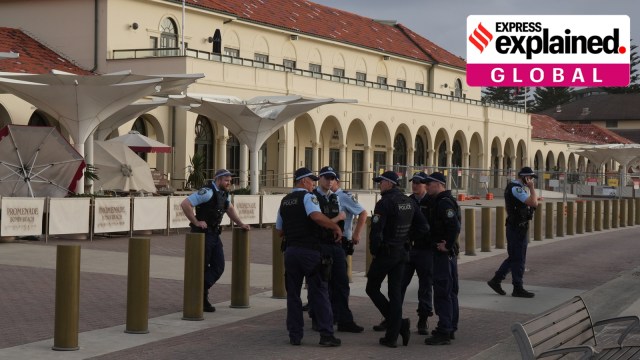 Police officers near the site of the Bondi Beach shooting. (AP)
In the aftermath of the 1996 Port Arthur shooting, that left 35 people dead and another 23 injured, Australia’s conservative government stared down the gun lobby to introduce unprecedented restrictions on gun sales and ownership. As a result, the number of guns and instances of gun violence plummeted — gun deaths in Australia fell from 2.9 per 100,000 in 1996 to just 0.88 per 100,000 in 2018, data from the Australian Gun Safety Alliance show.
Compared to the US, where mass shootings continue to be a relatively common occurrence (the US saw a whopping 14 gun deaths per 100,000 in 2023), Australia has been hailed as a success story when it comes to gun control, a so-called ‘gold standard’ of how commonsensical laws and strict enforcement can curb gun violence.
On Sunday (December 14), Australia witnessed its worst mass shooting since the Port Arthur tragedy when two armed gunmen opened fire in the crowded Bondi Beach, resulting in at least 15 deaths and 41 injuries. The attack, which has seemingly shaken Australia’s confidence in its gun control success story, may once again force the country to grapple with its gun laws.
Australia Prime Minister Anthony Albanese said, in a statement, the country’s leaders had agreed “that strong, decisive and focused action was needed on gun law reform as an immediate action”.
Since Britain set up its colony in Australia, firearms have been a quintessential part of Australian culture. The colonial experience shaped this culture: like the US, Australia too has vast, sparsely-populated interiors, a history of conflict between European settlers and native populations, and plenty of feral pests to shoot.
By the 1980s, however, incidences of gun violence had led to a nascent push toward gun control. After peaking in 1989, there was a gradual decline in private ownership of firearms, with restrictions introduced at the provincial level. Nonetheless, gun control remained deeply unpopular among a majority of Australians, who considered the right to own guns an essential extension of their freedom.
Things fundamentally changed after the Port Arthur massacre. Four days after the shooting, then Prime Minister John Howard promised to “significantly strengthen laws relating to gun control in Australia”.
This was deemed as an act of immense political courage, given how many members of his party were opposed to any such reform. But the public was now with Howard, even as he proposed what was considered to be radical reforms.
Twelve days after the massacre, the Howard government announced the National Firearms Agreement (NFA), a suite of measures from the federal, state, and territory governments designed to strengthen Australia’s gun control laws. The NFA included:
These measures were — and remain — popular among the gun-loving Australian public. That there were no major mass shootings for two decades after the Port Arthur massacre worked in these laws’ favour. However, a closer look at these laws’ implementation points to persisting problems in Australia’s gun control framework.
Promises unfulfilled and a worrying trend
Despite the reforms of 1996 enjoying public and political support, many elements of the NFA are yet to be fully implemented.
The promised national gun register, for instance, is still not a reality. In December 2023, the Australian cabinet agreed to implement an NFR in four years; in April 2024, the federal government committed more than $160 million to implement the register. But progress has been slow.
Other rules, such as those governing firearm use among minors, have been implemented inconsistently across Australia’s states and territories, hampering their effectiveness. As Australian Federal Police Association president Alex Caruana said in 2024, “[if] you’ve got softer laws in one state, that weakens the laws in the other states”.
“Nearly thirty years later, Australia’s firearm laws are not living up to the promise of the Howard Government’s bravery,” stated Canberra-based think tank The Australia Institute’s report ‘Australian gun control: 29 years after Port Arthur’ published earlier this year.
Data compiled by The Australia Institute shows that the number of registered privately owned firearms in Australia breached the 4 million mark in 2024 for the first time ever, and that there is at least one licensed firearm for every seven Australians. “There are now more guns in Australia than before the introduction of the NFA,” the report states.
(All this said, current Australian gun laws, while not perfect, have been effective. The Bondi Beach massacre, for instance, could have been even more deadly if the perpetrators were using AR-15-style assault rifles with far higher rates of fire instead of bolt-action rifles.)
Another shooting, more promises
The Bondi Beach attack comes at a time when there has been growing concern among Australian gun control advocates that the country has grown about firearms regulation, and that the so-called “gold standard” framework is falling short of its promise.
After a Monday meeting of the national cabinet, Prime Minister Anthony Albanese announced the leaders had commissioned police ministers and attorneys-general to develop options for extensive measures. Some proposals include:
Albanese said that the 1996 NFA will be “renegotiated” to “ensure it remains as robust as possible in today’s changing security environment”.


A post by an Indian traveller comparing day-to-day life in Sri Lanka with that of India has triggered a lively discussion online about infrastructure, cleanliness, and public behaviour. Posting on X, a user named Ish shared how returning to Delhi after a visit to Sri Lanka left him feeling unsettled. He described the contrast between the two countries as hard to ignore.