Budget in a nutshell: Five major takeaways from Finance Minister’s speech
Budget 2025 Highlights and Important Points: The focus is on putting more money in taxpayers’ hands through tax cuts, and creating more jobs. The infra expenditure push has reduced, but stress on fiscal discipline remains
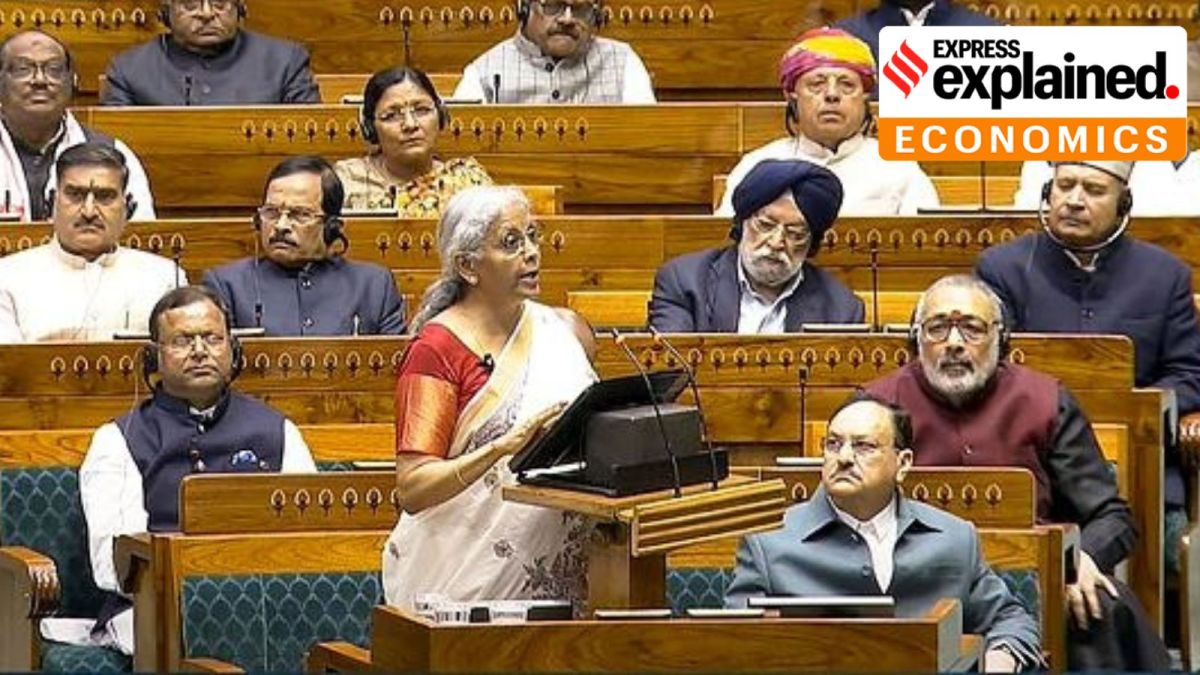
The FM surprised everyone by announcing massive income tax relief by raising the tax rebate level to an annual income of Rs 12 lakh. This level has been Rs 7 lakh until now. (PTI Photo)
Budget 2025 Highlights: Finance Minister Nirmala Sitharaman presented the second Budget for the third term of the BJP government led by Prime Minister Narendra Modi on Saturday.
In the lead up to the Budget, it had become clear that the Indian economy was losing its growth momentum. India’s GDP has grown at an average of less than 5% annually since 2019 and less than 6% since 2014.
You’ve Read Your Free Stories For Now
Sign up and keep reading more stories that matter to you.
Here are the five key takeaways from the Union Budget for the next financial year (2025-26).
01
MASSIVE INCOME TAX CUTS, MORE MONEY IN HANDS OF TAXPAYERS
Discontent has been simmering among the middle class about being taxed too much. Many had, therefore, expected some form of tax relief in the Budget.
However, the FM surprised everyone by announcing massive income tax relief by raising the tax rebate level to an annual income of Rs 12 lakh. This level has been Rs 7 lakh until now.
She also tweaked tax slabs in a manner that the highest tax rate in the country — 30% — will come into effect only after one reaches an annual income of Rs 24 lakh per annum, or Rs 2 lakh per month.
This relief is, of course, limited to income taxpayers. It will leave them with more money in their pockets. The government hopes that the additional money will be spent, and that will kick-start a growth process that will also incentivise companies to finally start investing in new capacities, thus creating new jobs and incomes.
02
FISCAL DISCIPLINE MAINTAINED, DEFICIT TO REDUCE DESPITE FOREGONE REVENUE
When governments overspend or provide tax relief, there is fear that it may force them to borrow more money.
When governments borrow more, they either leave less money for private citizens and companies to borrow, which, in turn, raises interest rates for everyone. Or, they are forced to print money – and that leads to inflation, which also works like a tax because it reduces the purchasing power of people’s money.
However, despite the massive tax cut, which will cost the government around Rs 1 lakh crore in foregone revenues, the fiscal deficit (or the level of money borrowed) of the government will be reduced further to 4.4% (of the GDP) in 2025-26, the Finance Minister said.
03
CAPITAL EXPENDITURE GROWTH STALLS, SIGNALLING SHIFT AWAY FROM RECENT BUDGETS
Capital expenditure growth stalls: The big story from the budgets in the second term of the Narendra Modi government (2019-24) was the focus on increased capital expenditure by the government.
Capital expenditure essentially refers to spending towards creating productive assets such as roads and ports and bridges, etc.
Not only did the government miss its capital expenditure target for the current financial year by almost Rs 1 lakh crore, the budgeted capex for next year is less than Rs 10,000 crore over the current year.
That being said, the capex allocation is still high by historical standards.
04
FOCUS ON EMPLOYMENT GENERATION, VISIBLE IN ATTEMPT TO BOOST SPECIFIC SECTORS
Another big turnaround in focus has been the shift towards employment generation.
For a while now, the government has been criticised for ignoring the employment generation aspects of its policy measures. For instance, the Production Linked Incentive (PLI) scheme was essentially a subsidy for companies and ventures that were heavy on the use of capital instead of labour.
This Budget brings the focus back on employment generation, and this shows up in the shape of measures announced for boosting economic activity in sectors such as textiles and leather that traditionally create more jobs for the same level of GDP.
05
PUSH FOR REGULATORY REFORMS, A LATE BUT WELCOME STEP
The FM announced the creation of a committee that will look into regulatory reforms that are required to make it easier for companies and entrepreneurs to do business in India.
While this is a welcome step, it is late – it has come as many as 11 years after the Modi government first came to power.
While this is a welcome step, it is late – it has come as many as 11 years after the Modi government first came to power.
Udit Misra is Senior Associate Editor at The Indian Express. Misra has reported on the Indian economy and policy landscape for the past two decades. He holds a Master’s degree in Economics from the Delhi School of Economics and is a Chevening South Asia Journalism Fellow from the University of Westminster.
Misra is known for explanatory journalism and is a trusted voice among readers not just for simplifying complex economic concepts but also making sense of economic news both in India and abroad.
Professional Focus
He writes three regular columns for the publication.
ExplainSpeaking: A weekly explanatory column that answers the most important questions surrounding the economic and policy developments.
GDP (Graphs, Data, Perspectives): Another weekly column that uses interesting charts and data to provide perspective on an issue dominating the news during the week.
Book, Line & Thinker: A fortnightly column that for reviewing books, both new and old.
Recent Notable Articles (Late 2025)
His recent work focuses heavily on the weakening Indian Rupee, the global impact of U.S. economic policy under Donald Trump, and long-term domestic growth projections:
Currency and Macroeconomics:
"GDP: Anatomy of rupee weakness against the dollar" (Dec 19, 2025) — Investigating why the Rupee remains weak despite India's status as a fast-growing economy.
"GDP: Amid the rupee's fall, how investors are shunning the Indian economy" (Dec 5, 2025).
"Nobel Prize in Economic Sciences 2025: How the winners explained economic growth" (Oct 13, 2025).
Global Geopolitics and Trade:
"Has the US already lost to China? Trump's policies and the shifting global order" (Dec 8, 2025).
"The Great Sanctions Hack: Why economic sanctions don't work the way we expect" (Nov 23, 2025) — Based on former RBI Governor Urjit Patel's new book.
"ExplainSpeaking: How Trump's tariffs have run into an affordability crisis" (Nov 20, 2025).
Domestic Policy and Data:
"GDP: New labour codes and opportunity for India's weakest states" (Nov 28, 2025).
"ExplainSpeaking | Piyush Goyal says India will be a $30 trillion economy in 25 years: Decoding the projections" (Oct 30, 2025) — A critical look at the feasibility of high-growth targets.
"GDP: Examining latest GST collections, and where different states stand" (Nov 7, 2025).
International Economic Comparisons:
"GDP: What ails Germany, world's third-largest economy, and how it could grow" (Nov 14, 2025).
"On the loss of Europe's competitive edge" (Oct 17, 2025).
Signature Style
Udit Misra is known his calm, data-driven, explanation-first economics journalism. He avoids ideological posturing, and writes with the aim of raising the standard of public discourse by providing readers with clarity and understanding of the ground realities.
You can follow him on X (formerly Twitter) at @ieuditmisra
... Read More