In December last year, northern Gujarat’s Vadnagar city and the Sun Temple of Modhera, both part of the Mehsana district, made it to the Tentative list of the UNESCO World heritage sites.
The Ministry of Culture has now announced the redevelopment of a primary school here attended by Prime Minister Narendra Modi, whose hometown is Vadnagar. Children from across the country will spend a week at the Prerna school to learn “how to live a very evolved life”, as part of a joint initiative by the central and state governments.

Vadnagar has been known by names like Anartapura, Anandapur, Chamatkarpur and so on, during different periods of its history, and has often been compared to Varanasi in terms of both claiming to be “living cities”. What is known about Vadnagar’s past?
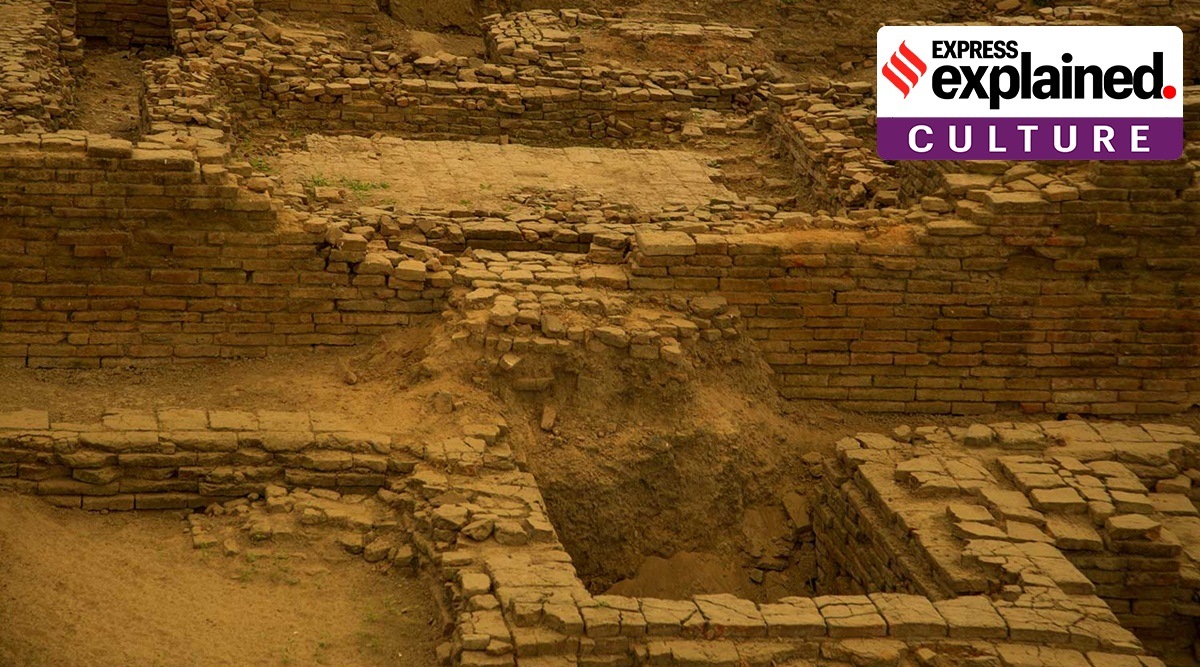
Archaeological excavations at Vadnagar
Vadnagar was first excavated by archaeologists B Subbarao and RN Mehta from Maharaja Sayajirao University of Baroda in 1953, mainly to understand its “ceramic sequence” which revealed a flourishing conch shell trade industry, with bangles and other wares also found here.
Several archaeological excavations began here from 2005-06, when PM Modi was the Chief Minister of Gujarat. The excavation work taken over by the ASI from 2014 onwards has found over 20,000 artefacts.
Yadubir Singh Rawat, former director of the State Archaeology Department, identified five periods of continuous settlement at the site from its formative period. In 2014, the year Modi became Prime Minister, the Archaeological Survey of India (ASI) took up excavations in Vadnagar’s Ghaskol, Darbargadh and Badi Garbano Sheri. The excavation was conducted till 2022 to establish its chronology and to help create an Experiential Museum.
An unbroken sequence of seven successive cultures going back to 750 BCE was found and divided into seven periods: pre-rampart phase (in 2nd century BCE), Rampart phase (2nd century BCE – 1st century CE), Kshatrapa phase (1st – 4th century CE), post-Kshatrapa phase (5th – 9th/10th century CE), Solanki phase (10th – 13th century CE), Sultanate-Mughal phase (14th – 17th century CE) and Gaekwad phase (17th/18th – 19th century CE).
Story continues below this ad
Most of the excavations – like the fortification, a Buddhist monastery, votive stupas, house-complexes, lanes/streets and industrial hearth – are from pre-2nd century BCE to the Gaekwad period (18th – 19th century CE).
Vadnagar as a ‘living city’
These structures showcase the architectural influence of various cultural periods. Extensive water management system in and around the town also played a role in its continuity.
“The town represents a continuously evolving historic urban landscape/area which played a major role in the hinterland trade network of Western India. The continuity of the historic town proves its resilience and outstanding universal value unlike the sites like Harappa and Kalibangan, (Rajasthan) which were abandoned eventually,” states the description of Vadnagar in UNESCO’s Tentative List.
In his paper ‘Vadnagar Excavations’ in the journal Asian Renaissance, Rawat, who is now Officer on Special Duty at the Gujarat Department of Archaeology and Museums, writes that Vadnagar was an important centre of Sammitya Buddhists, a sect which Chinese traveller Hieun Tsang also supported.
Story continues below this ad
“Located at the intersection of two major trade routes – Central India to Sindh and northwest, and Gujarat to Rajasthan and north India, Vadnagar was also known as one of the important land ports (Sthal Pattan) of Gujarat,” writes Rawat.
A mound here rises gently and the highest point in the middle of the settlement is 25 metres high, called Darbargadh. “Such types of a mound on which Vadnagar is built are not available in other parts of India. As evidenced through literature, mythology and various scriptures, this town has been an attraction for ages,” Rawat had told The Indian Express earlier.
Human habitation existed here from mid-8th century BCE till date, as per ASI findings. “These findings uncovered a unique aspect of the town: an uninterrupted extensive human habitation and cross-cultural evolution that sustained itself and continues till date. Such a long period of human habitation is exceptional in the Indian scenario with very few sites claiming similar uninterrupted continuity,” states ASI’s submission to UNESCO.
Evidence of Buddhism
According to Rawat, Hieun Tsang or Xuanzang visited Vadnagar around 641 CE and called it o-nan-to-pu-lo (Anandpur). “He recorded that ‘there are more than 1000 monks of the Sammitiya School or Little Vehicle in 10 monasteries’. He also records Vadnagar as a capital city which has no king,” writes Rawat.
Story continues below this ad
The first evidence of Vadnagar’s Buddhist association came in1992, in the form of a red sandstone image of a Bodhisattva or a deity-like revered figure in Buddhism. An inscription on the pedestal of the image records that it was brought for the Chaitya of Sammatiya. The image is an example of Mathura art and seems to have been brought from there. Similar images have been found from many other sites of the Indian subcontinent.
Senior ASI officials revealed some significant Buddhism related structures found here, such as an elliptical structure or a circular stupa, along with a square memorial stupa of 2×2 metre and 130 cm in height with a wall enclosure. “It is like a platform which has a chamber on it at the centre that resembles a pradikshana [circumambulation] path,” an ASI official said.
The excavation work recently completed at the last two sites – Ambha Ghat and the grains godown near Ambaji Kotha Lake – will be followed by restoration and conservation for regular maintenance.
The influences
Kumarpal, the Jain king from the Solanki dynasty (1144-74 CE) undertook repairs of the fort wall in 12th century CE, as recorded in a stone inscription on the Arjuna Bari.
Story continues below this ad
Abul Fazl’s Ain-e-Akbari from the 16th century makes a note of Vadnagar or Barnagar, as a “large and ancient city containing 3,000 pagodas, near each of which is a tank” and “chiefly inhabited by Brahmans.”
The ASI, in its submission to the UNESCO, claims a “Roman connection” in the finding of an intaglio in clay – a coin mould of Greco-Indian king Apollodotus II (80-65 BC) – and a sealing with impression of a Roman coin belonging to Valentinian-I (364-367 CE). “Careful analysis and study of non-indigenous pottery such as torpedo jars and Glazed ware establish the site’s contacts with the Sassanid region and West Asia,” the submission says.
According to ASI, Vadnagar “evolved with time and took up many roles like early historic fortified settlement, hinterland port, centre for industries of shells and beads, late medieval town, religious centre/temple town, a significant junction on trade routes, and mercantile town.”
Also found were 11,000 shell bangles and cowry shells, implying its indirect involvement in overseas trade, as the cowry shells were traced to the Maldives. A gold coin, believed to be of the Mamluk dynasty of Egypt dating back to the 15th century, has also been found.
The current town
Story continues below this ad
Vadnagar is an L-shaped town spread across 85 hectares, with the Sharmishtha Lake located on its north eastern edge.
It is surrounded by the remains of a fortification wall, punctured by a series of gates that mark the entry and exit points of the town. There are primary entry and exit points to the town in all cardinal directions, along with gateways that are elaborate single storey stone structures.
While most gates are mediaeval, the Ghanskol and Pithori gates are of the 11th- 12th century CE. Other prominent gates are Nadiol Gate, Amtol Gate, Amarthol Gate and Arjun Bari Gate (protected by the ASI).
Vadnagar still retains a large number of historic buildings that are primarily religious and residential in nature. The Ambaji Mata Temple dates back to 10th-11th century CE, while other important Hindu and Jain temples within the town are from the 17th century onwards.
Story continues below this ad
While the Hatkeshwar temple is located outside Nadiol gate, the two identical glory gates outside the fortification wall to the north of the town are the Kirti Torans, built in yellow sandstone without mortar or any other cementing material.


 8 min read