3 min read


© The Indian Express Pvt Ltd



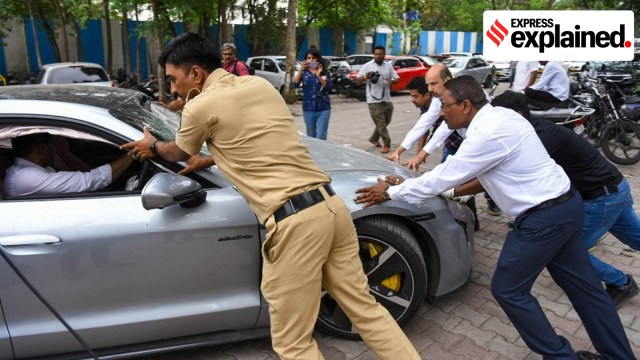 A technical team from Porsche checking the car involved in the Pune crash. (Express photo)
Written by Dr Sudhir K Gupta
The 17-year-old son of a Pune builder was reportedly inebriated while driving at high speed, when he crashed into a motorbike killing two young IT professionals on May 19. It has now come to light that blood samples collected to test for alcohol content at the time of the incident were swapped by the forensics team. One of India’s top forensics experts explains why blood samples should be collected immediately after an incident, and what happens if they aren’t.
A blood sample should ideally be collected within 10 hours of the incident. The washing rate of alcohol is around 10-15 mg/ 100 mL/hour (i.e., in a sample of 100mL of blood, with the passing of each hour, 10-15 mg of alcohol is metabolised). This rate differs from person to person — young men are likely to process it faster than older men and women. The 10-15 mg/mL/ hour rate is just an average.
Based on the blood alcohol level found in a sample, it is very easy to determine the levels at the time of the incident. It is even possible to calculate the blood alcohol level at the time of an incident after 10 hours have passed, based on the trace amounts found in the blood. But this is not ideal.
Even when the blood alcohol level is found to be zero, it doesn’t invalidate that the person had been drinking. The lab report is just one of the things that forms the basis of evidence a forensic doctor presents in court. The number of drinks consumed can be reconstructed from the bills at the bar, statements of the bar owner or staff, and available CCTV footage.
Looking at the number of drinks consumed, the blood alcohol level can be calculated using an easy formula.
In the Pune case, such a scientific reconstruction can be used to determine the accused’s blood alcohol levels. This would be permissible in court. Even in the 1999 BMW hit-and-run case, in which six people were killed in Delhi, the samples were collected after 14 hours — and the accused had consumed three drinks after the incident as well. But it was possible to accurately calculate the levels using the totality of evidence available.
The samples are sealed and handed over to the authorities to prevent tampering. Yet, it is possible to tamper with them, especially during transit. This is why AIIMS now has a machine to calculate the blood alcohol level on site, so that samples do not have to be sent out for testing.
Dr Gupta the Head of the Department Of Forensic Medicine in AIIMS, New Delhi