4 min read
© The Indian Express Pvt Ltd



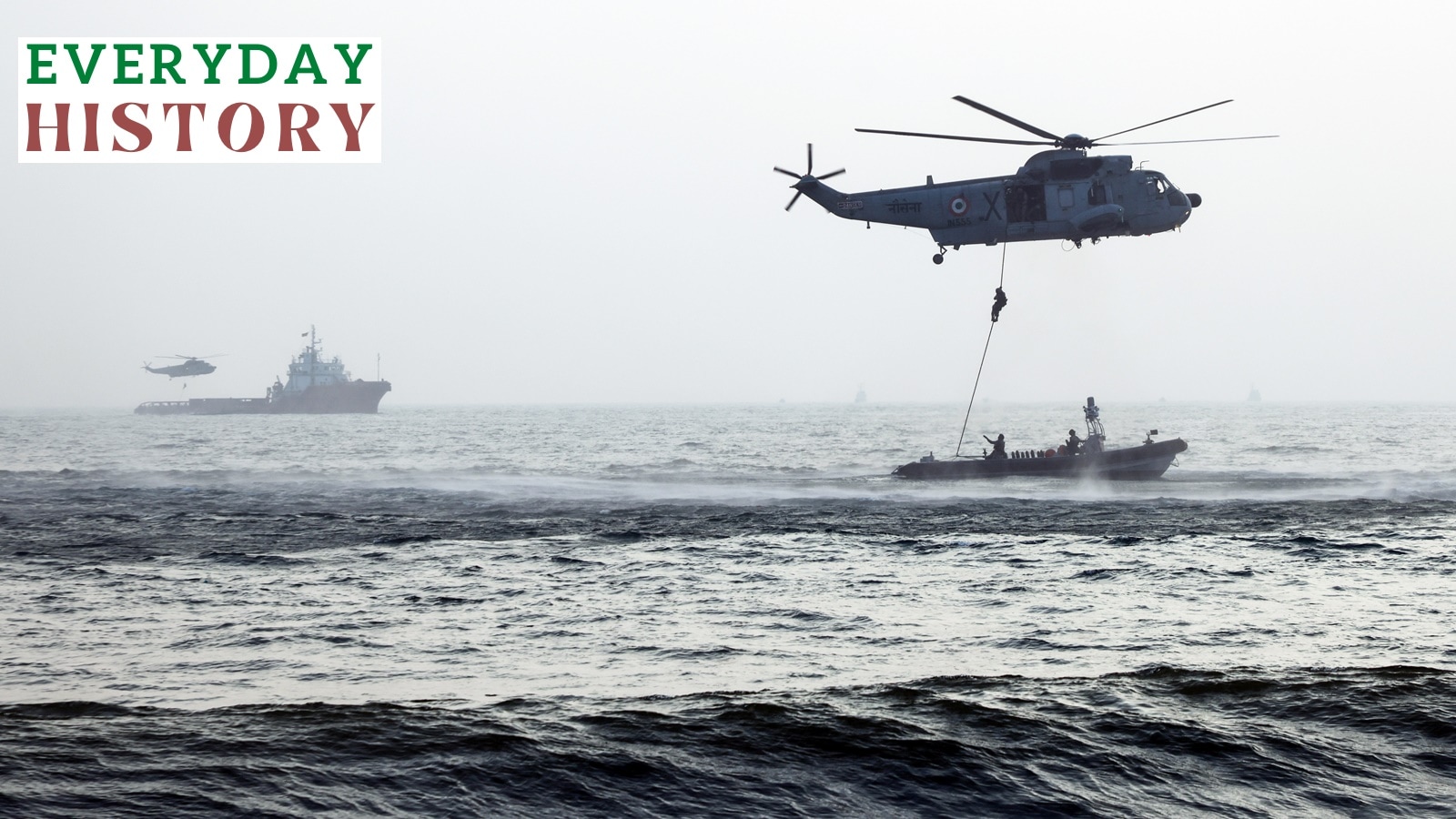 Navy Day 2025: Rehearsal underway for Navy Day celebrations at the Shanghumugham beach in Thiruvananthapuram on Monday. (ANI Photo)
Navy Day 2025: December 4 is annually celebrated as India’s Navy Day. On Thursday, President Droupadi Murmu, who is also the Supreme Commander of the Indian Armed Forces, extended her greetings to Navy personnel, veterans and their families.
She said, “The nation salutes the brave men and women who safeguard our maritime borders and national interests with courage, vigilance and unwavering commitment.”
Interestingly, the date behind the commemoration has changed over time. On October 21, 1944, the Royal Indian Navy held its first Navy Day. By 1945, it was celebrated in Bombay (now Mumbai) and Karachi on December 1. After Indian Independence and until 1972, it was marked on 15 December. What was behind December 4 becoming the ultimate choice?
Navy Day on December 4 marks Operation Trident, when the Indian Navy inflicted heavy damage on Pakistani vessels in Karachi harbour amid the Bangladesh Liberation War of 1971.
The war began a day before the naval operation, when the Pakistan Air Force launched pre-emptive strikes on airfields in western India. India responded by formally declaring war in the wee hours of December 4.
That day, under Operation Trident, the Indian Navy sank three vessels near the Pakistani port city of Karachi. The stars of the mission were the then-recently acquired Soviet Osa missile boats, fitted with 4 SS-N-2 (P-15) Styx missiles.
INS Kiltan, Katchall, Nipat, Nighat and Veer sank PNS Khaibar, killing 222 Pakistani sailors, and PNS Muhafiz, killing 33 Pakistani sailors, as well as a merchant ship, MV Venus Challenger. The Indian Air Force also played a crucial role during Operation Trident, when Karachi’s Kemari oil tanks were strafed by the IAF on the same day in an independent operation which it did not claim.
On December 5, the Indian Navy’s Western C-in-C, Vice Admiral SN Kohli, received the code word “Angaar”, which meant success in the operation. The 1971 War ended on December 16, as India sealed its victory when the instrument of surrender was signed by Lt Gen A A K Niazi of Pakistan with Lt Gen J S Aurora watching, at Dhaka at 4.55 pm that day. That remains the lasting image of the 1971 War.
As The Indian Express previously reported, “Many aspects of the attacks were novel — the use of missiles in this region for the first time, towing by bigger ships to overcome the problem of endurance, radio silence and ingenious methods of communication to remain undetected and using vessels meant for coastal defence in an offensive role.”
“Missile boat crews were well versed in Russian, having been trained in that country. The language was used for radio communications in the clear, foxing Pakistani signals intelligence. Vijai Jerath, captain of the Vinash, was awarded the Vir Chakra for the coolness and skill that he showed during the operation. A third missile attack, codenamed Operation Triumph scheduled for December 10 was cancelled in view of the virtual naval supremacy achieved by the Indian Navy.”
Ankush Banerjee, a serving Naval Officer, earlier wrote for The Indian Express that apart from the officers helming the operation at the time, credit must also be given to prior timely upgrades and planning.
“From 1965 to 1971, much thought had gone into how to best capitalise and strategise India’s maritime position, given the available resources and existing threat perceptions. Over these ‘silent’ years, infrastructure was committed, new platforms acquired, and practical knowledge management frameworks were institutionalised.”
“For instance, between 1969 and 1970, the following new acquisitions were made: five Petya class anti-submarine vessels (Kamorta, Kadmatt, Kiltan, Kavaratti and Katchall), four submarines (Kalveri, Khanderi, Karanj, and Kursura), submarine rescue vessel Nistar, two Polish built landing ships Gharial and Guldar, and five patrol boats Panvel, Pulicat, Panaji, Pamban and Puri. Further, in 1970-71, eight Soviet missile vessels (Nashak, Nipat, Nirbhik, Vinash, Veer, Vijeta, and Vidyut) were in various acceptance and delivery stages,” he wrote.
The result was that during this campaign, no casualties were observed on the Indian side. On December 8, Operation Python was launched, where further damage was inflicted. The morale of the Pakistani Navy was dented, with their ships ordered to reduce the ammunition on board on December 9, to decrease the explosion damage if hit.