


© The Indian Express Pvt Ltd
Tags:


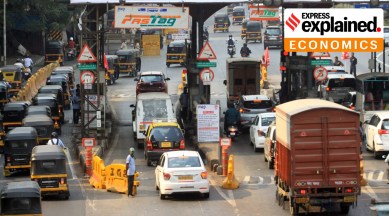
In a move that is expected to help curb tax evasion, Goods and Services Tax (GST) authorities will now be able to track real-time data of commercial vehicle (CV) movement on highways by integration of the e-way bill (EWB) system with FASTag and RFID. The integration of e-way bill, RFID and FASTag will allow live vigilance for e-way bill compliances by businesses and help prevent revenue leakage by real-time identification of cases of recycling of e-way bills or non-generation of e-way bills.
Newsletter | Click to get the day’s best explainers in your inbox

What is the new system?
Tax officers can now access reports about vehicles that have passed the selected tolls without e-way bills in the past few minutes. They can also view details of vehicles carrying critical commodities specific to the state that have passed the selected toll.
Further, tax authorities can view details of any suspicious vehicles and vehicles of e-way bills generated by suspicious taxpayer GST identification numbers (GSTINs) that have passed the selected toll on a near real-time basis.
Officers can use these reports while conducting vigilance and make the vigilance activity more effective. Moreover, officers of the audit and enforcement wing can use these reports to identify fraudulent transactions like bill trading, recycling of e-way bills.
From January 1, 2021, RFID/FASTag has been integrated with the e-way bill system and a transporter is required to have a radio-frequency identification (RFID) tag in his vehicle and details of the e-way bill generated for goods being carried by the vehicles are uploaded into the RFID system.
When a vehicle passes the RFID tag reader on the highway, the details fed into the device get uploaded on the government portal.
The information is later used by revenue authorities to validate the supplies made by a GST registered person.
What are e-way bills?
Under the indirect tax regime, e-way bills have been made mandatory for inter-state transportation of goods valued over Rs 50,000 from April 2018, with exemption to precious item such as gold. On an average, 25 lakh goods vehicle movements from more than 800 tolls are reported on a daily basis to the e-way bill system.
About 180 crore e-way bills were generated in three years till March 2021.
Of this, only 7 crore bills were verified by tax officers. In the 2020-21 fiscal, 61.68 crore e-way bills were generated, of which 2.27 crore were picked up for verification.
The top five states which generated the maximum number of e-way bills for inter-state movement of goods are Gujarat, Maharashtra, Haryana, Tamil Nadu and Karnataka.
The top five sectors where maximum e-way bills were generated in the past three years are textiles, electrical machinery, machinery and mechanical appliances, iron and steel, and automobiles.


