


© The Indian Express Pvt Ltd
Tags:


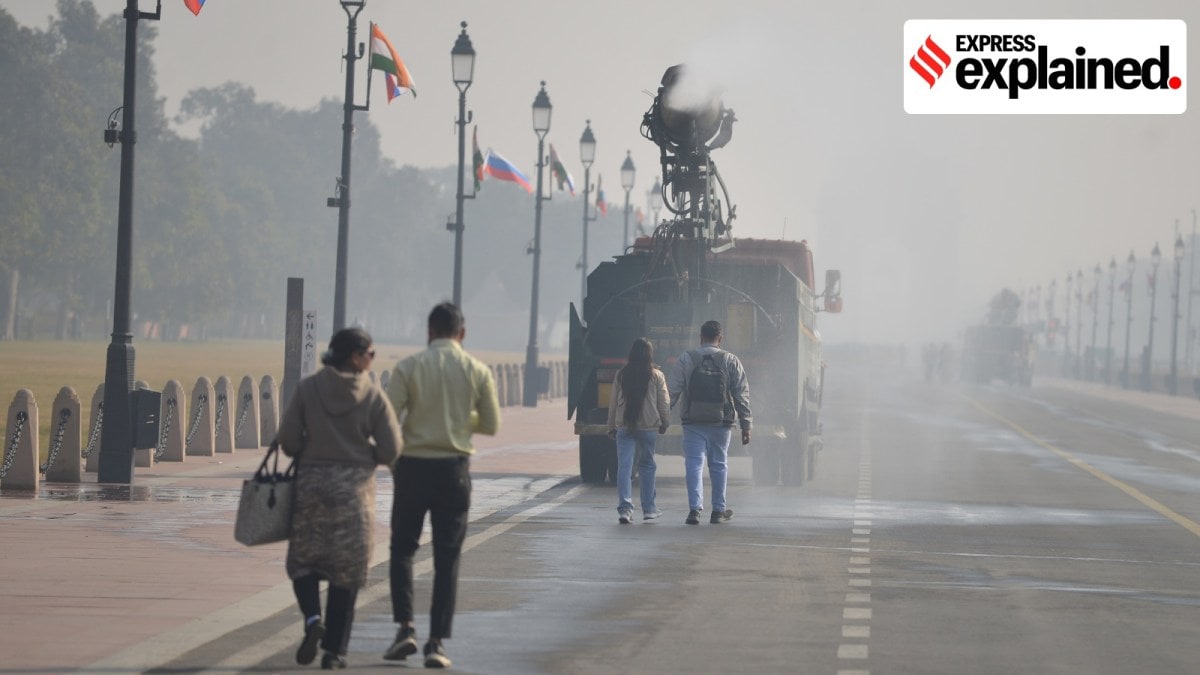
Like in the past few years, Delhi’s air quality once again deteriorated with the onset of winter this October. On Tuesday, a thick layer of haze enveloped parts of the national capital, with the Air Quality Index (AQI) remaining in the ‘poor’ category at 294. To tackle the situation, the state government has announced a host of measures, from conducting a new study to identify the sources of pollution in the region and calling for a shift to electric vehicles.
A new report, ‘Different Paths to Clean Air: Global Insights for India’s Reform Agenda’, by Sustainable Futures Collaborative (SFC), a New Delhi-based research organisation, has provided detailed pathways to improve air quality in India, including Delhi, by examining how other countries addressed their diverse pollution challenges. The researchers — Ishita Srivastava, Arunesh Karkun, and Bhargav Krishna — looked at environmental regulatory regimes in Brazil, China, Germany, Mexico, Poland, South Korea, and the United States. These countries were chosen for their relevance to India: large economies, histories of severe air pollution, rapid industrialisation, high GDP growth, and representation from both the Global North and South, according to the report.

The three researchers explained why pollution is a seasonal issue in India, what other foreign cities with geographies similar to Delhi did to improve their air quality, and why India is more focused on tackling PM10 and not PM2.5.
Between 2015 and November 2025, the average annual Air Quality Index (AQI) in Delhi has been 235, far from the safe air quality levels. However, pollution comes under the spotlight only seasonally. Why is pollution not a make-or-break political issue in India like in other countries?
Bhargav Krishna: Air quality is generally lower on the priority list for voters, even those living in Delhi, as shown in recent research. That is partly because we have done a poor job of communicating the harms of bad air quality on people’s health and financial well-being.
Also, we have to see the legacy of how air pollution has been managed, and what drivers have forced actions on air quality in the past. Over the years, external factors have largely contributed to making pollution a subject in public discourse and forced the State to respond to it.
For instance, public interest litigations (PILs) and the Supreme Court drove the first generation of reforms to fix air quality. Then came the Supreme Court-established authority — Environment Pollution (Prevention and Control) Authority (EPCA) — which was tasked with managing pollution in Delhi-NCR. However, EPCA was situated adjacent to the government, not necessarily within the government, and drew its authority from the Court.
This shows that air pollution has not been a central pillar for governmental action. In the past few years, the issue has become more salient for the government. But its importance has increased from a very low baseline because it has been externally driven, not internally driven as an issue.
In contrast to this, countries such as China, Mexico, and Poland, which were able to deal with pollution, saw the implementation of either top-down or bottom-up government-led approaches to make air quality better.
Ishita Srivastava: Take the example of Poland. Despite being part of the European Union, where there were strict standards for emissions, the country was an outlier in terms of not meeting the targets and had poor air quality. However, this changed after the civil society took up the mantle and pulled up local and national authorities, demanding administrative and policy changes. For instance, the Polish Smog Alert (PSA) movement began in 2015 in Krakow, where the air quality was terrible. This prompted the streamlining of emission targets, improving the air quality.
Arunesh Karkun: On the other hand, Beijing implemented a top-down approach to tackle pollution, where Premier Li Keqiang declared a war on air pollution and set a vision for China to clean its air in a particular timeframe. The whole state was mobilised around this vision. Local and national authorities, and different sectors, were given specific goals regarding reducing air pollution.
Clean air became an issue of national prestige for them. They were seen as directly competing with the United States, and air pollution was deemed to be unacceptable.
Delhi’s geography exacerbates air pollution, as the city is located in the Indo-Gangetic Plains, where the pollutants get trapped. Are there any foreign cities whose geography played a role in making air quality worse, but they were still able to successfully tackle the issue?
AK: One example is that of Mexico City, whose geography (it is located on a plateau, surrounded by mountains) and atmospheric conditions played a role in worsening the air quality. In the 1950s, strong winds would bring dust from a dry lake bed, where the city’s sewage would go. As a result, the city would often witness sewage particles floating in the air, which would drop on food, making people sick.
To tackle the situation, Mexico City established science- and health-based air quality standards. In the 1990s, the city introduced a coordinated action plan, known as the Management Programme to Improve Air Quality (ProAire). It set up a supply of unleaded petrol, introduced stricter vehicle emissions standards with the introduction of catalytic converters (which convert toxic pollutants into less harmful substances), and expanded the metro system.
BK: Beijing also has a similar problem (it is surrounded by mountains to its west, north and northeast), as mountain ranges stop pollutants from dispersing, especially during winters. However, industries were moved out of the city’s airshed — the typical circulatory region for a body of air — so that they do not contribute to the added load of pollution in the region.
There is no shortage of such examples. What other cities have done is take stringent actions around the key sources that were contributing to air pollution within their region to deal with the pollution.
In your research, you found that the countries you analysed put a stronger focus on PM2.5 than India does. Why is that the case with India, and why is this an issue?
IS: PM2.5 is an atmospheric particulate matter of a diameter smaller than 2.5 micrometres, which is around 1/20th of the diameter of a human hair. This makes it easier for PM2.5 to get absorbed in the body, the bloodstream, and vital organs, making it more toxic than PM10 for humans.
But unlike other countries, India does not prioritise dealing with PM2.5. For example, the National Clean Air Programme (NCAP) focuses only on PM10 reduction in 131 non-attainment cities (they consistently fail to meet the National Ambient Air Quality Standards for pollutants over several years), seeking to improve annual average ambient PM10 levels by 40% (with 2017 as a base year) or meet the NAAQS for PM10 by 2026.
As a result, PM2.5 reduction does not feature in plans for tackling pollution, and misplaced actions such as using smog guns are implemented.
BK: The choice of PM10 as the pollutant of interest for the NCAP as a metric to show progress was one of convenience. It was done so because many of the 131 non-attainment cities had monitoring practices for PM10 and not PM2.5. That’s why the entire focus of NCAP is on construction dust management, and investments are being made in activities such as road sweeping or paving.
You have also highlighted the fact that India’s pollution regulators are comparatively ‘resource-poor’, as they are understaffed and not well funded. How is the issue affecting the fight against air pollution?
AK: Pollution control boards in India were first set up under the Water (Prevention and Control of Pollution) Act, 1974. From then till now, the industrial output has grown 17 times. The country’s pollution has increased by 130%. However, the staffing in these boards has barely increased — when compared to the US and China, India’s staffing numbers are much smaller.
There is also an issue of understaffing. As of 2024, out of 12,016 sanctioned posts for the State Pollution Control Boards (SPCBs) and Pollution Control Committees (PCCs) — they work and operate within states and Union Territories, respectively — combined, only 5,941 positions were occupied. The Central Pollution Control Board (CPCB) — the apex regulator operating at the national level — has a staff strength of 504 out of a sanctioned maximum of 603.
All of this has led to a workload problem for the people who are responsible for overseeing industrial pollution.
BK: As part of the research, we analysed how much time it takes for a pollution control board, as per their own procedure, to monitor pollution compliance of an industry. We examined the time taken by an environmental engineer to review an application that has been accepted, go to the field and do monitoring work on the location of the industry, write the report and then file it. We found that to do all these tasks takes an engineer a maximum of three days, which is too little time for proper monitoring.
And, when, say, an SPCB does not have the time for monitoring compliance, it sometimes outsources work by hiring consultants, who write the report and submit it to the board. Then, the engineer signs it off on their own behalf. There is a chance that the engineer never even visited the industry in question. This can lead to issues, such as conflicts of interest.
The workload is also expanding. An engineer who was earlier responsible for monitoring, for example, air and water pollution, is now also overseeing e-waste and biochemical waste compliance. All of this means that very little compliance monitoring is taking place on the ground.


