8 min read
© The Indian Express Pvt Ltd



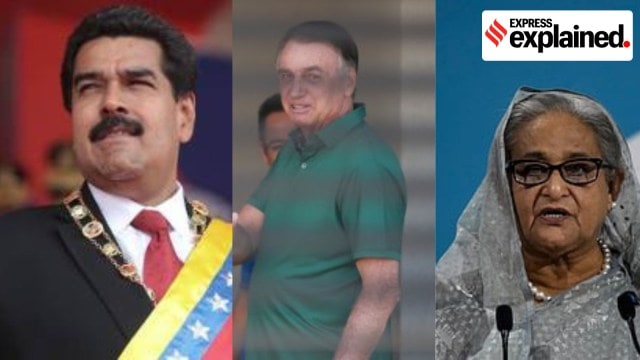 Former Brazil President Jair Bolsonaro, Venezuela President Nicolas Maduro, and former Bangladesh Prime Minister Sheikh Hasina. (AP)
* On Wednesday (November 26), former Brazil President Jair Bolsonaro, 70, began a 27-year prison sentence for plotting to overthrow the newly-elected government of President Lula in 2023. Bolsonaro supporters had stormed the Presidential Palace, the Supreme Federal Court, and the National Congress Palace after he lost the election to Lula.
* With the US sharpening its rhetoric against Venezuela and its socialist leader, President Nicolás Maduro, Caracas is preparing to resist an American military intervention. Maduro cites America’s history of intervening militarily, or through covert operations, in the affairs of Latin American countries as precedent for such an attack.
* Fifteen months after she was ousted from power on the back of a popular student movement, former Bangladesh Prime Minister Sheikh Hasina has been sentenced to death by a tribunal in Dhaka for using excessive force against the protestors. Hasina was forced to step down after the protests went out of hand and the Bangladesh military refused to cooperate with her.
The attempted regime change in Brazil, a possible American military intervention in Venezuela, and the ouster of Hasina in Dhaka have variously been labelled as “coups”. But they are all qualitatively different.
David Lane, an Emeritus Professor of Sociology at the University of Cambridge, laid down four kinds of political change: putsch, coup d’état, revolutionary coup d’état, and political/social revolution (‘The Orange Revolution: ‘People’s Revolution’ or Revolutionary Coup?’, British Journal of Politics and International Relations, 2008).
These classifications are made based on (1) the type of organization of political activity; (2) level of public participation; (3) intentions of the insurgents and counter political elitism; and (4) the consequences (See Table).
| Type of political change | Type of organisation | Level of public participation | Intentions of insurgents/counter-elites | Consequences, if successful |
| Putsch | Counter-elite led | Low | Elite replacement | New elite |
| Coup d’etat | Elite or counter-elite led | Low | Governing elite renewal | New personnel in ruling elite |
| Revolutionary coup d’etat | Elite or counter-elite led | High: audience participation | Elites: renewal of governing elite; for mass participants, changes of leaders and priorities | New personnel in ruling elite |
| Political/social revolution | Counter-elite led | Very high: mass push from below | Fundamental replacement of political class and socio economic system | New political class, reconstituted institutions, including property relations |
| Source: David Lane, ‘The Orange Revolution: ‘People’s Revolution’ or Revolutionary Coup?’, British Journal of Politics and International Relations, 2008 | ||||
Putsch: Lane defines a putsch as “a sudden illegitimate overthrow of a ruling elite by another competing elite”, for example, the installation of a military regime in place of a political one.
| Hitler’s Beer Hall Putsch Story continues below this ad In 1923, inspired by the rise of Benito Mussolini in Italy, Adolf Hitler and some 600 supporters of his stormed into the beer hall Bürgerbräukeller in Munich during a political event. Hitler declared the overthrow of the Weimar government and the beginning of a “nation revolution”. Of course, his plan failed. But the putsch brought Hitler national fame — his subsequent trial was widely followed, and gave the young politician a perfect platform to express his nationalistic views. Hitler served only nine months in prison. |
Coup d’état: A coup d’état is an illegitimate replacement or renewal of one governing set of personnel by another, for example, the replacement of a ruling faction of a political party by another from that party or another party.
| The Wagner Group Rebellion
In 2023, the Wagner Group, a Russian private military company, staged an uprising against the Russian government. Wagner chief Yevgeny Prigozhin used to be a trusted ally of Russia President Vladimir Putin, but fell out with Moscow, especially Defence Minister Serei Shoigu and Chief of the General Staff Valery Gerasimov, over the mistreatment of Wagner troops fighting on the frontlines in Ukraine. Story continues below this ad Wagner mercenaries fell back from the frontlines and began a march towards Moscow. They successfully seized the cities of Rostov-on-Don and Voronezh before heading northwards along the M4 highway towards Moscow. The rebellion was put down after Prigozhin reached an agreement with Putin; Prigozhin died in a plane crash a few months later. |
Both a putsch and a coup are defined by relatively low levels of public participation, either in the overthrow or in the defence of the incumbents. Moreover, neither seek to, and generally lead to, any significant social or economic effects.
The difference, as per Prof Lane, is in the nature of the leadership. A putsch is carried out by someone outside the establishment whereas a coup is headed by someone within the establishment. By this definition, the 2023 Brazil “coup” was technically a putsch: Bolsonaro had already been voted out of power.
Revolution: Lane’s last two classifications can be discussed together — both talk about slightly different kinds of revolution. Here, the Cambridge professor uses the term “revolution” in a broad sense — it is a movement driven by the masses, in order to bring a “transformation of a society’s state and class structures”.
Unlike the previous two instances, popular participation is the defining feature of revolutions. Lane writes about two kinds of “revolutions”.
“In a minimal definition, there are two elements: changes in the structure of political authority (an elite renewal of the incumbents of state power) and high levels of mass participation. I define this as a revolutionary coup d’état as no major changes of regime type are intended by the new political incumbents (despite such demands by many of the supporters),” he writes.
| Hasina’s overthrow: classic case of a revolutionary coup
There was popular resentment against the Hasina regime that had ruled Bangladesh for a decade-and-a-half. This manifested as widespread protests and demonstrations on the streets, triggered the reintroduction of a controversial quota in government jobs and education. But more than a year after Hasina’s ouster, Bangladesh is as it was under Hasina: there has been no fundamental economic, social, or political restructuring of the country. In fact, idealistic student leaders have long been either cast aside or converted to pro-establishment voices, with Hasina’s political opposition, be it the BNP or the Jamaat, exerting power. Story continues below this ad While elections are set to take place next year, none of the parties in play have the capacity or the intention to enable the kind of political restructuring that the student protests were calling for. |
On the other hand, a “maximalist definition of a social or political revolution requires major changes in the social and economic system consequent on the political transformation of the ruling elites by a new political class taking power”. This is, according to Lane, a true political/social revolution.
“If the intentions of the insurgents are not subsequently realised in structural transformation, a political revolution cannot be said to have occurred. In this way, we may distinguish a social/political revolution from a coup d’état consequent on public protest.”
| Cuban Revolution
In 1952, Fulgencio Batista overthrew Cuban democracy with the backing of the Army (and the CIA). He would rule over Cuba with an island fist for the next five years. Meanwhile, revolution brewed amid popular resentment. Finally, in 1958, communist insurgents led by Fidel and Raúl Castro, and Che Guevara, who had been waging a guerilla war against Batista, toppled the Batista regime. Fidel Castro consolidated power and established a Marxist-Leninist state. Story continues below this ad In the six decades since, the communists fundamentally reshaped Cuban politics and the economy, and ushered in large changes to society. Despite decades of US sanctions and often amid crippling economic crises, the revolutionary government in Cuba has made great strides in education, healthcare and other human development indicators. |
Why this matters
This classification is not merely an intellectual exercise: the overuse (and misuse) of the word ‘coup’ obscures critical differences between qualitatively dissimilar political events. This could have tangible effects on how other governments and people respond to these events.
This is not to say that coups are uncommon: the replacement of one ruling elite by another is perhaps the most prevalent form of political change around the world. But not all coups are made the same, and not all political changes are coups.