Premium
This is an archive article published on November 9, 2019

Explained: What is Article 142, invoked by SC to give land for a mosque?

The Supreme Court, implicitly referring to the demolition of the Babri Masjid at the disputed site, said that it was invoking Article 142 "to ensure that a wrong committed must be remedied".

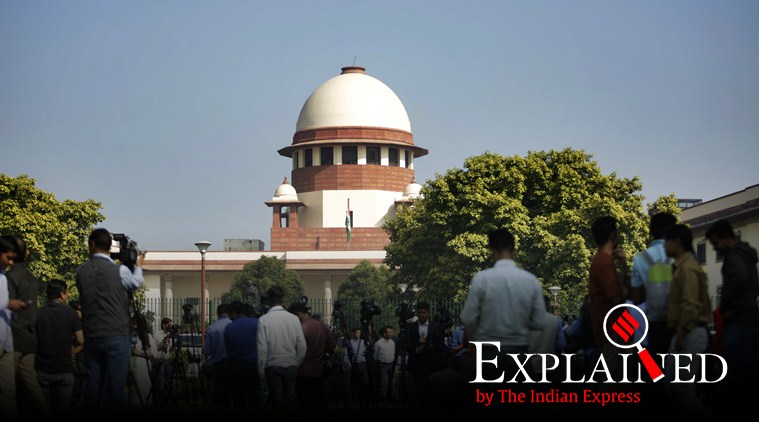
Ayodhya verdict, Ayodhya verdict Supreme Court, Ram Temple Babri Masjid Supreme Court, Article 142, What is Article 142, Muslims mosque land Ayodhya, Indian Express Explained The provision that vests sweeping powers in the Supreme Court for the end of ensuring “complete justice” has been used generally in cases that involve human rights and environmental protection. (Express photo: Praveen Khanna)

In granting five acres of land in Ayodhya, but outside the disputed area, to Muslim parties, the Supreme Court used extraordinary powers granted to it by Article 142 of the Constitution.

The Supreme Court, implicitly referring to the demolition of the Babri Masjid at the disputed site, said that it was invoking Article 142 “to ensure that a wrong committed must be remedied”.

It said that “justice would not prevail if the court were to overlook the entitlement of the Muslims who have been deprived of the structure of the mosque through means which should not have been employed in a secular nation committed to the rule of law”.

“The Constitution postulates the equality of all faiths. Tolerance and mutual co-existence nourish the secular commitment of our nation and its people,” the court said.

Article 142(1) states that “The Supreme Court in the exercise of its jurisdiction may pass such decree or make such order as is necessary for doing complete justice in any cause or matter pending before it, and any decree so passed or order so made shall be enforceable throughout the territory of India in such manner as may be prescribed by or under any law made by Parliament and, until provision in that behalf is so made, in such manner as the President may by order prescribe”.

Explained: Why Hindus won claim over both the outer and inner courtyard at disputed site


The provision that vests sweeping powers in the Supreme Court for the end of ensuring “complete justice” has been used generally in cases that involve human rights and environmental protection.

This was the first time that the court invoked this power in a case involving a civil dispute over an immovable property, involving private parties. It said that while the court’s power under Article 142 “is not limitless”, it “embodies both the notion of justice, equity and good conscience as well as a supplementary power to the court to effect complete justice”.

Story continues below this ad

In fact, it wasn’t just for the Muslim parties that the SC invoked Article 142. The same article was invoked in the case of the Nirmohi Akhara, who were party to the case.

Explained: Why Supreme Court rejected the Allahabad HC judgment on Ayodhya dispute

The Akhara will now be part of the board, which will formulate the scheme for the construction of the temple.

“…Having regard to the historical presence of Nirmohi Akhara at the disputed site and their role, it is necessary for this Court to take recourse to its powers under Article 142 to do complete justice. Hence, we direct that in framing the scheme, an appropriate role in the management would be assigned to the Nirmohi Akhara,” the Bench said.

As City Editor ( Delhi) at the Indian Express, Kaunain Sheriff  leads city reporting with a sharp focus on accountability journalism, data-driven stories, and ground-level impact. As the National Health Editor he leads the newsroom’s in-depth coverage of pressing health issues. He is the author of Johnson & Johnson Files: The Indian Secrets of a Global Giant, a definitive investigation into the accountability of one of the world’s most powerful pharmaceutical corporations. Areas of Expertise Investigative Reporting: Has deep expertise in investigative reporting spanning public health, regulatory affairs, drug safety, and the criminal justice system. His work sits at the intersection of governance, law, and accountability, with a particular focus on how regulatory failures, institutional lapses, and policy decisions affect citizens’ rights and safety. Data Journalism: Has extensively on big data–driven investigations, including analyses of flagship government schemes and large datasets on criminal trials, uncovering systemic gaps. Global Collaborations Kaunain is a key contributor to major international journalistic projects: The Implant Files: Collaborated with the International Consortium of Investigative Journalists (ICIJ) to expose global malpractices in the medical device industry. Chinese Big-Data Investigation: Uncovered how a foreign data firm monitored thousands of prominent Indian institutions and individuals in real-time. Awards & Recognition His commitment to "Journalism of Courage" has been recognized with the industry's highest honors: Ramnath Goenka Award for Excellence in Journalism SOPA Award (Society of Publishers in Asia) Red Ink Award (Mumbai Press Club) Indian Express Excellence Awards (Triple recipient for investigations into the NSA abuse in UP, Vyapam scam, and the anti-Sikh riots). Education: Studied Mechanical Engineering at Visvesvaraya Technological University (VTU), Bangalore, before moving to Delhi to pursue his passion for journalism. His engineering training informs his analytical approach, enabling him to decode technical, legal, and data-heavy systems with precision. Social media LinkedIn:  linkedin.com/in/kaunain-sheriff-3a00ab99 X ( fromerly Twitter): @kaunain_s ... Read More


Latest Comment
Post Comment
Read Comments
Advertisement
Advertisement
Advertisement
Advertisement