7 min read
Click here to follow Screen Digital on YouTube and stay updated with the latest from the world of cinema.
© IE Online Media Services Pvt Ltd



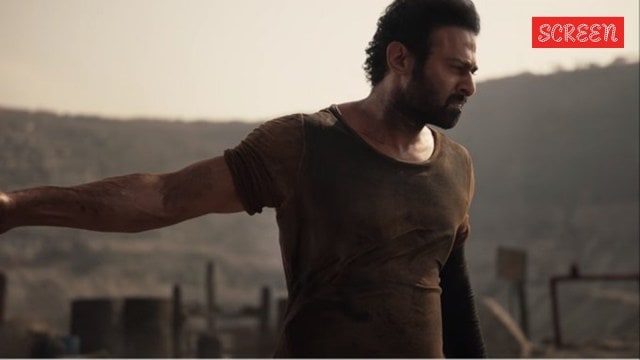 On Prabhas's 46th birthday, we look back at how the star turned into a quiet mark of power in Prashant Neel's Salaar
Restraint is not a word one associates with Prashant Neel‘s Salaar. A true-blue action epic from the creator of KGF, everything in the world of Salaar is over-stated. The incessant black clothes, emotions, action, score, performances, styling, and even the background acting—every passing line is treated with the reverence of a mythical statement of purpose. Salaar reverberates with the motif of fear in each frame, and the filmmaking accentuates this aesthetic overkill with ample signifiers of crowd-pleasing commercial cinema. However, one thing in Salaar is dialed down and almost non-existent—the hero. On the occasion of Prabhas celebrating his 46th birthday, we look back at why this performance feels so underdiscussed in his post-Baahubali filmography.
In a film filled to the brim with aggressively suggestive imagery and immersive action set pieces, the protagonist of Salaar becomes the calm, stayed presence that anchors the cataclysmic events of the world in motion. Deva, played by Prabhas, is unlike any Telugu action hero in that he is a passive observer in his own movie; a force of deafening focus and maddening restraint. Emotionality and vulnerability are all there, but hidden beneath the sheen of startling restraint. The rage and aggression of Mahendra Bahubali, his most popular and career-defining character, is traded for the quiet rebellion of Deva, a coal miner and mechanic in a remote Assamese village.
Deva barely speaks except for a few instances and is a keen listener in scenes, who just registers his presence through long silences and bulky physique. Stoicism is fine, but the moment the hero becomes affectless and deadpan, the intensity of his larger-than-life persona is hampered. The only moment in the film he breaks and offers us a glimpse into his emotional side is when he kills a man to save Varadha in the gladiator ring. The child in him breaks out, who has been tasked with protecting his mother and staying away from the place where he was born. The trauma and years of pent-up anger come out only at that moment.
Prabhas is framed as an archaic and mystical ‘cut out’, hiding a history of brutal violence. The actor is tasked with humanizing fear and relentless commitment to a way of subdued life that is borderline ritualistic. Vows, words, and promises made long ago become the emotional roadmap for Deva, whose only aim is to be there for his best friend Varadha Raja Mannar (Prithviraj Sukumaran), and his stubborn yet protective mother, who harbours fears about her son’s blood-fueled past.
Deva listens to Varadha complain about his conflicted existence back home in one of the crucial scenes in the movie, where they meet each other after years, and Prashant Neel cuts back to a mirroring scene from their childhood, when a young Varadha and Deva used to look out for each other. Prabhas has to act out all his history and bond with Varadha, without even saying a single word, yet we feel the wheels turning in his head. There is this held-back aggression inside him that is channeled through Prabhas’s eyes. This is not the usual way such scenes are acted or written in big-ticket films, as the noise and fervor of the previous high-stakes moments are all washed out by the poignant silence of these moments.
You can see this chiseled, giant of a man stand with his head held down like a guilty child, when his mother gets worked up about a visitor from his past who has opened some long forgotten wounds. The childlike innocence of Deva in such scenes is not an incidental detail but a carefully designed choice by the actor and filmmaker. Salaar earns its narrative ‘highs’ using the accumulated power derived from suggestion and gradual buildups. Deva gets tangled with the messy inner politics of ‘Khansaar’, only by virtue of his commitment to his friend and his inability to shy away from the suffering of the helpless.
He would never insert himself in a place and effect changes, just because he can, as often is the case with many onscreen hero archetypes. Prashant Neel and Prabhas perfectly calibrate the tightrope characterization of the ‘most violent man among the most violent men’ conceit by ensuring that Deva is bereft of the over the top, theatrical eccentricity we usually associate with such larger than life roles. The stillness and reserved passivity contradicts with the devilish facet of Deva that is presented to us through bits and pieces of his famed history shared by the secondary characters in the film.
Also Read | Mozhi: When Prithviraj transcended stardom to become a sensitive everyman
Deva from Salaar is almost an antidote to ‘Rocky Bhai’ from KGF films, whose wildly enigmatic persona is a projection of his splendid showmanship. Deva is a force of nature, a silent volcano always at the verge of erupting with all its fury. You won’t get the victory laps or dialogue baazi here. Just splendid negation of heroism and candid valor till push comes to shove. The icy demeanor and minimal lines ensure that you wait for the proverbial show to drop— for Prabhas to break free and show us a sampling of the much hyped history everyone seems to be alluding to from frame one of the film.
It’s a performance that is often overlooked for its subtle gestures, but one that is perfected only by someone with a screen image built over a consistent filmography that adds gravitas and weight to what he is holding back from doing on screen. In a movie filled with boisterous and intentionally loud performances, each glance, side eye from Prabhas takes on a meaning of its own.
It’s a performance style that is inherently subdued and far from showy. Prabhas has to let go off two things that made him captivating as a screen presence—aggression and fury. Salaar makes him underplay the toughness in a way not many films have asked of the actor in recent years. You sense a lifetime of running around, hiding and evading capture with his mom weighing down on Deva like a ton of bricks, that has made him this piercing black hole of man with uncontained violent multitudes within him.
It’s as if the character is scared of his own ability to inflict violence once the constraints are off. He knows what he is capable of doing and is trained by years of passivity to conduct himself as just a ‘silent type’ to prevent falling prey to his own worst impulses. A tour de force in stripped back aura farming that could easily have gone awry with the wrong star is perfected by Prabhas and one can only look forward in hopes to see more of the quiet intensity in the upcoming sequel.
Click here to follow Screen Digital on YouTube and stay updated with the latest from the world of cinema.